"Bali belly" is travellers' diarrhoea: at least three loose stools in 24 hours, most often caused by a bacterium swallowed with food or water. It usually clears up on its own, in 1 to 3 days according to France's High Council for Public Health (HCSP, 2026), and in 3 to 7 days when a bacterium is to blame according to the US CDC. The first step is to drink from the very first watery stool, ideally an oral rehydration solution, sold in Indonesia as oralit without a prescription for under 1,000 IDR a sachet (prices checked on 20 October 2026). See a doctor if you have a fever, blood in your stools, signs of dehydration, vomiting that stops you drinking or no improvement after three days, and sooner for a young child.
Bali belly: what exactly is it?
The term is not a medical one: an article published by the Indonesian health ministry (January 2026) describes it as the popular name for travellers' diarrhoea. The HCSP gives the reference definition: at least three unformed stools in 24 hours, during the trip or after getting home.
When the germ can be identified, it is a bacterium in around 80% of cases, according to the HCSP. Doctors grade an episode by how much it gets in the way: mild when it changes nothing about your plans, moderate when it disrupts them, severe when it makes activities difficult or impossible. Any diarrhoea with blood is automatically classed as severe, and beyond two weeks it becomes "persistent" (HCSP and CDC).
It is common. According to the HCSP, 20 to 56% of adult international travellers develop diarrhoea within 100 days of their trip, and 3% a severe form; the risk rises with the length of the stay. The CDC puts the attack rate at 30 to 70% over two weeks, depending on destination and season, and the UK's National Travel Health Network and Centre (NaTHNaC) places most of Asia among the high-risk areas, where more than 20% of travellers are affected. Among child travellers, the HCSP reports 13.5 to 39% of cases. According to the CDC, young adults are more exposed than older travellers, and a first episode does not appear to protect against the next one.
No official rate specific to Bali has been published. In four healthcare facilities in Ubud, out of 453 records of foreign travellers seen between January and August 2017, acute diarrhoea was the leading diagnosis, at 68% of consultations, far ahead of upper respiratory infections (13.2%), according to a study presented in 2018 at the AASEC scientific conference. At Kasih Ibu hospital in Denpasar, among 71 travellers admitted for diarrhoea in 2015-2016, 5.6% had severe dehydration complicated by acute kidney failure, and E. coli was the bacterium most often isolated. These series are small and say nothing about how many tourists fall ill.
How long does Bali belly last?
It all depends on the germ, which nobody knows on day one; the table brings together the HCSP and CDC figures.
| Type of germ | Share of identified cases | Time before symptoms | Usual duration without treatment |
|---|---|---|---|
| Bacteria (mainly E. coli, also Campylobacter, Shigella, Salmonella) | around 80% (HCSP); 75 to 90% or more (CDC) | 6 to 96 hours | 3 to 7 days |
| Viruses (mainly norovirus) | 10 to 15% (HCSP); at least 10 to 25% (CDC) | 6 to 96 hours | 2 to 3 days |
| Parasites (mainly Giardia) | 5 to 10% (HCSP); around 10% (CDC) | 1 to 2 weeks | weeks, even months |
| Toxin in food (food poisoning) | not quantified | a few hours | 12 to 24 hours |
Sources: HCSP, Recommandations sanitaires aux voyageurs (health recommendations for travellers) 2026, chapter 4; CDC Yellow Book 2026, "Travelers' Diarrhea" chapter, page dated 24 March 2026.
The HCSP describes the classic episode, which the French call turista, as mild and clearing up on its own in 1 to 3 days; NaTHNaC says 3 to 4 days, with around 1% of cases lasting more than a month; the UK's National Health Service (NHS) says diarrhoea, whatever the cause, usually stops within 5 to 7 days, and vomiting within one or two days. Up to 40% of cases never have a cause identified, according to NaTHNaC.
The Indonesian ministry's article puts the first symptoms at 2 to 24 hours after exposure: cramps and bloating, intense diarrhoea, nausea and vomiting, sometimes a mild fever and marked weakness as dehydration sets in. According to NaTHNaC, the episode most often starts in the first week of the stay, but it can begin up to ten days after you get home.
What should you do first? Drink, and not just water
The HCSP considers the measures that prevent or correct dehydration "essential" in every case: drink without limiting the volume from the very first watery stool, without waiting to feel thirsty, since thirst is already a sign of dehydration, alternating salty and sugary drinks or taking oral rehydration solutions (ORS), particularly for young children and older people. It specifies that "water alone is not enough and must be accompanied by electrolytes", and advises small amounts taken often if you are vomiting.
On fizzy drinks, the sources disagree: the HCSP lists cola among the possible sugary drinks, while the NHS advises against fizzy drinks and fruit juice, which can make diarrhoea worse. ORS is where they all agree: according to the WHO, this mixture of clean water, salt and sugar replaces the water and electrolytes that have been lost.
In Indonesia, ORS is called oralit. The sachet carries the green logo of over-the-counter medicines (obat bebas) and costs 559 IDR on the website of the K-24 pharmacy chain and 855 IDR at Medicastore (prices checked on 20 October 2026; K24Klik warns that the price may differ in store). At the European Central Bank rate of 20 October 2026 (€1 = 20,170.57 IDR), that comes to 3 to 4 euro cents.
Make it up following the leaflet, with safe water (bottled or boiled) rather than tap water. The Indonesian health ministry adds two don'ts: do not mix oralit with milk or sweet tea, and avoid spicy food, fatty food and alcohol during the episode. A factsheet on the Halodoc platform, reviewed by a doctor (5 October 2026), adds that a prepared solution should be thrown away after 24 hours and that oralit is not suitable for severe dehydration.
Severe dehydration is a job for a health professional. If you cannot drink enough, because of constant vomiting or very heavy stools, the HCSP recommends seeing a doctor promptly for rehydration through a drip, "often lasting only a few hours", which can be done at a local dispensary provided the equipment is single-use. As for meals, it advises returning early to a varied diet; babies carry on breastfeeding.
What can you buy at the pharmacy, and what needs a doctor?
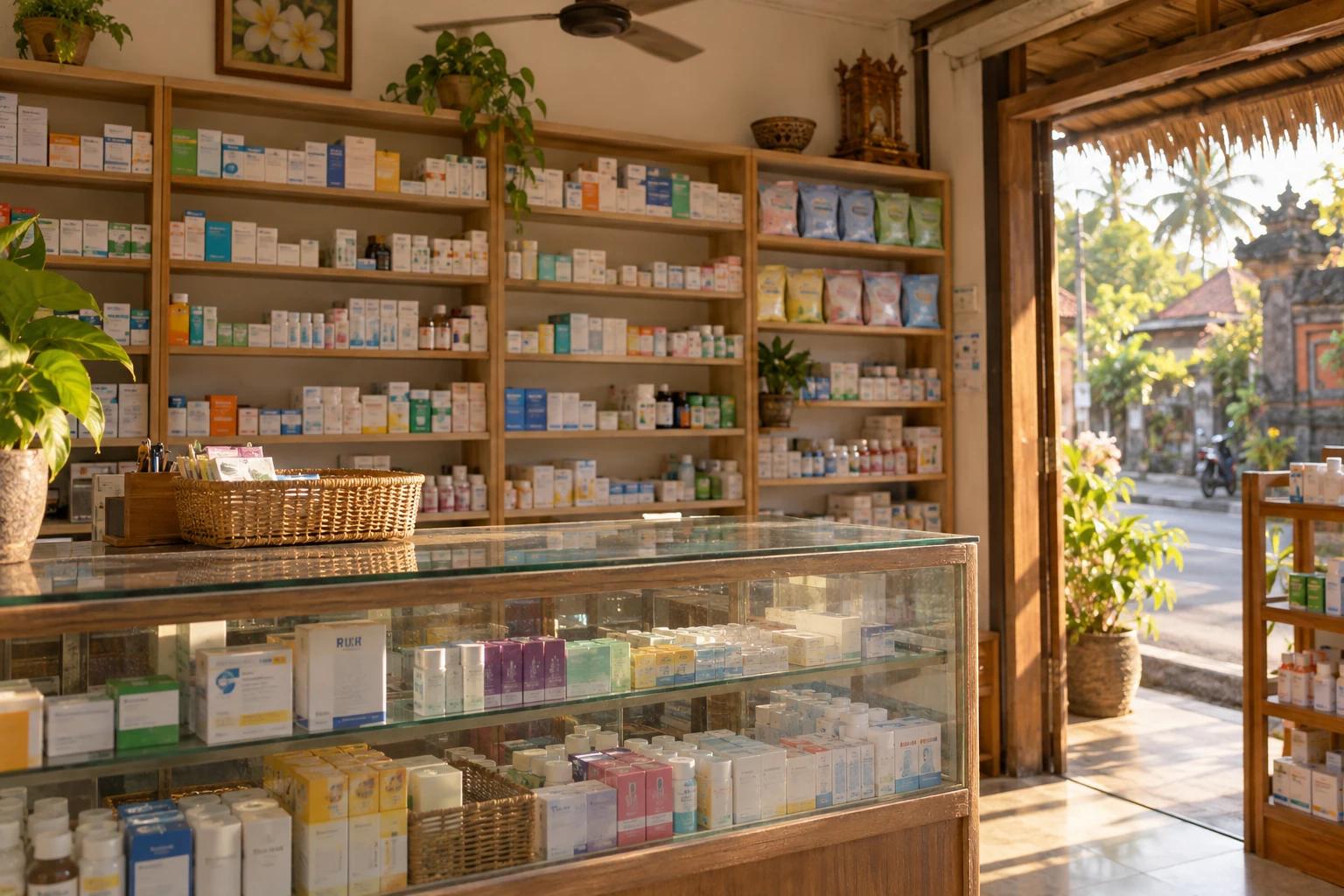
In Indonesia, the box tells you something before the pharmacist does: the medicines agency (BPOM) requires three logos, a green circle for over-the-counter sale, a blue circle for sale without a prescription in limited quantities, and a red circle marked with a K (obat keras) for prescription-only medicines, dispensed only in a pharmacy (apotek). BPOM asks people to buy from a pharmacy or another authorised outlet; France Diplomatie, the French foreign ministry's travel advice service, warns against medicines sold on the street because of counterfeits.
| Product | Status in Indonesia | What the health authorities say |
|---|---|---|
| Oralit (ORS) | Obat bebas, green logo, no prescription | Preventing dehydration: "Always" (HCSP, table 12) |
| Loperamide (Imodium and generics) | Obat keras, red K logo, prescription only (BPOM register) | Not advised for mild or moderate forms, to be avoided altogether with blood or fever (HCSP) |
| Antibiotics | Obat keras, prescription only (health ministry) | Not recommended for mild or moderate forms (HCSP) |
| Racecadotril (antisecretory) | Obat keras: a single registered product, under the letter K (BPOM register) | May ease mild or moderate forms; to be avoided during pregnancy and breastfeeding (HCSP) |
| Probiotics | not verified | Weak evidence of efficacy (HCSP); insufficient data for prevention (CDC) |
| Diosmectite ("gut-coating" agent) | no medicine registered under this name (BPOM register) | Efficacy not proven (HCSP) |
Status checked on 20 October 2026 in BPOM's public register and on the K24Klik, Medicastore and Halodoc product pages; opinions: HCSP 2026, CDC Yellow Book 2026, Indonesian health ministry (4 October 2024).
Loperamide (Imodium) is where the sources contradict each other. Two Indonesian health platforms present it as freely available: Halodoc's "Bali Belly" article, checked on 20 October 2026, and the Alomedika factsheet, which says "Dijual bebas" (sold freely). The official register says the opposite: on 20 October 2026, all 40 loperamide registration numbers valid for the Indonesian market in BPOM's public database carry the letter K, which the agency uses to denote obat keras, and the Imodium product page on Halodoc shows the red logo.
The HCSP advises against it for mild or moderate forms, because the constipation and bloating it causes are often more troublesome than the diarrhoea itself; it reserves it for very heavy diarrhoea or a practical constraint such as a flight, and rules it out for bloody or feverish diarrhoea, where the CDC also advises against taking it on its own. The minimum age varies: 6 on the Indonesian product leaflet, 12 for the NHS, 15 for the HCSP. That decision belongs to the pharmacist or the doctor.
Antibiotics cannot be bought freely: on 30 September 2024 (in a release published on 4 October), the Indonesian health ministry's spokesperson reiterated that they are obat keras, require a prescription and must not be bought "secara bebas" (freely), in order to limit resistance. The HCSP notes that Campylobacter picked up in Southeast Asia is resistant to fluoroquinolones in 80% of cases, and that carriage of multidrug-resistant bacteria reaches up to 85% after stays in Southeast Asia; taking antibiotics increases that risk. The CDC puts the benefit of an effective antibiotic at one or two fewer days of illness. The HCSP does not recommend an antibiotic for mild or moderate forms, and only considers one without testing for severe diarrhoea or a vulnerable person, when no prompt consultation is possible. In Bali, where a clinic consultation is listed from 100,000 IDR, that choice belongs to the doctor.
When should you see a doctor?
The health authorities agree on the situations that call for prompt medical advice:
- fever: the HCSP calls for a consultation in every case, to rule out malaria and typhoid fever, even though Bali is classed as low-risk for malaria; NaTHNaC sets the threshold at 38°C;
- blood or mucus in the stools (NaTHNaC, NHS);
- vomiting that stops you keeping fluids down, or dehydration that persists despite oralit (NHS);
- severe abdominal pain, jaundice, a rash, confusion or an altered mental state (NaTHNaC);
- no improvement within three days (NaTHNaC), or diarrhoea lasting more than seven days (NHS);
- persistent diarrhoea, beyond two weeks (HCSP).
The NHS also lists the signs that mean going to an emergency department straight away: vomit containing blood or looking like coffee grounds, green vomit, sudden and intense abdominal pain, blue, grey, pale or blotchy lips or skin, very fast or laboured breathing, confusion. In Indonesia, the national medical emergency number is 119: the health ministry stated in October 2024 that it can be reached in every district and city, including through the SATUSEHAT Mobile app. Denpasar and Badung were among the first sites connected, in 2016.
Some people should see a doctor sooner:
- young children: the HCSP asks parents to seek medical advice at the first signs of dehydration (thirst, listlessness, a pale or greyish complexion, cold hands and feet, mottled skin, sunken eyes, a dry mouth) and stresses the need for a consultation when diarrhoea persists in a child under 2; the NHS wants urgent advice for any baby under 12 months you are worried about, or any child who stops breastfeeding or taking their bottle;
- pregnant women, whom NaTHNaC lists among the travellers who need to be particularly vigilant; the HCSP applies the general recommendations to them while tightening the food rules, and the CDC rules out bismuth during pregnancy;
- older people, whom the HCSP classes among those "at high risk of decompensation";
- people with chronic conditions (a weakened immune system, inflammatory bowel disease, kidney or heart disease), whom NaTHNaC asks to be especially vigilant.
In adults and children over 5, the NHS relies on two simple signs of dehydration: dark, strong-smelling urine, or peeing less often than usual; the Indonesian ministry adds dizziness, a feeling of dryness and marked weakness. The WHO speaks of severe dehydration when at least two of these signs are present: lethargy or loss of consciousness, sunken eyes, being unable to drink or drinking poorly, and a skin pinch that takes two seconds or more to go back.
Where can you see a doctor in Bali, and what does it cost?
For diarrhoea with no warning signs, a visit to a neighbourhood clinic costs little. The prices below are those shown on the booking site Alodokter on 20 October 2026, with no update date; the order is not a ranking.
| Service | Facility (area) | Listed price | In euros |
|---|---|---|---|
| GP consultation | Hydro Medical Canggu and Seminyak (Kuta Utara) | 100,000 IDR | ≈ €5 |
| GP consultation | Khaina Klinik (Kuta) | 147,500 IDR | ≈ €7.30 |
| GP consultation | RSIA Bunda Denpasar (Denpasar Barat) | 150,000 IDR | ≈ €7.40 |
| Stool test | Klinik Remedium Care (Denpasar Selatan) | 50,000 IDR | ≈ €2.50 |
| Stool test | Tirta Medical Centre Bali (Kuta) | 124,000 IDR | ≈ €6.10 |
| Home visit by a doctor | "doctor on call" service (travel advertised across the whole island) | 550,000 IDR, excluding tests and medicines | ≈ €27 |
*Sources: Alodokter, consultations in Badung and in Denpasar, stool tests in Bali, checked on 20 October 2026; home visit: guide published by a beach venue, undated, price not confirmed by the provider. Conversions rounded at the ECB rate of 20 October 2026.*
A stool test is not routine: the HCSP mentions it for cases that warrant a consultation. Home visits do exist: a 2012 text from BIMC hospital says most private clinics and hospitals will come to your hotel or villa for less serious conditions, sometimes with a long wait. The only public price we found, 550,000 IDR, comes from a commercial guide; ask for the total price, tests and medicines included, before the visit.
Some providers in the south of the island also sell drips at your villa: in Seminyak, one of them advertised 1.6 to 1.7 million IDR for a Diarrhea treatment package, according to bali.live (page updated on 25 August 2026), more than ten times the price of a consultation. The HCSP only recommends a drip if drinking is not enough or dehydration has set in, which is a matter for a doctor. And bali.live reported on 13 October 2026, citing detikBali, that the health service had announced inspections in Canggu, Seminyak, Kuta and Nusa Dua targeting unlicensed clinics, drips given outside a healthcare facility and foreign doctors without work permits: for the authorities, a drip is a medical procedure, reserved for a licensed facility. If you are dehydrated, the right place to go is still a clinic or a hospital.
For oralit in the middle of the night, the K-24 chain lists two pharmacies open 24 hours a day in Badung regency, in Jimbaran (Jimbaran Arcade, Jl. Uluwatu II) and in Dalung. In Denpasar, the Kimia Farma clinic at 125 Jl. Diponegoro has a pharmacy, but its listing gives contradictory opening hours (8am to 9pm, or 24 hours a day): call ahead. If things get worse, head to hospital: emergency department prices and the deposit required on admission are set out in our investigation into hospital costs in Bali without insurance, and our guide to choosing health insurance in Bali helps you check what your policy covers.
Water, ice, galon: which water is safe to drink in Bali?
In Bali, the Indonesian health ministry points out that tap water is not for drinking and asks people to use bottled water, including for brushing their teeth; the CDC considers tap water potentially unsafe for drinking, cooking, making ice and brushing teeth. The HCSP recommends capped bottled water "opened in front of you", or failing that water boiled for one minute at a rolling boil. The CDC advises a factory-sealed container, with the outside wiped before you drink; tea and coffee made with water that has just boiled are generally safe.
Ice is the blind spot. The Indonesian ministry lists ice made with untreated water among the sources of contamination, and the CDC says to avoid it unless you are reasonably sure the water used was safe. The alcohol in a cocktail changes nothing: as the CDC puts it, "the alcohol content of alcoholic beverages will not kill pathogens in ice made from contaminated water".
That leaves the big water bottle sitting on a dispenser, the galon, either factory-sealed or refilled at a neighbourhood depot (depot air minum isi ulang). Two student dissertations from Poltekkes Kemenkes Denpasar, the health ministry's school of health sciences, analysed refilled water in the south of the island: in Kuta in 2022, 5 samples out of 9 contained coliforms and E. coli; in Kuta Utara in 2023, 11 out of 16 tested positive for coliforms. Samples this small do not prove that every refill is contaminated; for refilled water of unknown origin, boiling remains the safeguard described by the HCSP.

Warungs, buffets, street food: how do you eat without getting ill?
The Indonesian health ministry sums up the rule as boil it, cook it, peel it, or forget it. The HCSP goes into more detail. Choose hot dishes that have been kept hot from the kitchen to the plate; avoid street food when it is unclear whether food has been kept properly hot or cold, as well as raw vegetables, raw shellfish, reheated dishes, home-made fresh fruit juices and home-made ice cream. Eggs, meat, fish and seafood should be eaten well cooked; wash or peel fruit yourself, with clean hands.
For the CDC too, food that is fully cooked and served hot is among the safest choices, and food from street vendors increases the risk. A dish coming straight out of a steaming wok fits the rule; a cold buffet, which France Diplomatie advises avoiding, does not. The CDC acknowledges that restaurant hygiene is out of the traveller's control, and NaTHNaC warns that these precautions do not offer full protection.
The one thing that is down to you is your hands: the HCSP asks you to wash them before meals, before handling food and after using the toilet, with hand sanitiser if there is no soap and water. The CDC specifies that the gel should contain at least 60% alcohol and that it works less well than washing against norovirus. Once you are ill, avoid cooking for other people; the NHS advises waiting 48 hours after your symptoms have stopped before going back in a swimming pool.
As for preventive remedies, the HCSP recommends neither probiotics nor bismuth, and the CDC considers the data insufficient to recommend probiotics, or bovine colostrum either. If you are settling in Bali, a few sachets of oralit deserve a place in the household medicine cabinet, alongside the other essentials on our checklist for moving to Bali.

Frequently asked questions
How long does Bali belly last?
Usually less than a week. The HCSP describes the classic episode, turista, as mild and clearing up on its own in 1 to 3 days; NaTHNaC says 3 to 4 days. According to the CDC, bacterial diarrhoea lasts 3 to 7 days without treatment, viral diarrhoea 2 to 3 days, and parasitic diarrhoea can last for weeks. If there is no improvement after three days, see a doctor.
What are the symptoms of Bali belly?
At least three loose stools in 24 hours, often with cramps, bloating, nausea or vomiting, and sometimes a mild fever and marked weakness caused by dehydration. According to the Indonesian health ministry, they appear 2 to 24 hours after exposure. Blood in the stools or a temperature of 38°C or more means you should see a doctor.
What should you take for Bali belly?
First, something to rehydrate with: oralit, an oral rehydration solution sold without a prescription for under 1,000 IDR a sachet (checked on 20 October 2026). The HCSP points out that water alone is not enough. For any other medicine, ask a pharmacist or a doctor: loperamide is classed as prescription-only in Indonesia, and the HCSP advises against it for uncomplicated forms and rules it out when there is blood or fever.
Can you buy antibiotics without a prescription in Bali?
Not legally. The Indonesian health ministry reiterates that antibiotics are obat keras, marked with a red circle containing a K, and require a prescription. The HCSP does not recommend them for mild or moderate forms, and notes that carriage of multidrug-resistant bacteria reaches up to 85% after a stay in Southeast Asia, a risk made worse by taking antibiotics.
When should you see a doctor for Bali belly?
If you have a fever, blood or mucus in your stools, vomiting that stops you drinking, signs of dehydration (little, dark urine, dizziness, marked weakness), intense abdominal pain, or no improvement after three days. Young children, pregnant women, older people and people with chronic illnesses should see a doctor sooner. In an emergency, the national number is 119.
Can you brush your teeth with tap water in Bali?
The health authorities advise against it: the CDC considers tap water potentially unsafe, including for brushing teeth, and the Indonesian health ministry asks travellers in Bali to use bottled water even for that. The HCSP recommends a capped bottle opened in front of you, or water boiled for one minute.
How much does a doctor's visit for diarrhoea cost in Bali?
At a neighbourhood clinic, a GP consultation is listed at between 100,000 and 150,000 IDR (around €5 to €7.50) on the Alodokter platform, and a stool test at between 50,000 and 124,000 IDR (checked on 20 October 2026). A home visit is advertised at around 550,000 IDR excluding tests and medicines, according to an undated commercial guide.
Sources
- (official) HCSP, Recommandations sanitaires aux voyageurs (health recommendations for travellers), 2026 edition, document dated 28 May 2026, posted online on 7 July 2026: chapter 4, "Diarrhée du voyageur" (travellers' diarrhoea: definition, frequency, germs, resistance, prevention, rehydration, medicines, consultation), § 10.3.4 (pregnancy), Indonesia malaria table.
- (official) CDC Yellow Book 2026, "Travelers' Diarrhea", page dated 24 March 2026: attack rates, germs, incubation, duration, medicines, special populations.
- (official) CDC Yellow Book 2026, "Food and Water Precautions for Travelers", page dated 23 April 2025: water, ice, alcohol, food, hand sanitiser.
- (official) WHO, "Diarrhoeal disease" fact sheet, 7 March 2024: definition, signs of dehydration, oral rehydration, prevention.
- (official) NaTHNaC / TravelHealthPro, "Travellers' diarrhoea", updated 27 February 2024: frequency by region, duration, warning signs, at-risk groups.
- (official) NHS, "Diarrhoea and vomiting", reviewed 21 December 2023: duration, pharmacy, emergency signs, dehydration.
- (official) France Diplomatie, Indonesia health advice, updated 15 September 2026: water, food, counterfeit medicines.
- (official) Indonesian health ministry, "Fenomena Bali Belly yang Masih Sering Terjadi pada Wisatawan di Pulau Bali", 30 January 2026: definition, causes, ice, bottled water, oralit, prescription-only antibiotics.
- (official) Indonesian health ministry, "Penanganan Awal pada Diare", 11 September 2024: oralit, foods to avoid, signs of dehydration.
- (official) Indonesian health ministry, "Jangan Buru-Buru Beri Obat Antibiotika", 4 October 2024: antibiotics classed as obat keras, prescription only.
- (official) Indonesian health ministry, "Akses Darurat Medis 119 Kini Bisa Melalui SATUSEHAT Mobile", 5 October 2024: 119 reachable in every district and city.
- (official) Indonesian health ministry, launch of the 119 number, 10 June 2016: Denpasar and Badung among the first sites.
- (official) BPOM, public product register (Cek Produk BPOM), consulted on 20 October 2026: 40 loperamide registration numbers valid for the Indonesian market, all with the letter K; racecadotril (1 product, letter K); oralit (letter B).
- (official) BPOM, "Beli obat di tempat legal", 3 October 2006: green, blue and red K logos.
- (official) European Central Bank, reference rates of 20 October 2026: €1 = 20,170.57 IDR.
- (academic study) Sumadewi, Masyeni et al., "Travel related infection among international travellers visiting clinics at Ubud Bali", AASEC 2018: 453 records, acute diarrhoea 68%.
- (academic study) Masyeni et al., "Diarrhea Among International Travelers in Bali-Indonesia: Clinical and Microbiological Finding", International Journal of Travel Medicine and Global Health, 2017: 71 patients at Kasih Ibu hospital.
- (academic study) Payana, bacteriological quality of refilled drinking water in Kuta, Poltekkes Kemenkes Denpasar, 2022: 5 non-compliant samples out of 9.
- (academic study) Parnawan, microbiological quality of refilled drinking water in Kuta Utara, Poltekkes Kemenkes Denpasar, 2023: 11 positive samples out of 16.
- (media) detikHealth, "Begini Cara Cek Nomor Izin Edar", 1 November 2016: a BPOM official explains that the letter K in the registration number denotes obat keras, prescription only.
- (media) bali.live, inspections of clinics and at-home drips, updated 13 October 2026, citing detikBali.
- (media) bali.live, at-home drips in Bali, updated 25 August 2026: prices advertised by the providers, with no date for when they were recorded.
- (commercial) Alodokter, GP consultations in Badung, in Denpasar and stool tests in Bali, checked on 20 October 2026, prices undated.
- (commercial) K24Klik, Oralit 200 and K-24 pharmacies in Badung, checked on 20 October 2026.
- (commercial) Medicastore, Oralit 200, checked on 20 October 2026.
- (commercial) Halodoc, Oralit factsheet, updated 5 October 2026, Imodium 2 mg product page, checked on 20 October 2026, and "Bali Belly: Complete Guide" article, checked on 20 October 2026.
- (commercial) Alomedika, Loperamide factsheet, consulted on 20 October 2026: access listed as "Dijual bebas" (sold freely).
- (commercial) Hello Sehat, Klinik Kimia Farma Diponegoro, checked on 20 October 2026.
- (commercial) BIMC Hospital, "Medical Attention in Indonesia", 23 February 2012: hotel and home visits.
- (commercial) FINNS Beach Club, guide to home medical care in Bali, undated: price of a home visit.