In Bali, you don't shop for furniture where you live. The Kerobokan–Seminyak corridor holds the showrooms: of the 13 shops Honeycombers picked on 1 January 2026, five are in Kerobokan. Denpasar lines up the local-price stores along four streets named by the sources: Jl. Gatot Subroto, Jl. Cokroaminoto, Jl. Teuku Umar and Jl. Imam Bonjol. Ubud, Mas and Tegallalang sell carved wood and suar slabs; Gianyar and Tampaksiring house the big workshops; Kuta has the island's only IKEA, open 10am to 9pm WITA, seven days a week.
On budget, there is no single price ladder but three distinct markets: a dining table runs 800,000 to 20M IDR on the local market and 15 to 55M IDR in a design showroom — the two ranges barely overlap. Custom pieces leave the workshop in 4 to 8 weeks. A showroom invoicing under a tax number adds 11% VAT; village workshops and market sellers, as a rule, don't. Every conversion in this article is pegged to Bank Indonesia's reference rate for 21 July 2026: 17,909 IDR to 1 USD.
Before you start the scooter: the area names lie
You'll read "Seminyak" on one site and "Kerobokan" on another for the same shop. Latif Living is registered at Jl. Raya Kerobokan No. 132, but Honeycombers files it under Seminyak; Own Property Abroad puts Kim Soo Home in Seminyak while Balipedia gives its address as "Jl. Kayu Aya, Kerobokan Kelod, Kec. Kuta Utara". Same street, two vocabularies: the expat nickname on one side, the Indonesian administrative boundary on the other. Trust the street name, never the area name — least of all in a GPS. Throughout this guide I use the common names, the ones you'll actually hear on the ground, and I always give the street.
There is no "furniture price in Bali". There are three.
No official body publishes furniture prices for Bali. Every range in circulation comes from lifestyle media, manufacturers or property agencies, and they are not describing the same market. On a dining table, one source's floor (800,000 IDR) sits almost nineteen times below the other's (15M IDR). That isn't an error, it's segmentation:
- Local and wholesale — Denpasar, markets, distributors. Ready to take away, finish quality varies, rarely a VAT invoice.
- Design showroom — Kerobokan, Seminyak, Sanur. Styled pieces, quality control, delivery organised for you — plus the premium the studio DesRes Bali calls, without dressing it up, a convenience tax.
- Custom workshop — Kerobokan, Canggu, Gianyar, Tampaksiring. You pick the timber, the dimensions and the finish, then you wait.
| Item | Local / wholesale (IDR) | Design showroom (IDR) | USD equivalent, local / showroom (BI rate, 21 July 2026) |
|---|---|---|---|
| Dining table | 800,000 – 20M | 15 – 55M (teak) | 45 – 1,117 / 838 – 3,071 |
| Three-seater sofa | 1.4 – 20M | 15 – 30M | 78 – 1,117 / 838 – 1,675 |
| Bed frame | 1.5 – 15M | 20 – 65M | 84 – 838 / 1,117 – 3,630 |
| Outdoor lounge set | — | 15 – 25M | 838 – 1,396 |
| Plain rattan chair | 800,000 – 1.5M | — | 45 – 84 |
| Balinese teak per m² | 1.5 – 3M | — | 84 – 168 |
*"Local" column: Own Property Abroad, updated 3 May 2026, except the rattan chair, taken from its second page, updated 2 May 2026. "Showroom" column: Honeycombers, 1 January 2026. Conversions recalculated: the ones Own Property Abroad displays rest on a rate of roughly 16,390 IDR/USD, 8.5% below the real July 2026 rate.*
That leaves the question of where Bali sits against the rest of the world. Honeycombers reckons pieces made on the island cost "30 to 60% less" than their equivalents in Australia, Singapore or Europe — a magazine comparison, not a measurement. The manufacturer Bali Best Buy Furniture claims a 20 to 30% saving on buying direct from the workshop rather than in a shop: a seller's pitch, and worth reading as one.
See also: What Does a Tukang Cost in Bali in 2026? Day Rates, Fixed Prices and Quotes
Kerobokan and Seminyak: the showroom corridor
This is where the mid- and high-end new stock is concentrated. Latif Living describes the corridor as the most design-driven stretch on the island; Honeycombers' 2026 selection backs that up numerically, with 5 of its 13 addresses in Kerobokan.
- Lio Collection — Jl. Raya Kerobokan No. 2, Banjar Taman (rattan, bamboo, leather, wood, lighting)
- Balquisse Living — Jl. Bumbak No. 134 (outdoor rattan, textiles, antiques)
- Warisan Living — Jl. Raya Kerobokan Br. Taman No. 38 (rustic and contemporary, natural materials)
- DC Habitat Interiors — Jl. Raya Kerobokan No. 88X (coastal, vintage, minimalist)
- Craft District — Jl. Gunung Salak Utara No. 80 (reclaimed teak)
- Soo Santai — Jl. Sunset Road No. 89, Seminyak (poufs and bean bags)
- Latif Living — Jl. Raya Kerobokan No. 132 (teak and rope outdoor)
DesRes Bali boils the Kerobokan–Umalas axis down to a useful formula: polished showrooms, villa-ready pieces, delivery that runs smoothly, tight quality control — and prices to match. What you're buying is the certainty that the sofa turns up in the right colour on the right day.
Canggu and Pererenan: you live there, you don't shop there
Canggu absorbs most of the new arrivals — and stocks almost no furniture. Of the 13 addresses in Honeycombers' 2026 selection, exactly one is there: The Showroom Bali, on Pererenan's main road (Jl. Sempol). Own Property Abroad's list, updated in May 2026, adds a single name, Heveya. What Canggu does share with Kerobokan is the custom workshops serving villa projects and hospitality: supply built around a project, not around a Saturday emergency.
Translated into a route: if you're moving to Canggu, your furniture shop is somewhere else — Kerobokan, the closest showroom hub, or Denpasar, a good deal further. If you haven't settled on an area yet, our tour of Canggu's 10 micro-neighbourhoods and the comparison of yearly rental prices by area spare you from discovering the logistics after you've signed the lease.
Ubud, Mas, Tegallalang: wood, hands and haggling
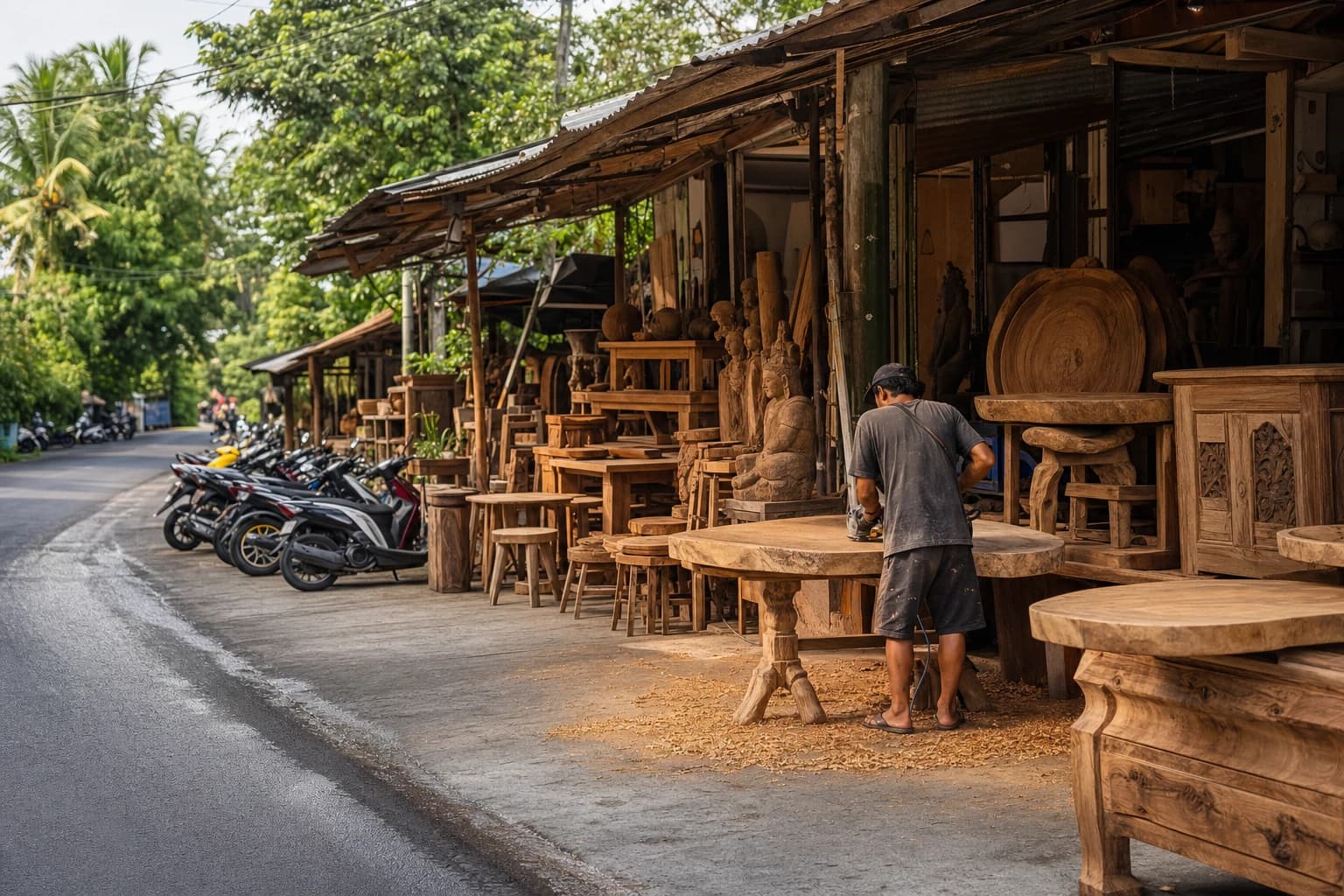
DesRes Bali calls Jalan Raya Andong in Ubud a "Furniture Disneyland": shopfronts elbow to elbow, teak tables, rustic sideboards, carved stools. The same source flags the catch: some pieces are made on site, others are shipped in from Java. Comparing and negotiating aren't optional here. They are how the street works.
Around Ubud, each village has its speciality:
- Mas — wood carving. Craftsmen work with chisels and hand tools, turning raw teak into bed frames, Balinese doors and worked wall panels.
- Tegallalang — rustic and unapologetic about it. "Roadside shops stack suar wood tables and bamboo shelving," as DesRes Bali puts it. Rough, grainy, knotty stock.
- Ubud itself — hand-carved or hand-painted furniture, plus bohemian rattan and bamboo.
The area yields two confirmed addresses: Ruesters Furniture, Jl. Raya Kengetan No. 44 (minimalist, natural fibres), and Mercia Home Living, Jalan Raya Andong, Petulu (water hyacinth, sea grass, raffia, banana fibre) — the second comes from a 2023 source, so phone ahead before making the drive. That rule holds for the whole area: don't trust any opening hours you find online for these shops, because the only precise listings date from March 2023.
Denpasar: the streets where Balinese people buy their furniture
Bali Best Buy Furniture describes Denpasar as the widest concentration of local-price furniture stores, stocked with take-away pieces, and names two streets: Jl. Gatot Subroto (locally "Gatsu") and Jl. Cokroaminoto. DesRes Bali names two others — Jl. Teuku Umar and Jl. Imam Bonjol — lined with showrooms aimed at Indonesian buyers: copies of contemporary models, plywood wardrobes, the odd mid-century-inspired piece. Neither source claims to be exhaustive, so keep all four streets, not two.
Latif Living adds that the city hosts the large suppliers and distributors: the logic here is volume and unit price on a big order, not love at first sight through a window. One contemporary custom maker appears in the 2026 selection, Jezz Living, Jl. Imam Bonjol No. 422, in the trade since 1990 — on one of the very streets DesRes flags.
Next door, Tuban, near the airport, is where the hospitality-supply warehouses sit: stackable chairs, sun loungers, bulk basics. The address if you're kitting out a warung, a coworking space or a guesthouse. Not a living room.
One practical warning before you drive over: no source consulted publishes a local delivery price for Bali — no flat fee, no per-kilometre rate, no free-delivery threshold. For a large Denpasar purchase that has to get home somehow, get the transport quoted in writing before you close the deal.
Gianyar, Tampaksiring, Sanur: workshops and mixed stock
Gianyar and Tampaksiring are workshop country: volume orders, custom builds, longer lead times, better prices if you're fitting out an entire villa or a café. Latif Living separately describes Gianyar and the eastern villages as silverwork, ceramics and decorative objects, with furniture of a more traditional character. Sanur plays a mixed hand — traditional Balinese pieces alongside modern outdoor — with three 2026 addresses: Hatiku Indonesia (Jl. Batur Sari, Gg. Tunjung Sari Gg. Jempiring No. 1), Carlo Showroom (Jl. Danau Poso No. 22) and Latif Living's second outlet (Jl. By Pass Ngurah Rai No. 125x).
One trap to sidestep: Sukawati and Guwang are markets for décor, accessories and bargaining — not large furniture.
Here's the whole map in one table, before we get to the odd one out, Kuta:
| Area | What you'll find | Who it's for |
|---|---|---|
| Kerobokan / Umalas | Mid- and high-end showrooms, custom workshops | Turnkey villa, comfortable budget |
| Seminyak | Design showrooms, pre-styled pieces | Impulse buy, statement piece |
| Canggu / Pererenan | Almost no showrooms, project workshops | Planned project, not a quick fix |
| Ubud / Jl. Raya Andong | Wood shops side by side, local or Javanese made | Solid wood, artisan look, haggling |
| Mas | Wood carving, Balinese doors | Decorative piece, carved teak |
| Tegallalang | Rustic, suar, bamboo | Characterful tables, shelving |
| Denpasar (Gatsu, Cokroaminoto, Teuku Umar, Imam Bonjol) | Volume, local prices, wholesale | Tight budget, whole-house fit-out |
| Tuban | Hospitality-supply warehouses | Warung, coworking, guesthouse |
| Gianyar / Tampaksiring | Big workshops, volume orders | Entire villa, café, long lead times |
| Sanur | Mix of traditional and modern outdoor | Homeowners, resorts |
| Sukawati / Guwang | Décor and accessories only | Objects, textiles, no furniture |
| Kuta | IKEA, displayed prices | Price benchmark, in-store collection |
Kuta: IKEA, the one price that doesn't move
IKEA Bali sits inside Kuta Central Park, which the brand describes as well connected to the island's main roads. It's a compact format: a scaled-down showroom paired with an order and collection point. Hours: 10am to 9pm WITA, every day. How it works, documented on IKEA Indonesia's official "how to shop" page, differs from a standard store:
- Yellow tag: order the item through a co-worker. Red tag: collect it yourself in the Market Hall.
- Collection in store or at a Pick-up Point; delivery to home or office, advertised "at reasonable rates" — no price is published, and nowhere does the page say collection is free.
- Payment: Visa, Mastercard, American Express, JCB, Gopay, Jenius, OVO, QRIS, Kredivo, Union Pay.
- Services: delivery, assembly, interior design, installation, planning, take-back and recycling.
One thing I can't confirm: the full postal address appears on none of the brand's official pages I opened, including the Indonesian store page. Third-party directories circulate an address and a phone number that can't be verified. Check the address on the brand's own site before setting off; the opening hours, on the other hand, are solid.
IKEA's real value here isn't the catalogue. It's a displayed, fixed, comparable price in a market where nearly every other channel is negotiable. An hour there before you go and talk numbers in Denpasar or Ubud gives you a mental yardstick those channels will never hand you.
Custom-made: four to eight weeks, priced in dollars
Having furniture built is the Bali reflex par excellence, and the only segment where ex-workshop prices circulate publicly. The list below comes from a 2026 guide published by a manufacturer-exporter — a commercial party, so treat it as a sales argument rather than a reference tariff.
| Custom piece | Quoted workshop price (USD) | IDR equivalent at the BI rate, 21 July 2026 |
|---|---|---|
| Dining chair, solid teak + rattan | 65 – 130 / unit | 1.16 – 2.33M IDR |
| 2m table, solid suar, live edge | 450 – 800 / unit | 8.1 – 14.3M IDR |
| 2m table, grade A solid teak | 600 – 1,200 / unit | 10.7 – 21.5M IDR |
| Queen bed, teak or mahogany | 400 – 900 / unit | 7.2 – 16.1M IDR |
| Fitted kitchen, plywood + HPL or teak | 150 – 350 / linear metre | 2.7 – 6.3M IDR / lin. m |
The quoted lead time is 4 to 8 weeks of production, plus quality-control time. Nusantara Lifestyle widens the window to "a few weeks to several months". Plan on the upper end.
One figure catches a lot of people out: you'll often see "6 to 8 weeks" attached to Balinese furniture. That's sea freight for export, out of Indonesia — nothing whatsoever to do with a local delivery.
Furnishing a whole villa: the orders of magnitude
Every published whole-villa budget traces back to the same commercial player, and each assumes a rate of 18,000 to 18,500 IDR/USD — above the real July 2026 rate, which mechanically inflates the rupiah figures quoted. The structure itself is coherent, though: three tiers for each villa size.
| Villa | Entry level (USD) | Mid range (USD) | High end (USD) |
|---|---|---|---|
| 1 bedroom | 10,000 – 20,000 | 20,000 – 40,000 | 40,000 – 70,000+ |
| 2 bedrooms | 20,000 – 40,000 | 40,000 – 70,000 | 70,000 – 120,000+ |
| 3 bedrooms | 35,000 – 65,000 | 65,000 – 110,000 | 110,000 – 180,000+ |
| 4-5 bedrooms | 55,000 – 100,000 | 100,000 – 180,000 | 180,000 – 300,000+ |
At the BI rate for 21 July 2026, that spread runs from 179M IDR (one bedroom, entry level, bottom of range) to 5.37 billion IDR (four to five bedrooms, high end, top of range). The same page offers two extra benchmarks: 4,000 to 8,000 USD per guest bedroom (72 to 143M IDR) and 25,000 to 70,000 USD for a typical two- or three-bedroom rental villa (448M to 1.25 billion IDR).
The trap isn't in the numbers, it's in how people read them. Hold the villa size constant and the budget quadruples across the tiers: a one-bedroom villa starts at 10,000 USD entry level and 40,000 USD at the high end, for the identical property — and runs to 70,000 USD at the top. Never quote "the budget for a one-bedroom villa" without naming the tier.
The 11% VAT behind part of the gap
This is the only component of the price with a public legal basis, and it's routinely misunderstood. Since 1 January 2025, the headline rate of Indonesian VAT (PPN) has been 12%. But for goods not classified as luxury, the taxable base is reduced to 11/12 of the value, giving an effective rate of 11%. That mechanism is set out by Indonesia's Directorate General of Taxes and confirmed by regulation PMK-11/2025, in force since 4 February 2025.
In practice: a showroom invoicing under an NPWP (Indonesian tax number) adds 11%; a village workshop or a market trader, as a rule, invoices without PPN. So part of the gap between the two channels isn't margin at all, it's tax — bearing in mind that a workshop can perfectly well be registered and charge it, which will show up on the quote.
One limit worth stating plainly: I found no source establishing that furniture counts as barang mewah (luxury goods). The reasoning above treats it as an ordinary good at an effective 11%. For a large purchase, or if you're equipping a business, have the applicable regime confirmed by a local accountant rather than by a blog post — this one included.
To convert your quotes, the official reference rate is the **JISDOR published by Bank Indonesia**: 17,909 IDR/USD on 21 July 2026, 17,976 the day before, 17,944 on 17 July. Be sceptical of conversions frozen into online guides — several sources used in this article still run on a rate somewhere between 16,400 and 18,500.
Second-hand: the only channel that furnishes a house this week
Run the clock over each channel. Custom builds need 4 to 8 weeks of production. The new-stock hubs — Kerobokan, Denpasar — mean a journey, with no guarantee the piece you want is in stock that day. Move into an unfurnished villa on a Friday and none of those channels puts a bed in it by Saturday. Local second-hand is the only channel that delivers on that timescale — a point about logistics, not a promise about price.
The catch is knowing where to look, and the landscape is full of dead ends:
- No centralised second-hand platform has taken hold in Bali. The Bali Guider guide writes that the island "may not have a centralised buy-and-sell platform for second-hand goods like Craigslist or Facebook Marketplace". In practice, used goods move through markets, word of mouth, café and restaurant noticeboards, a handful of specialist shops, and marginally through Tokopedia or Lazada — mostly new stock.
- The art markets (Ubud Art Market, Sukawati Art Market, Kumbasari) carry second-hand clothes, furniture, antiques and crafts.
- A trap worth checking: the famous pasar loak — Pasar Becing-Becing, Beringkit, Kodok, Kreneng, Terminal Batubulan — are second-hand clothing, footwear and small-goods markets. The source that lists them mentions no furniture at all. Pasar Beringkit only opens on Wednesdays and Sundays, and shuts around 1pm.
- Facebook groups along the lines of "Bali Expat Garage Sale" or "Canggu Community Buy & Sell" exist, though there's no way to verify how active they are in 2026: these groups require a login and can't be viewed publicly.
That gap is exactly what a local marketplace fills. On Lokalfinds, furniture searches filter by area — Canggu, Kerobokan, Seminyak, Ubud, Denpasar — which answers the question that actually matters logistically: not "where is the cheapest table on the island" but "who is selling a table less than 20 minutes from my door".
The etiquette, meanwhile, is the one the expat community describes: haggling is expected, cash is preferred, and inspecting condition before you buy is non-negotiable. Ask for extra photos, check how old the seller's profile is, and never pay before you've seen the piece.
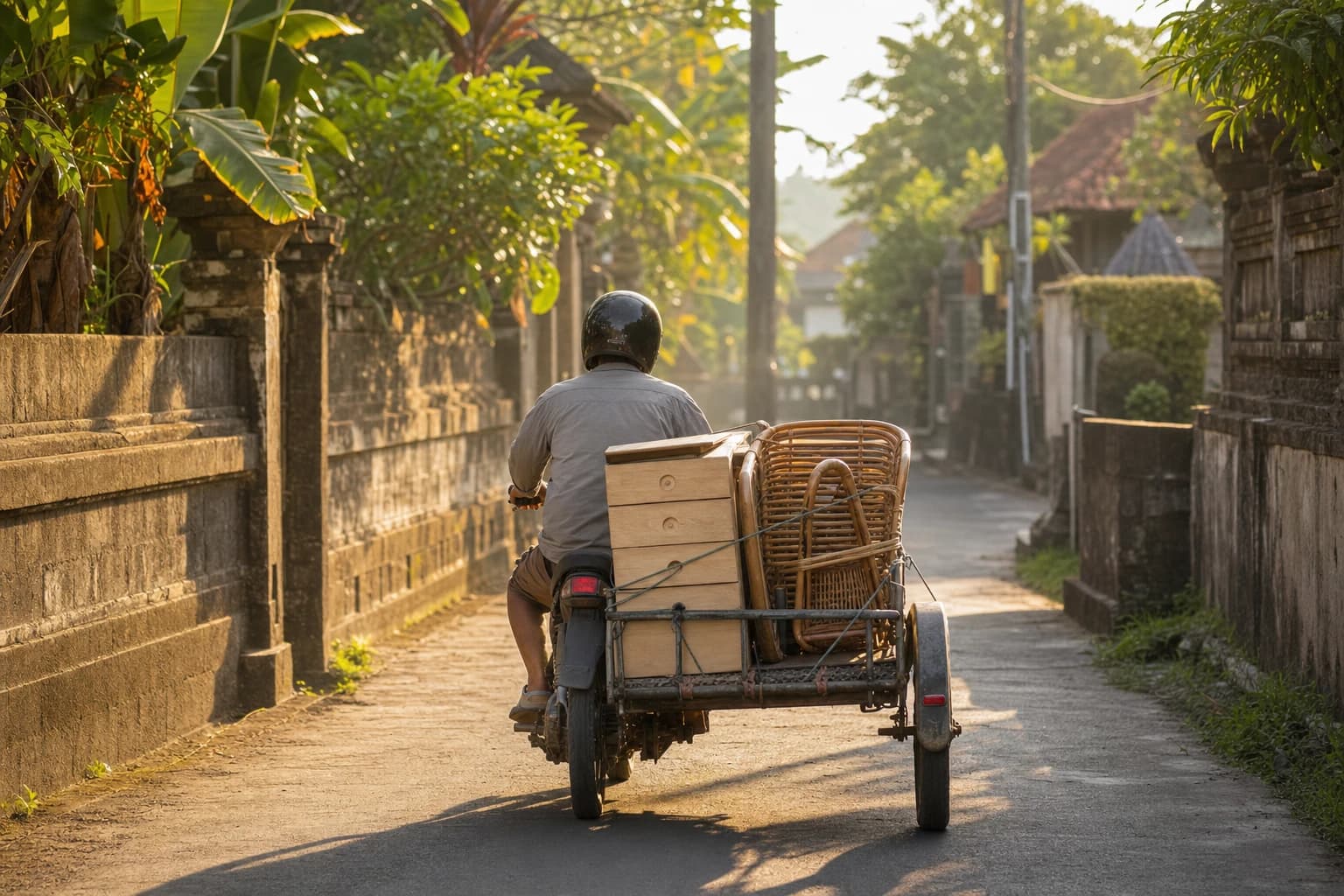
If you go that way, two companion reads: our guide to furnishing a villa without wrecking your budget and the five things that make a listing sell fast — worth reading in both directions, since expat furniture hitting the market is very often someone's departure.
What this guide can't tell you
Four gaps, left open rather than filled with guesswork:
- The cost of local delivery. No rate, flat fee or free-delivery threshold is published for delivery within Bali. IKEA itself goes no further than "at reasonable rates", with not a single figure attached.
- Second-hand depreciation. Nothing is published on resale prices for used furniture in Bali, or on how fast it moves. Treat any percentage you read elsewhere as unsourced.
- What the climate does. Humidity, termites and salt air are real issues for which I found no consultable source. The line about "plywood that swells within six months in Canggu" can be neither confirmed nor denied here.
- Timber legality. Nothing verified on SVLK certification or teak labelling as it applies to a private buyer.
Frequently asked questions
Where can I buy cheap furniture in Bali?
Denpasar has the widest concentration of local-price stores. Four streets are named across the sources: Jl. Gatot Subroto and Jl. Cokroaminoto by the manufacturer Bali Best Buy Furniture, Jl. Teuku Umar and Jl. Imam Bonjol by the studio DesRes Bali. You'll find take-away stock there, plus wholesalers for larger orders. Recorded ranges in this segment run from 800,000 IDR for a plain rattan chair to 20 million IDR for a dining table.
How much does a teak dining table cost in Bali in 2026?
It depends entirely on the channel, and the gap is enormous. In a Kerobokan or Seminyak design showroom, Honeycombers records 15 to 55 million IDR for a teak table (January 2026). On the local market, Own Property Abroad puts dining tables between 800,000 and 20 million IDR (May 2026). Ex-workshop, a 2m table in grade A solid teak is quoted at 600 to 1,200 USD by a manufacturer-exporter — a commercial price, not an independent benchmark.
Do I need to go to Ubud for wooden furniture?
Jalan Raya Andong in Ubud lines up wood shops one after another: teak tables, rustic sideboards, carved stools. Be aware that some of the stock is imported from Java rather than made locally — always ask where a piece comes from. The neighbouring villages specialise: Mas for wood carving and Balinese doors, Tegallalang for suar and bamboo.
How long does custom furniture take to make in Bali?
Allow 4 to 8 weeks of production plus quality-control time, according to a local manufacturer's 2026 price guide. Another source widens the range from a few weeks to several months. Don't confuse this with the "6 to 8 weeks" figure often quoted, which refers to sea freight for export out of Indonesia, not to a local delivery in Bali.
Is there an IKEA in Bali?
Yes, at Kuta Central Park. It's a compact format: a scaled-down showroom paired with an order and collection point, open 10am to 9pm WITA every day. Yellow tags mark products you order through a co-worker, red tags the ones you collect yourself in the Market Hall. Collection in store or at a Pick-up Point, paid home delivery, assembly, interior design and a take-back and recycling service are all offered.
How much does it cost to furnish a whole villa in Bali?
The only published whole-villa budgets come from a manufacturer-exporter, so from a commercial party. Its 2026 grid prices a one-bedroom villa at 10,000 to 20,000 USD entry level, 20,000 to 40,000 USD mid range and 40,000 to 70,000 USD and up at the high end; a four- or five-bedroom runs from 55,000 to 300,000 USD depending on tier. The same page also gives 25,000 to 70,000 USD for a typical two- or three-bedroom rental villa, and 4,000 to 8,000 USD per guest bedroom. Always state the tier: at equal size, the budget quadruples from one tier to the next.
Where can I find second-hand furniture in Bali?
No centralised Craigslist-style platform has taken hold in Bali: used goods move through markets, word of mouth, café noticeboards, community Facebook groups and local classifieds platforms. Skip the well-known pasar loak — Beringkit, Kodok, Batubulan — which sell second-hand clothes, shoes and small items rather than furniture. Haggling is expected, cash is preferred, and inspecting the piece before buying is essential.
Sources
- Bank Indonesia — JISDOR reference rate — official source. The USD/IDR rate behind every conversion here: 17,909 on 21 July 2026, 17,976 on 20 July, 17,944 on 17 July.
- Directorate General of Taxes — PMK-131/2024, PPN rate and the 11/12 base — official source, article dated 6 January 2025. A headline rate of 12% applied to a base reduced to 11/12, i.e. an effective 11% on goods not classified as luxury.
- DJP — Press release on PMK-11/2025 — official source, release dated 18 February 2025. The regulation has been in force since 4 February 2025 and confirms that the move to 12% does not affect goods and services outside the luxury category.
- IKEA Indonesia — How to shop, Bali store — official brand source (commercial). Yellow and red tags, collection in store or at a Pick-up Point, home or office delivery "at reasonable rates", ten payment methods, assembly, design and take-back services.
- IKEA Indonesia — Furniture store Bali — official brand source (commercial). Located at Kuta Central Park, compact format, open 10am to 9pm WITA every day.
- Honeycombers — Furniture shopping in Bali (01/01/2026) — 13 shops for 2026 with exact street addresses, five of them in Kerobokan, four showroom-segment price ranges, and the "30 to 60% cheaper than Australia, Singapore or Europe" comparison. Press source.
- Own Property Abroad — Furniture costs in Bali (updated 03/05/2026) — local and wholesale ranges by furniture type, plus Balinese teak per m². USD conversions out of date, recalculated here. Commercial source.
- Own Property Abroad — Where to buy furniture in Bali (published 29/06/2023, updated 02/05/2026) — rattan chair prices, wholesale furniture range, shop distribution by area (including the list's only Canggu address, Heveya). Commercial source.
- DesRes Bali — Bali furniture 101 (2026 edition) — the best area-by-area mapping available: Kerobokan-Umalas and its convenience tax, Jalan Raya Andong, Mas and Tegallalang, Gianyar and Tampaksiring, the Teuku Umar and Imam Bonjol streets in Denpasar, and Tuban's hospitality warehouses. Commercial source.
- Bali Best Buy Furniture — Where to buy furniture in Bali (12/06/2026) — names two of Denpasar's furniture streets (Gatot Subroto and Cokroaminoto) and specifies that Sukawati and Guwang are décor rather than large furniture. Commercial source.
- Bali Best Buy Furniture — Custom furniture price guide 2026 — ex-workshop price list in USD, 4 to 8 week lead time, claimed saving of 20 to 30% versus retail. Commercial source.
- Bali Best Buy Furniture — Cost to furnish a villa in Bali (04/06/2026) — furnishing budgets across three tiers by bedroom count, per-guest-bedroom benchmark, two- to three-bedroom rental villa figure, and an assumed exchange rate of 18,000-18,500 IDR/USD. Commercial source.
- Latif Living — Where to buy furniture in Bali (18/05/2026) — the Seminyak-Kerobokan corridor as the most design-driven stretch, Denpasar as the wholesale hub, Sanur as mixed, Gianyar and the east as more traditional. Commercial source.
- Nusantara Lifestyle — Buying furniture in Bali (12/11/2024) — custom lead times "from a few weeks to several months" and the distinction with sea freight at "6 to 8 weeks or more". Commercial source.
- Bali Guider — Second hand shopping in Bali (06/12/2024) — the absence of a Craigslist equivalent, the real second-hand channels, art markets, and the norms around haggling, cash and inspection before purchase. Community source.
- What's New Indonesia — Thrift, flea and street markets in Bali (06/09/2023) — heads off a common mistake: Bali's pasar loak sell second-hand clothes, shoes and small items, with no furniture listed. Days and hours for Pasar Beringkit. Press source.
- Balipedia — Furniture shopping in Bali (06/03/2023) — used only for street mapping and the address of Mercia Home Living (Jalan Raya Andong, Petulu); its opening hours, now more than three years old, have not been carried over. Press source.
Written on 22 July 2026 from sources consulted on that date. There is no official source for furniture prices in Bali: every range quoted here comes from media or commercial players and is presented by market segment. Prices, addresses and opening hours change — call before you make the drive. Informational content; not tax advice.