Yes, buying a secondhand garment in Bali in 2026 is still legal for a private individual: what is banned is bringing it into the country. Regulation No. 47 of 2025 from Indonesia's Ministry of Trade, adopted on 29 December 2025 and in force since 1 January 2026, lists pakaian bekas (used clothing, tariff heading 6309.00.00) among goods prohibited from import. Its article 3 targets "the importer" and the act of importing — not the buyer, and not the trader selling down stock already in the country. An importer faces up to 5 years in prison and/or a 5 billion IDR fine (Law No. 7 of 2014, art. 112), and 1 to 10 years plus 50 million to 5 billion IDR where smuggling is established (Law No. 17 of 2006, art. 102). The nuance that matters for you: article 103, letter d, of that same customs law punishes with 2 to 8 years and/or 100 million to 5 billion IDR anyone who buys, stores or resells imported goods that they know or can reasonably suspect come from smuggling. Reselling clothes you already own in Indonesia, on the other hand, falls under none of these provisions.
What does the text banning imported thrift clothing actually say?
The text exists, it is public, and it runs to nine articles. Peraturan Menteri Perdagangan No. 47 of 2025, titled "Barang yang Dilarang untuk Diimpor" (goods prohibited from import), was signed by Trade Minister Budi Santoso on 29 December 2025 and promulgated the following day. Its article 9 sets entry into force at 1 January 2026. On the ministry's legal database its status is "Berlaku" — in force — and no amending text from 2026 appears there as of 8 September 2026.
One detail deserves flagging, because it could cast doubt on everything else: the PDF the ministry has put online carries the word "RANCANGAN" (draft) in its header, plus a "Hasil Telaahan Biro Hukum" banner dated 29 November 2016. Those are template leftovers, not a status. The same file contains the signed enacting formula — "done in Jakarta, 29 December 2025, Minister of Trade, Budi Santoso" — and the order for publication in the Berita Negara; the ministry's own record sheet independently gives the adoption date, the promulgation date, the status "Berlaku" and the publication reference: Berita Negara 2025 No. 1156, 5 pages. The PDFs of regulations 16/2025 and 19/2026 cited further down, downloaded from the same database, carry no such header. The text is in force; it is the file's layout that is at fault.
Its article 2 sets out twelve prohibited categories — sugar, rice, ozone-depleting substances, refrigeration equipment, hazardous waste, mercury medical devices, and others — including letter d: "kantong bekas, karung bekas, dan pakaian bekas", used bags, used sacks and used clothing. Annex IV gives the tariff headings: 6305.10.21 and 6305.10.29 for jute sacks, and line 23, 6309.00.00, "pakaian bekas dan barang bekas lainnya".
The architecture of the text repays close reading, because it is what draws the line. Article 3 provides that "the importer is prohibited from importing, from outside the customs territory, goods designated as prohibited from import". The subject of the sentence is the importer; the object is the act of importing. Article 1, point 3, defines the importer as "a natural person, an institution or a business undertaking an importation" — so a private individual can fall squarely within the text if they bring the goods in. Article 4 closes the classic workarounds: the ban also applies to entry into free-trade zones (Batam and the other KPBPB), special economic zones, bonded warehouses and the import-for-processing-and-export regime. Article 5 opens a single exception to those two bans: reimportation of goods previously exported. The text does contain a second derogation, in article 7, but it is transitional and covers only certain HCFC-123 refrigeration equipment shipped before entry into force — nothing touching clothing. For pakaian bekas, then, reimportation remains the only door open. Article 8 repeals, among others, regulations 18/2021 and 40/2022, which carried the ban until now.
That point explains a recurring confusion in press coverage: until 31 December 2025, the basis cited by officials was regulation 40/2022 — still the one invoked by Mario Josko, director general for consumer protection at the Ministry of Trade, in an interview with detikBali on 15 December 2025. Since 1 January 2026 the current reference is 47/2025; the ban itself has not changed in substance since 2022.
| The text at a glance | Content |
|---|---|
| Reference | Permendag No. 47 of 2025, "Barang yang Dilarang untuk Diimpor" |
| Adopted / promulgated | 29 December 2025 / 30 December 2025 |
| In force since | 1 January 2026 (article 9) |
| Goods covered | Pakaian bekas — tariff heading 6309.00.00 (annex IV, line 23) |
| Person covered | The importer, defined as a natural person, institution or business (art. 1.3 and 3) |
| Scope | Customs territory, free-trade zones, special economic zones, bonded warehouses (art. 4) |
| Exception applicable to clothing | Reimportation of previously exported goods (art. 5) — art. 7 derogates only for certain refrigeration equipment |
| Repeals | Notably Permendag 18/2021 and 40/2022 (art. 8) |
| Penalties | Cross-reference to the laws; the regulation sets none itself (art. 6) |
Who risks what, and for which act?
Regulation 47/2025 provides no penalties of its own: its article 6 simply refers to "the provisions of the applicable regulations". The sanctions sit in two laws, and they do not hit the same people.
Law No. 7 of 2014 on trade forbids an importer from importing prohibited goods (art. 51, para. 2) and punishes the breach with up to five years in prison and/or a fine of up to five billion IDR (art. 112, para. 2). It also contains a broader rule that many people miss: article 47, paragraph 1, requires that "every importer imports goods in a new condition", with non-compliance punished under article 111 by the same penalties. Be careful not to read more into it than is there, though: paragraph 2 of the same article expressly allows the government to designate non-new goods that may be imported — used capital equipment unavailable locally, disaster relief equipment, among others. Importing used goods is therefore not banned across the board; it is used clothing that sits on the prohibited list.
Law No. 17 of 2006 on customs is harsher and, above all, reaches further down the chain. Its article 102 punishes import smuggling — goods off manifest, unloading outside a customs area, concealment, false declaration of type or quantity — with a floor of one year and a ceiling of ten, plus a fine of 50 million to 5 billion IDR. Its article 102B raises those penalties to 5-20 years and 5-100 billion IDR where the offence "disturbs the foundations of the national economy". And its article 103, letter d, names the downstream end of the chain: storing, warehousing, holding, buying, selling, exchanging, obtaining or transferring imported goods that one "knows or can reasonably suspect" come from an offence under article 102, with a penalty of two to eight years in prison and/or a fine of 100 million to 5 billion IDR — the text does say "dan/atau", so prison and fine are not necessarily cumulative. Confiscation, for its part, is not in article 105, contrary to what is sometimes written: that article punishes breaking customs seals. It is article 109 that provides for imported goods deriving from offences under articles 102, 103 letter d or 104 letter a to be forfeited to the State, along with any means of transport "used exclusively" to commit the article 102 offence.
In practice, the law makes it possible to prosecute a trader who buys bales of imported thrift knowing where they come from. No source consulted reports proceedings against an end consumer, and the "knew or could reasonably suspect" test calls for a demonstration — but the text sets no quantity threshold.
| Act | Text | Penalty faced |
|---|---|---|
| Importing used clothing (prohibited goods) | Law 7/2014, art. 51.2 and 112.2 | Up to 5 years and/or up to 5,000,000,000 IDR |
| Importing non-new goods outside the cases allowed by the government | Law 7/2014, art. 47 and 111 | Up to 5 years and/or up to 5,000,000,000 IDR |
| Import smuggling (off manifest, concealment, false declaration) | Law 17/2006, art. 102 | 1 to 10 years and 50,000,000 to 5,000,000,000 IDR |
| Smuggling that disturbs the national economy | Law 17/2006, art. 102B | 5 to 20 years and 5 to 100 billion IDR |
| Storing, holding, buying, selling or transferring goods from that smuggling, knowingly or with reasonable suspicion | Law 17/2006, art. 103 d | 2 to 8 years and/or 100,000,000 to 5,000,000,000 IDR |
| Fate of the goods and of vehicles used exclusively for the offence | Law 17/2006, art. 109 | Forfeiture to the State |
Why does Indonesia care so much about this ban?
Three arguments come up from ministers, and they come with numbers. The first is economic: Deputy Industry Minister Faisol Riza said on 4 February 2026 that illegally imported thrift sells for 10.4 to 19.9 times less than the equivalent local product, in a clothing market worth roughly 10 trillion IDR a month — 119.8 trillion IDR a year for 281.6 million people. In Bali, the head of the provincial Industry and Trade office, I Wayan Jarta, said in March 2023 that he could not put a figure on the damage, but estimated that the trade was holding back the distribution of local products by 30 to 40 % — a brake on sales, not a price gap.
The second is public health: in the Tabanan case, laboratory analysis of fabric samples found bacillus sp bacteria.
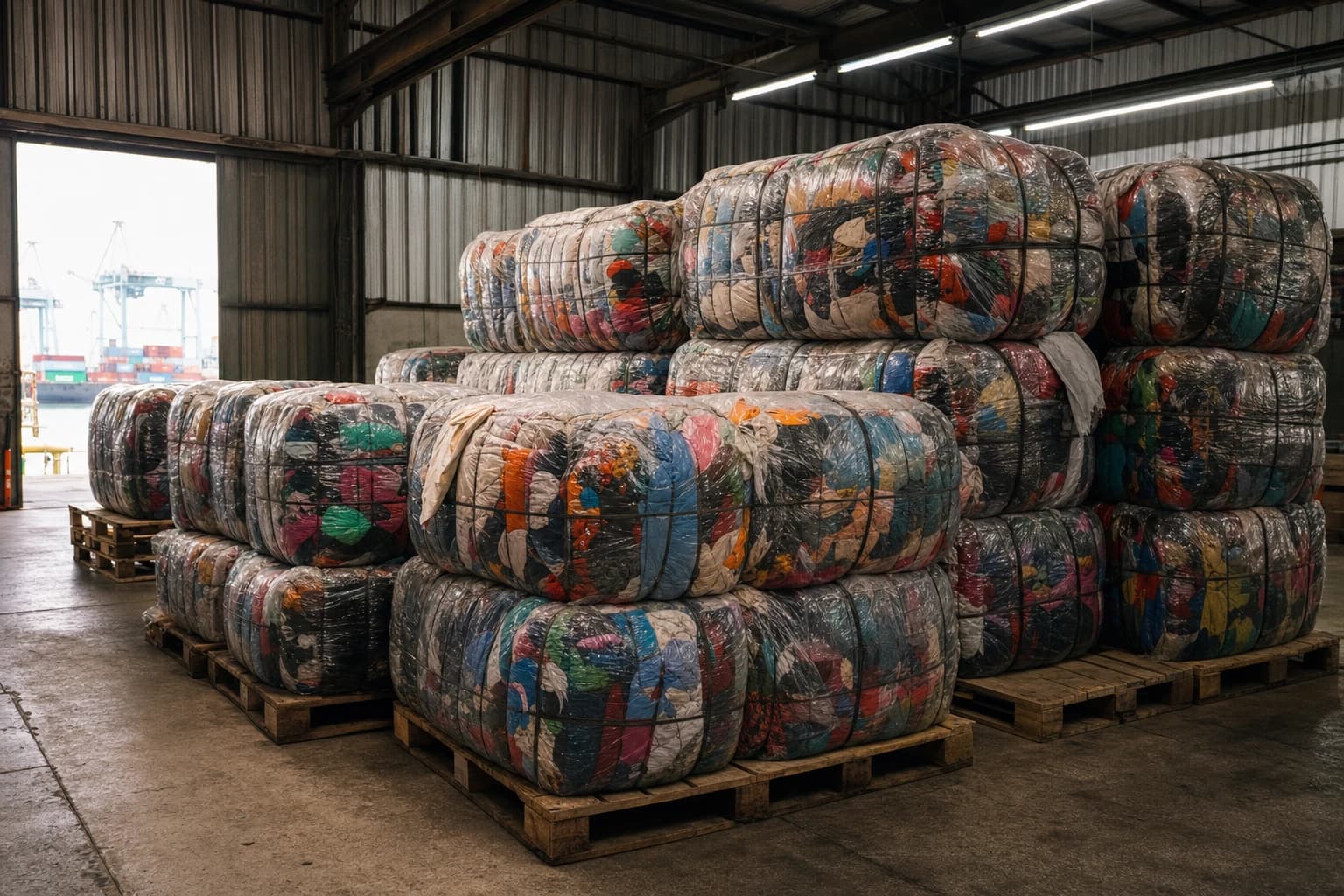
The third is a refusal to become, in Budi Santoso's phrase, a "major destination for textile waste". The volumes bear that out: imports of finished textiles and used clothing reached USD 78.19 million from January to July 2025, up 17.33 % year on year, mainly from China, Vietnam and Bangladesh. Over the twelve months to November 2025, the authorities impounded 17,200 bales, or 1,720 tonnes, roughly 8.6 million items; with destruction costing 12 million IDR per container, the government opted instead for a recycling plan with the textile association AGTI.
| Date | Seizure | Location | Estimated value |
|---|---|---|---|
| August 2022 | 750 bales | Karawang, West Java | ~8.5 billion IDR |
| 2023 | 112.95 tonnes | Batam | ~17.35 billion IDR |
| January 2025 | 463 bales | Surabaya | ~6.3 billion IDR |
| January 2025 | 1,200 bales | Subang | ~8.3 billion IDR |
| 14-15 August 2025 | 19,391 bales | West Java | ~112.35 billion IDR |
| December 2025 | 846 bales | Tabanan, Bali | 3.5 billion IDR |
| June 2026 | 43 containers, ~4,687 bales | Jakarta and South Kalimantan | ~37.5 billion IDR (≈ USD 2M) |
| July 2026 | 2,065 bales | Pontianak, West Kalimantan | not disclosed |
Figures compiled on 8 September 2026 from the state news agency Antara and detikFinance.
What happened in Bali: Pasar Kodok and the Tabanan case
Bali has its epicentre: Pasar Kodok, officially Pasar Obral Bekas, in Banjar Tegal Belodan, Dauh Peken village, Tabanan. It was the island's largest thrift market. It closed after a police raid on 16 March 2023, the day after Joko Widodo's announcement — "importing used clothing must stop, it badly disrupts our domestic industry". Three days later the stalls were still empty. On 20 March, two collectors were arrested with 117 sacks worth 1.17 billion IDR, shipped in from Malaysia via ports in North Sumatra and Jambi.
The market did not stay shut. On 15 December 2025, the national criminal police announced they had dismantled a network whose warehouse was in Tabanan: 846 bales seized, two suspects identified by the initials ZT and SB, supplied by two South Korean nationals. The goods had been ordered in South Korea since 2021, shipped via Malaysia, and brought in through unregistered ports. Investigators put the network's transactions at 669 billion IDR since 2021, including 367 billion in clothing purchases, and seized 22 billion IDR in assets — seven buses, a Pajero, a Toyota Raize, 2.5 billion IDR in bank accounts. The charges announced combine money laundering and illegal importation, carrying up to twenty years. The distribution chain ran through physical shops, markets, retailers and online sales apps — with Pasar Kodok as a key distribution point.
At provincial level, the admission is candid. Ni Luh Putu Suratini, head of trade supervision at Bali's Industry and Trade office, summed it up that same day: "controlling imports of used clothing is extremely difficult… We have run awareness campaigns, education, we have worked with central government. But at the end of the day, there is always some."
Is imported thrift still sold in Bali in 2026?
Yes, on a smaller scale and under watch. Pasar Kodok was still operating in December 2025 when police traced the Korean supply chain through it. No public source consulted gives the number of traders still active there, or any 2026 price survey for Bali — better to say so than to invent a figure.
Two reference points do exist. In Tabanan in March 2023, a reseller bought a branded item for 50,000 to 75,000 IDR at the market and resold it from 150,000 IDR, on starting capital of 2 million IDR. In Jakarta, the Senen market was still going at the end of December 2025, noticeably quieter, its stock coming mainly from warehouses built up before the restrictions, at prices from 20,000 IDR to a few hundred thousand IDR an item. Those amounts date from March 2023 and December 2025: an order of magnitude, not today's going rate.
The pressure applies online too. On 6 November 2025, SME Minister Maman Abdurrahman ordered e-commerce platforms to shut down shops selling imported secondhand clothing — and several operators began taking them down straight away. On 4 December, the Trade Minister dismissed the idea of taxing these goods, with an unambiguous argument: "such a tax is impossible, given that the status of importing used clothing is illegal in Indonesia". In parallel, the Senen (Jakarta) and Gedebage (Bandung) markets are being repositioned towards local brands, with more than 150 partner labels.
Online commerce has also fallen, since 8 June 2026, under regulation 19/2026: businesses must comply with the rules on goods whose trade is prohibited or restricted (art. 25), and — on the narrower ground of electronic advertising — platforms must cut off access to advertisements that breach the regulations, then, after three such cut-offs against the same business account, to the account itself (art. 33), with the authorities empowered to order those cut-offs (art. 34). The text addresses the "Pelaku Usaha", defined as any person or entity carrying on a business activity online, with no numerical threshold separating the occasional private seller from a professional — a blind spot worth knowing about.
How do you tell an illegally imported stock from a private resale?
The difference is not just moral, it is tariff-based. Legal note 3 to chapter 63 of the Harmonised System — the international customs nomenclature — restricts heading 63.09 to articles meeting two cumulative conditions: signs of appreciable wear and presentation "in bulk or in bales, sacks or similar packings". It is the second criterion that separates a compressed bale from a dress sold one at a time. Indonesian vocabulary draws the same line: thrift means used clothing imported wholesale for resale, preloved means personal belongings someone is clearing out.
| Signal | Imported stock (baled thrift) | Private resale |
|---|---|---|
| Stated origin | "New arrival", "fresh bal", "import Korea / Japan" | "It's mine", "I'm leaving", "it doesn't fit me any more" |
| Volume | Tens or hundreds of items, regular restocking | A handful of items, no restocking |
| Consistency | A batch of one type or one origin | Mixed sizes and styles, one person's wardrobe |
| Labelling | Labels in Korean, Japanese, English; sometimes torn out | Local retail or original brand labels |
| Entry price | 50,000 to 75,000 IDR wholesale for a branded item (Tabanan, March 2023) | Freely set, often close to a neighbour-to-neighbour price |
| Location | Specialist market stall, warehouse, fast-turnover shop | Home, wardrobe sale, listing from a personal account |
| Buyer's legal position | Exposed under art. 103 d of Law 17/2006 if they know or can suspect | Outside the scope of regulation 47/2025 |
Does a traveller arriving with their own clothes fall under this?
Nothing in the sources consulted suggests they do, and no case of a suitcase of personal effects being treated as a thrift import is documented — but let us say up front that the demonstration rests on reasoning, not on a sentence in a text. A personal allowance is not a commercial import. Indonesia's Directorate General of Customs and Excise (Bea Cukai) states that "a passenger's personal goods, up to a customs value of FOB USD 500 per person, are exempt from import duty"; above that, a flat duty of 10 %, VAT of 11 % and income tax of 0.5 to 10 % with an Indonesian tax number, or 1 to 20 % without one, apply.
Regulation 16/2025 on import policy provides, for its part, in article 42, that people who cannot hold an importer identification number may bring in "passenger personal goods" and "relocation goods of Indonesian and foreign nationals", new or not new, on the express condition that the operation "is not carried out for a commercial activity".
The limit of that article 42 has to be stated immediately, because it is decisive and almost always passed over in silence: its paragraph 1 opens the regime only to goods that are "free to import" (Barang Bebas Impor) and "restricted from import" (Barang Dibatasi Impor). It does not mention the category of prohibited goods, the one used clothing sits in. The personal effects regime is therefore not, in itself, a derogation from the 47/2025 ban.
Hence the honest caveat: no Indonesian text consulted says in black and white that a traveller's worn clothes escape heading 6309. What holds up is a tariff-classification argument — a suitcase of personal effects does not meet the "in bulk or in bales" presentation condition in the chapter note quoted above, and so falls outside the heading covered by the ban before you even reach the question of whether article 42 applies. The reasoning looks sound, it is consistent with the absence of any reported case, but it is written that way in no Indonesian text: present it as such if an officer asks. Conversely, bringing in a batch of identical, still-tagged items to resell leaves the personal effects regime and lands unambiguously inside the ban.
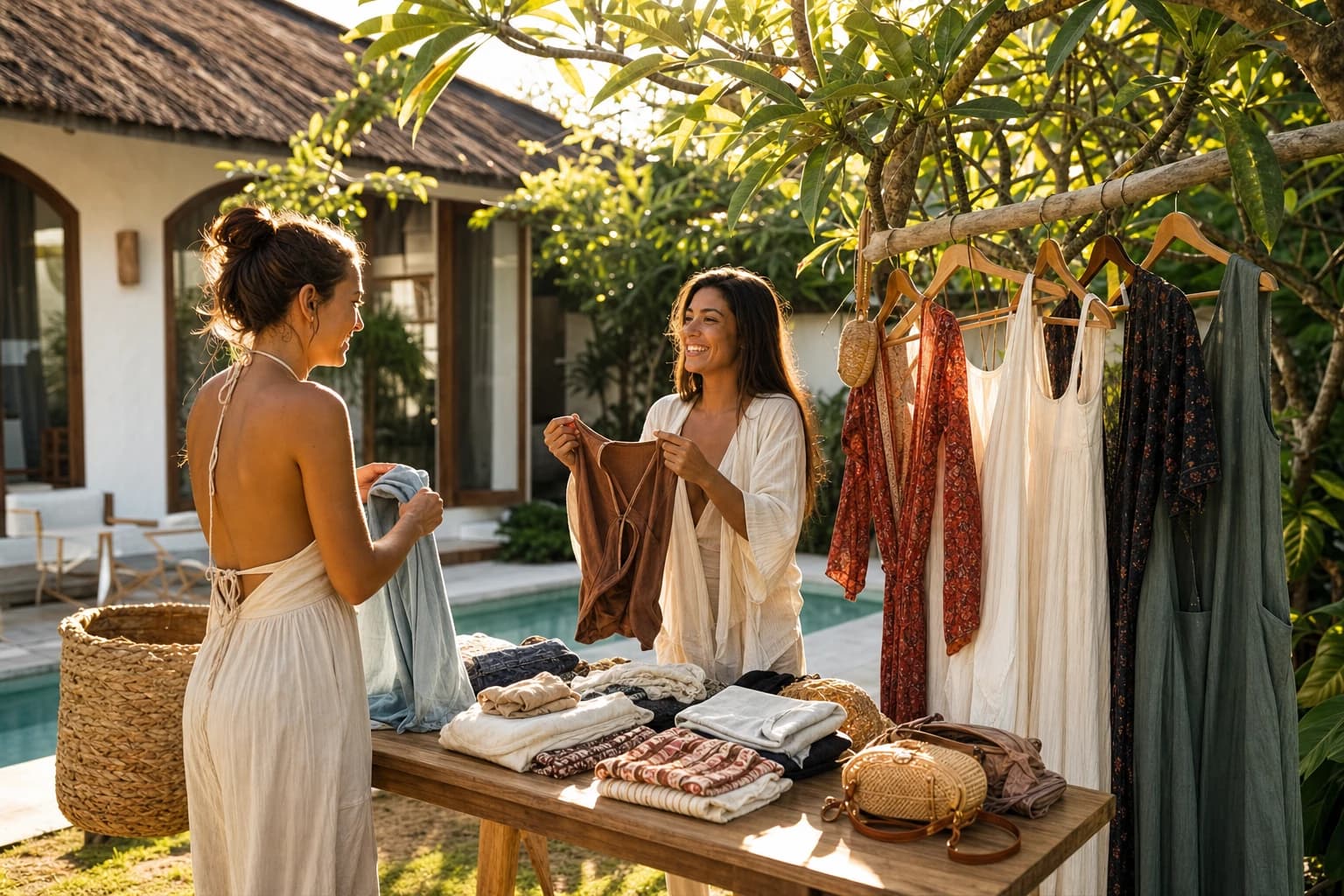
Selling your own secondhand clothes in Bali: still perfectly legal
Here is the point to hold on to if you are clearing out a wardrobe. Regulation 47/2025 is about importation and nothing else: its title, its article 3 and its entire apparatus concern goods entering the customs territory. A title search on the Ministry of Trade's legal database for "barang dilarang diperdagangkan" — goods prohibited from trade — returns no regulation. The government itself, when it ruled out taxation, pointed at "the status of the importation" of used clothing, not its domestic circulation.
A garment you bought new in Indonesia, or brought in legally in your luggage, belongs to you. Reselling it to a neighbour, a friend or through an online listing brings no goods into the country and falls under none of the offences set out above. That is exactly what the preloved category covers: personal belongings changing hands. On Lokalfinds, a listing for clothes you already own is an ordinary private sale, no different from a scooter or a sofa.
Two habits worth keeping, all the same. Describe the origin in the listing — "mine for two years", "bought in Seminyak in 2024": transparency about provenance is what distinguishes your sale from a stock clearance, and what reassures the buyer. And apply the usual precautions: the safe meetup checklist for buying and selling in Bali applies to a box of clothes as much as to a camera, and the classic marketplace scams in Bali do not change nature just because the price is low.
For a whole lot before you leave, the logic is that of a move: our tips for selling your listings faster and the price ranges in our guide to reselling furniture in Bali apply as they stand.
Frequently asked questions
Is it illegal to buy secondhand clothing in Bali in 2026?
No, no text forbids a private individual from buying secondhand clothing in Indonesia. The ban in regulation 47/2025 covers importation and targets the importer. One caveat does exist: article 103, letter d, of customs law No. 17 of 2006 punishes with 2 to 8 years in prison and/or 100 million to 5 billion IDR the purchase of goods that one knows or can reasonably suspect come from smuggling. No prosecution of an end consumer is documented, but the provision sets no quantity threshold.
What is the exact number and date of the text banning imports of used clothing?
It is Peraturan Menteri Perdagangan No. 47 of 2025, "Barang yang Dilarang untuk Diimpor", adopted in Jakarta on 29 December 2025, promulgated on 30 December 2025 and applicable since 1 January 2026 under its article 9. It repeals regulations 18/2021 and 40/2022, which carried the ban before it. Used clothing appears in article 2, paragraph 1, letter d, and in annex IV under tariff heading 6309.00.00.
Can I bring my own worn clothes in my suitcase when I arrive in Bali?
A passenger's personal goods fall under a separate regime: the Indonesian Directorate General of Customs and Excise grants exemption from import duty up to FOB USD 500 per person, and regulation 16/2025 allows the entry of personal goods and relocation goods, new or not new, provided they are not used for a commercial activity. Two limits to know: article 42 of that regulation covers only goods that are free or restricted for import, not prohibited goods; and no Indonesian text consulted addresses the case of worn clothing explicitly. The reasoning rests on legal note 3 to chapter 63 of the Harmonised System, which restricts heading 6309 to articles presented in bulk or in bales — a suitcase is neither. It looks sound and nothing contradicts it, but it is written that way nowhere.
What exactly does someone importing bales of thrift face?
Two regimes stack up. Law No. 7 of 2014 on trade provides for up to 5 years in prison and/or up to 5 billion IDR in fines for importing prohibited goods (art. 112, para. 2). Law No. 17 of 2006 on customs provides for 1 to 10 years and 50 million to 5 billion IDR for import smuggling (art. 102), and 5 to 20 years with 5 to 100 billion IDR where the offence disturbs the foundations of the national economy (art. 102B). The goods, and any means of transport used exclusively for the offence, are forfeited to the State — under article 109, not article 105, which concerns breaking customs seals.
Is Pasar Kodok in Tabanan still open?
It was closed after a police raid on 16 March 2023, but it was operating again in December 2025: the national criminal police identified it as a key distribution point for the network dismantled in Tabanan, where 846 bales of Korean clothing were seized. No public source consulted gives its exact state or the number of traders active there in 2026.
Can you sell secondhand clothes online in Indonesia?
The SME Minister's directive of 6 November 2025 asks platforms to close shops selling imported secondhand clothing — that is how the state news agency presents it, and that is what the platforms began taking down. The minister's quoted sentence is broader, though ("selling used clothing is no longer allowed"), and no source consulted specifies whether a private individual reselling their own belongings is covered: on that precise point the ambiguity is in the source, not in our reading. Regulation 19/2026, in force since 8 June 2026, requires businesses to comply with the rules on goods whose trade is prohibited or restricted, and obliges platforms to cut off access to unlawful electronic advertising, with account closure after three cut-offs. That text applies to anyone carrying on a "business activity" online, with no numerical threshold set.
What is the difference between thrift and preloved, and why does it change everything?
Thrift means used clothing imported wholesale, generally in bales, to be resold: that is the channel the ban targets. Preloved means personal belongings resold by their owner. The distinction is also a tariff one: customs heading 6309 requires two cumulative conditions — appreciable wear and presentation in bulk or in bales. An item sold individually by its owner does not meet the second condition and therefore falls outside the heading covered by the ban.
Sources
Official sources
- Peraturan Menteri Perdagangan No. 47 of 2025, "Barang yang Dilarang untuk Diimpor" — legal database of the Indonesian Ministry of Trade (JDIH). Full text and annexes consulted on 08/09/2026.
- Peraturan Menteri Perdagangan No. 16 of 2025, "Kebijakan dan Pengaturan Impor" — regime for passenger personal goods and relocation goods (art. 42). Official.
- Peraturan Menteri Perdagangan No. 19 of 2026, trade through electronic systems — obligations of sellers and platforms. Official.
- Undang-Undang No. 7 of 2014 on trade — articles 47, 51, 111 and 112. Official.
- Undang-Undang No. 17 of 2006 amending customs law No. 10 of 1995 — articles 102, 102B, 103 and 109, regulatory database of the Indonesian Audit Board; status "Berlaku" as of 8 September 2026. Official.
- Bea Cukai — passenger personal goods — FOB USD 500 allowance per person. Directorate General of Customs and Excise, official.
- Customs tariff — legal notes to chapter 63 — note 3 on the cumulative conditions for heading 6309. Official UK source reproducing the international Harmonised System notes.
Press and news agencies
- Indonesia defends used clothing import ban on health, MSME grounds — Antara, 04/02/2026. State news agency: citation of regulation 47/2025 and seizure history.
- Impor ilegal thrifting rugikan industri, harga murah hampir 20 kali — Antara, 04/02/2026. Price gap of 10.4 to 19.9 times.
- Bareskrim Polri ungkap impor pakaian bekas senilai Rp669 miliar — Antara, 15/12/2025. The Tabanan case.
- Polisi Tangkap 2 Importir Pakaian Bekas Ratusan Miliar, Disuplai ke Pasar Kodok — detikBali, 15/12/2025. Distribution chain and charges.
- Pemprov Bali Sulit Kendalikan Pakaian Impor Bekas di Pasar Kodok — detikBali, 15/12/2025. Position of Bali's provincial office.
- Imbas Larangan Impor Baju Bekas, Pasar Kodok Tutup Lapak Sudah 3 Hari — detikBali, 18/03/2023. Market closure and reseller prices.
- Indonesia orders online marketplaces to shut down thrift stores — Antara, 06/11/2025. SME Minister's directive and import volumes.
- Pemerintah isyaratkan tolak wacana adanya pajak produk thrifting — Antara, 04/12/2025. Tax ruled out, illegal status of importation.
- Purbaya to destroy illegal bales of secondhand clothing — Antara, 23/06/2026. Seizure of 43 containers.
- Biaya Pemusnahan Mahal, Pakaian Impor Bekas Sitaan Mau Didaur Ulang — detikFinance, 16/11/2025. Volumes seized and cost of destruction.
- Pasar Thrifting Senen Masih Bertahan, Tak Seramai Dulu — detikTravel, 26/12/2025. Prices charged and state of the market.
- Perbedaan antara thrift dan preloved — Antara, 04/12/2025. The lexical distinction.
- Bali Yuk Bisa Yuk Setop Bisnis Baju Impor Bekas — detikBali, 21/03/2023. Remarks by I Wayan Jarta (30 to 40 % brake on the distribution of local products) and the arrest of 20 March 2023: 117 bales, 1.17 billion IDR.
- Ministry to rebrand thrift markets, promote sale of local products — Antara, 07/11/2025. Repositioning of the Senen and Gedebage markets, more than 150 partner local brands.
- Bea Cukai buru aktor utama penyelundupan 2.065 balpres — Antara, 01/07/2026. The Pontianak seizure, investigation ongoing, no suspect named at that date.
This article describes Indonesian law as it could be consulted in the official databases on 8 September 2026. It is not legal advice: for an individual situation, particularly a commercial one, consult a qualified adviser in Indonesia.