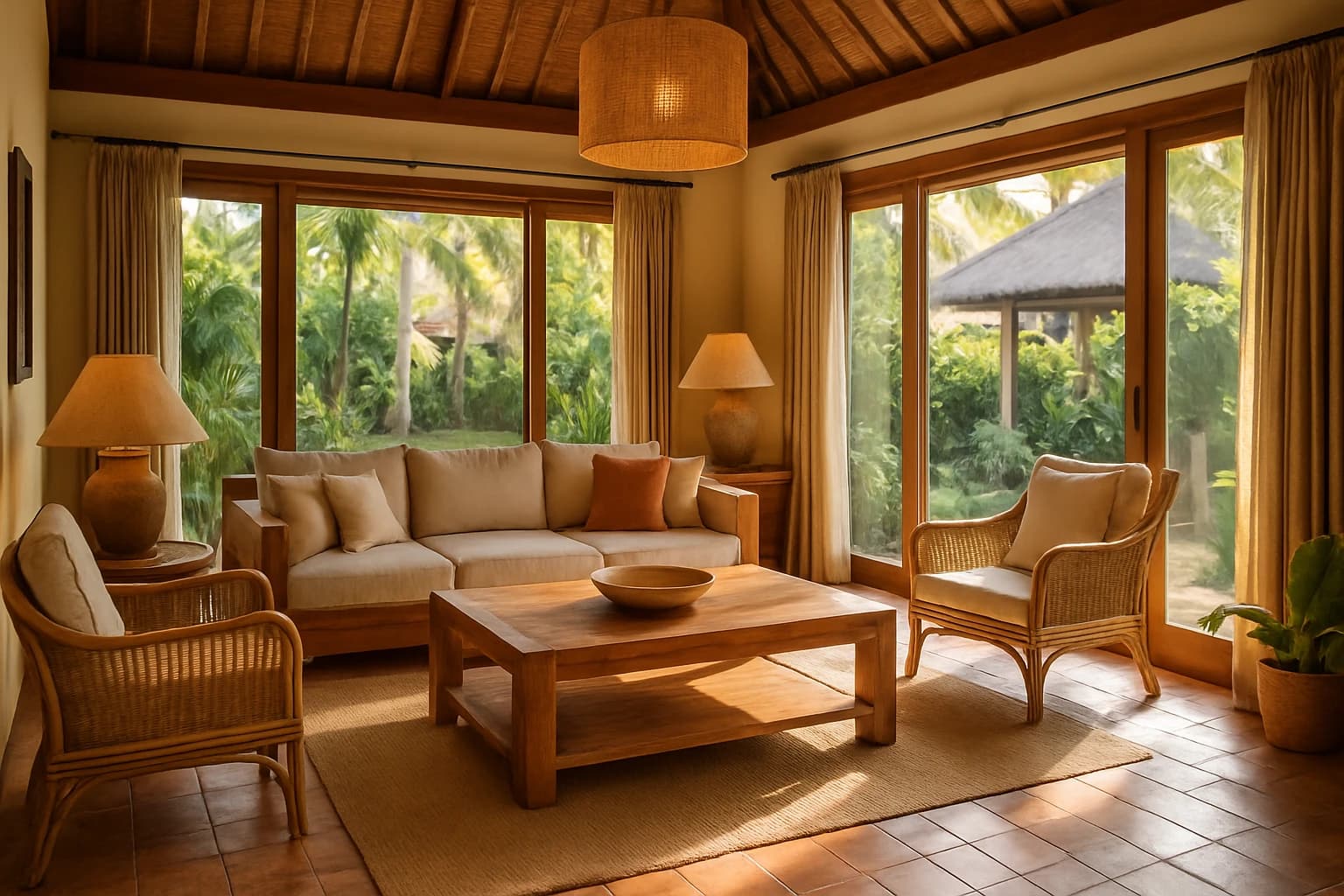
Furnishing a villa or apartment in Bali costs far less than in Europe, Australia or Singapore: furniture made locally — teak, rattan, suar, mango wood — is often 30 to 60% cheaper than the imported equivalent. But in Bali, the real bargain isn't necessarily new furniture. It's secondhand. The expat community turns over fast, and every departure puts near-new pieces back on the market, sold cheap because the villa has to be cleared before the flight. Here's how to furnish your place without blowing the budget — from expat hand-me-downs to custom pieces made to order — and the traps, especially around wood, to avoid in a tropical climate.
In short:
- Start with secondhand. Facebook groups, classifieds and above all departing expats feed a constant stream of good-quality furniture at knock-down prices.
- New local furniture sets the price benchmark. As a rough guide (depending on the store and finish): teak dining table 15–55 M IDR, three-seater sofa 15–30 M, bed frame 20–65 M. For grab-and-go options, IKEA is in Kuta and Informa in Denpasar.
- Custom-made is common and affordable: budget around USD 600 to 1,200 for a 2 m teak table ordered directly from a workshop, with a 2- to 6-week lead time.
- Insist on kiln-dried solid teak. The MDF and particle board used in flat-pack furniture swells, warps and gets infested with termites within 1 to 2 years in this climate.
Furnished or unfurnished? First check what your villa already includes
Before buying anything, ask the right question: is your place already furnished? In Bali, many long-term rental villas come furnished — bedroom furniture, a fitted kitchen, air conditioning, a water heater, and sometimes pool and garden upkeep. There are really three levels: unfurnished, semi-furnished and fully furnished. Furnishing from scratch mainly concerns unfurnished properties, empty kosts (rooms), or people who want to personalise everything.
See also: How much does electricity cost in Bali in 2026? PLN rates, tokens and what a villa really pays
The classic trap is buying duplicates. Inclusions vary enormously from one property to the next, and nothing is standardised. Always confirm in writing what's provided before you sign: bed and mattress, number of air conditioners, kitchen appliances, hot water. The same rent can hide a bare villa or a turnkey one. For rent levels by area and what they include, see our guide to Bali rental prices.
See also: Where to buy furniture in Bali in 2026: an area-by-area guide
Secondhand first: where to find near-new furniture in Bali
This is where Bali is unbeatable. The constant churn of expats and remote workers creates a very active secondhand market: whoever leaves sells everything, whoever arrives buys it. The furniture is often less than two years old, sold for a fraction of its price, and changes hands within days.
The channels that work:
- Facebook groups dedicated to buying and selling between expats and locals, very active: Bali Buy, Swap or Sell, Bali Secondhand Buy & Sell, Bali Furniture Buy and Sell, or BALI SECONDHAND. You'll find everything, from a sofa to a fridge.
- Classifieds: platforms such as expat.com or BaliTop list furniture, and Lokalfinds centralises local listings under the home & decor category. Posting a wanted ad or browsing the latest listings takes two minutes.
- Secondhand and villa-furniture stores: in Kerobokan, Bali Best Buy (Jl. Teuku Umar Barat) or Dewata Mebel resell used furniture, and several sites keep a "Used Villa Furniture for Sale" section.
The best time to grab a deal is an expat departure. When someone leaves the island, they clear an entire home in a matter of days — often in a single "everything must go" lot. It's the exact mirror of our guide to leaving Bali and selling up: what one person offloads, another picks up. Watch those listings: a sofa, a table, a bed and two AC units at once, at half price.
See also: Selling Furniture in Bali: What It's Worth, Where to Sell, How Long It Takes
Inspect before you buy. In the secondhand market under tropical conditions, condition matters more than the brand. Open and close the drawers, weigh the wooden pieces in your hand (an oddly light piece often hides plywood or MDF), look for the fine sawdust that gives away termites, and check mattresses and upholstery (damp leaves marks). On a full lot, always negotiate the bundle rather than piece by piece — a seller in a hurry would rather offload everything at once, and you save on transport too.
A word on depreciation, to be taken as a general benchmark (not a Bali-specific rule): furniture typically loses 20 to 30% of its value in the first year, solid wood and antiques hold up better than upholstery or flat-pack, and you often recover 25 to 60% of the original price on resale. In Bali, in practice, the price mostly depends on how urgently the seller needs to leave: a rushed departure slashes prices far more than any theoretical table.
New local furniture: a solid price benchmark (and IKEA/Informa in a pinch)
Even if you're aiming for secondhand, knowing new prices stops you from overpaying. Reminder: furniture made in Bali is often 30 to 60% cheaper than the same product in Australia, Singapore or Europe.
Here are some showroom price benchmarks (2026, in rupiah), purely indicative and depending on the store and finish — convert at the day's rate:
| Piece | New price range (IDR) |
|---|---|
| Teak dining table | 15–55 M |
| Three-seater sofa | 15–30 M |
| Outdoor lounge set | 15–25 M |
| Bed frame | 20–65 M |
| Rattan chair (entry level) | 800 k – 1.5 M |
| Small solid-teak table | from ~3.5 M |
The furniture district is Kerobokan (around Jl. Teuku Umar Barat and Jl. Raya Kerobokan), with showrooms in Seminyak, Sanur, Canggu, Ubud and Denpasar. For grab-and-go, big-box style:
- IKEA has a store in Bali, in Kuta (Kuta Central Park, on Jl. Patih Jelantik, Badung regency — not in Denpasar), open since late 2021, every day (roughly 10 a.m. to 10 p.m.).
- Informa runs a large store at the Living World Denpasar mall (Jl. Gatot Subroto Timur, Tonja, North Denpasar), with an Informa Electronics section for appliances.
One caveat: a good share of this flat-pack furniture is particle board (MDF), best kept to air-conditioned, dry rooms (see the tropical trap below).
To choose between the three routes, here's a quick comparison:
| Route | Budget | Lead time | Durability in the tropics |
|---|---|---|---|
| Secondhand (expats, FB groups, Lokalfinds) | Cheapest, especially on a departure | Immediate | Variable — inspect the wood |
| New local (showrooms, IKEA, Informa) | Price benchmark | In stock or a few days | Excellent in solid teak, poor in MDF flat-pack |
| Custom-made (workshops) | ~USD 600–1,200 for a 2 m teak table | 2 to 6 weeks | Excellent if kiln-dried |
Custom-made: having your furniture built in Bali
Having furniture made to order is a very common practice here, not a luxury. The workshops and joiners of Kerobokan and Sukawati/Batuan produce custom pieces in teak, rattan, suar (rain tree), mango wood or reclaimed wood, for villas, hotels and restaurants as well as private buyers.
See also: What Does a Tukang Cost in Bali in 2026? Day Rates, Fixed Prices and Quotes
On budget, a telling example (not a universal price list): a 2 m solid-teak dining table comes to roughly USD 600 to 1,200 direct from the workshop or factory; showrooms typically add 30 to 50% margin on top. So what you're mostly paying for is the chain of middlemen, not the wood.
Lead times are reasonable: allow 2 to 3 weeks for small pieces (chairs, stools) and 4 to 6 weeks for large ones (tables, sofas, beds), plus 1 to 2 weeks in high season.
The one non-negotiable requirement: kiln-dried wood (around 10–12% moisture). That's what stops the piece from cracking and "moving" once it's in your home. Be wary of large suar slabs sold undried: stunning in the showroom, they often split a few months later. Ask for the moisture content — it's your best guarantee.
In practice, the smartest strategy often mixes all three routes: secondhand for bulky items that lose value fast (sofa, bed, appliances), custom-made for one or two statement pieces meant to last (the big dining table, a bookshelf), and new as a stopgap for last-minute gaps. That way you concentrate the budget where quality actually matters, without overpaying for what will be resold in two years anyway.
Appliances and air conditioning: what you need to know
Two technical points to know before buying a single appliance.
Electricity. The Indonesian standard is 230 V / 50 Hz, with type C and F sockets (round European plugs fit; type F, known as Schuko, adds an earth). Your European appliances therefore generally work as-is; American or British appliances need an adapter, or even a transformer.
Air conditioning. It's sized in PK ("horse"): ½ PK, ¾ PK (~7,000 BTU), 1 PK (~9,000 BTU), 1½ PK, 2 PK… You pick the power based on the room's floor area. On price, a few indicative figures seen online for a new 1 PK unit (excluding installation): from around 3.9 M IDR (Sharp, Sanken), about 4.3 M (Polytron), 4.65 M (Panasonic), 5.6 M for a Daikin inverter, 6.2 M for a Samsung inverter. You can buy and get it installed easily via platforms such as Tokopedia, Selka or Mitra10.
One last trade-off: AC is by far the most expensive appliance to run on your electricity bill. For a small bedroom, a ½ PK unit is enough and uses very little — no need to oversize.
The tropical trap: solid teak versus MDF and termites
This is the mistake not to make. MDF and particle board — the material of cheap imported flat-pack furniture — are a poor choice in a tropical climate: they swell, warp and get infested with termites within 1 to 2 years, because moisture gets in through the edges. What lasts three years in a Paris living room can fall apart in a single rainy season in Canggu.
By contrast, grade-A solid teak is naturally resistant: its natural oil and tight grain repel termites, rot and moisture. Maintenance comes down to a coat of teak oil now and then. It costs more up front, but it's furniture that lasts for years — and resells well, precisely to the next arriving expat.
Then there's the fake teak trap: teak that's unusually light often means a blend of lesser woods. Before buying, check the density (heft the piece), the moisture content and the finish. Secondhand or new, it's the weight that doesn't lie.
Frequently asked questions
Should you buy new or secondhand furniture in Bali?
Start with secondhand. The high turnover of expats constantly feeds a market of near-new furniture at knock-down prices, especially on departures when everything has to go fast. New local furniture is still useful as a price benchmark and for specific pieces you can't find secondhand.
How much does it cost to furnish a villa in Bali?
It depends on the level, but as a rough new-furniture guide (showroom, rupiah): a teak dining table runs 15–55 M, a three-seater sofa 15–30 M and a bed frame 20–65 M. At entry level, a rattan chair can be found from 800 k–1.5 M. These ranges are wide: showrooms, workshops and markets don't have the same prices, and secondhand goes much lower.
Is there an IKEA in Bali?
Yes. IKEA opened its Bali store in Kuta (Kuta Central Park, Jl. Patih Jelantik, Badung regency — not Denpasar) in late 2021, and it's open every day. Informa also runs a large store at Living World Denpasar. Note that some of this flat-pack furniture is MDF, best kept to dry, air-conditioned rooms.
Is it better to have furniture custom-made?
It's very common in Bali and often worthwhile. Direct from a workshop, a 2 m solid-teak table runs around USD 600–1,200 (showrooms add 30 to 50%), with a 2- to 6-week lead time. The one condition: insist on kiln-dried wood, otherwise the piece may crack.
What plugs and voltage do appliances use in Bali?
Indonesia runs on 230 V / 50 Hz, with type C and F sockets compatible with round European plugs. European appliances generally work without an adapter; American or British ones need one. Air conditioners are sized in PK (1 PK is about 9,000 BTU) according to the room's floor area.
Does MDF furniture hold up in Bali's climate?
Poorly. The MDF and particle board in flat-pack furniture swell, warp and attract termites within 1 to 2 years, because moisture gets in through the edges. Keep them to air-conditioned, dry rooms. For anything living outdoors or in humidity, choose grade-A solid teak.
Where can you resell your furniture before leaving Bali?
On the same channels you buy from: secondhand Facebook groups, villa-furniture stores, and classifieds like Lokalfinds (post a listing). Plan two to three weeks ahead: a complete, well-photographed lot sells fast to new arrivals. Our guide to leaving Bali walks through the whole process.