In 2025 the Bali Villa Rental and Management Association (BVRMA) counted 101 victims of villa rental fraud on the island, and not one of them got their money back (Kompas Denpasar, 18 December 2025). The sums exposed run to tens or hundreds of millions of rupiah per booking ("puluhan hingga ratusan juta rupiah", Bali Post, 14 January 2026). The playbook never changes: photos lifted from genuine villa managers, fake social accounts, a price well under the market, payment demanded before any viewing, then silence.
Three free checks exist before you pay. The BVRMA verification code, online since 17 December 2025, with 62 member companies listed for 2026. The cekrekening.id portal run by Indonesia's Komdigi ministry, which returns the history of fraud reports filed against a bank account. And Sentuh Tanahku, the app from the land agency ATR/BPN, which confirms whether a land certificate exists at all. If the money has already gone, reports go through lapor.go.id (verification promised within 3 days, an answer within 5). Since 2 January 2026, fraud falls under article 492 of the new criminal code (Law No. 1 of 2023) rather than article 378: four years in prison at most, or a fine as an alternative. Travel insurance, meanwhile, will not refund a transfer you sent to a scammer.
What do we actually know about the scale of this?
Start with what is missing, because it explains why the coverage of this subject is so wildly uneven: there is no public statistic from the Indonesian government or from the Bali police on rental scams. The only sourceable count comes from a private trade association, the BVRMA, chaired by I Kadek Adnyana, and it reached the Indonesian press in December 2025 and January 2026.
| Figure | Value | Period | Source |
|---|---|---|---|
| Victims recorded by the BVRMA | 101 | full year 2025 | Kompas Denpasar, 18 December 2025 |
| Victims who recovered their money | 0 | 2025 | Kompas Denpasar, 18 December 2025 |
| Total declared losses | "ratusan juta rupiah" (hundreds of millions of rupiah) | 2025 | Kompas Denpasar, 18 December 2025 |
| Value at stake in one booking | tens to hundreds of millions of rupiah ("puluhan hingga ratusan juta rupiah") | January 2026 | Bali Post, 14 January 2026 |
| Similar cases recorded | "lebih dari 100 kali" (more than 100 times) | January 2026 | Bali Post, 14 January 2026 |
Two things need saying about that table.
The two amounts do not add up. At 10 million IDR a case, the floor of the range, 101 victims already come to more than a billion rupiah, not "hundreds of millions". The contradiction sits inside the Bali Post itself, which states in one and the same article that a single booking is worth tens to hundreds of millions and that travellers' losses run to hundreds of millions. Either those phrases describe an average loss per victim, or the real total runs into the billions. Nothing in the public sources settles it, so we quote the two orders of magnitude separately and never add them together.
There is a second distinction, and this one gets lost in every English-language retelling we found: the Bali Post is talking about the value of one booking ("nilai satu kali pemesanan villa"), meaning the sum you expose when you reserve a villa, not the amount stolen per victim. It is what you stand to wire, not what a scammer typically pockets.
The dollar figures doing the rounds belong in the bin. The "USD 500 to 5,000" and "USD 3,000 to 15,000 deposit" ranges published on several English-language blogs are attributed to no source at all, and neither are the "+30% fraud since 2021" or the "180 complaints in 2024". One site running similar numbers describes them itself as "estimates rather than independently verified data". Be equally wary of the versions that compress 101 victims over the whole of 2025 into "101 victims in the first months of 2025": that is false, and it inflates a problem that is real enough as it stands.
How the scam works, step by step
The picture the BVRMA drew between December 2025 and January 2026 describes a chain that repeats itself almost word for word.
1. Stolen photos. The images come from real villas, often ones managed by association members. I Kadek Adnyana, quoted by Dewata News on 19 December 2025: "Several members have had their villa photos stolen. After payment is made, the scammers can no longer be contacted."
2. A shopfront built to order. Fake website, fake Instagram account or fake WhatsApp number imitating an official manager, with follower counts padded artificially.
3. Rotating identities. The same operators change name after every victim. Two trading names the BVRMA has flagged specifically: "Bali Villa Rental" and "Beautiful Bali Villa".
4. The price bait. A rate clearly below the neighbourhood market. This one does not appear in the BVRMA statements we were able to read; it does come up in every typology published by the local guides cited below, and it is the easiest signal to check for yourself.
5. The transfer before the viewing. Payment up front, direct bank transfer, often into a personal account rather than a company one.
6. The vanishing act. Number dead, account deleted, money gone.
The association also notes a seasonal pattern: the documented wave lines up with the Indonesian end-of-year holidays (Nataru 2025/2026). Adnyana, quoted by Sightseeing Bali on 14 January 2026: "Kami melihat tren penipuan villa semakin meningkat, terutama menjelang high season" — the trend climbs as high season approaches. If you are house-hunting for December–January or July–August, you are hunting at the worst possible moment.
What are the concrete warning signs?
The typology below draws on several local guides, and it matters who writes them: Villa Inspection (1 January 2025) is a villa inspection company, Bali Trusted (24 January 2026) a rental platform — two commercial operators, not public authorities. Their read on the ground is useful and consistent. If no numbers come with it, that is because neither publishes any that can be verified.
| Signal | What it usually hides | The reflex |
|---|---|---|
| Price far below the neighbourhood market | Phantom villa, stolen photos | Compare with real local ranges before you even reply |
| Payment demanded before any viewing | Cash in, then disappear | No transfer without a viewing or a live video call |
| An immediate move to private WhatsApp | A negotiation with no written trace | Keep the exchange in writing on the original channel |
| Receiving account in an individual's name | Landlord with no authority, subtenant, fake agent | Insist the contract name and the account name match |
| Urgency pressure: "another client is taking it" | Blocking every check you might run | Say you will pay once you have verified, then watch the reaction |
| No written contract, everything by messaging | Zero recourse in a dispute | Written contract, bilingual if possible |
| Refusal of a video call inside the villa | A property that does not exist, or is already occupied | Insist on a live filmed walk-through, not a pre-recorded clip |
| Verbal promises (pool, wifi, works in progress) | A lesser property swapped in on arrival (bait-and-switch) | Everything promised goes into the contract |
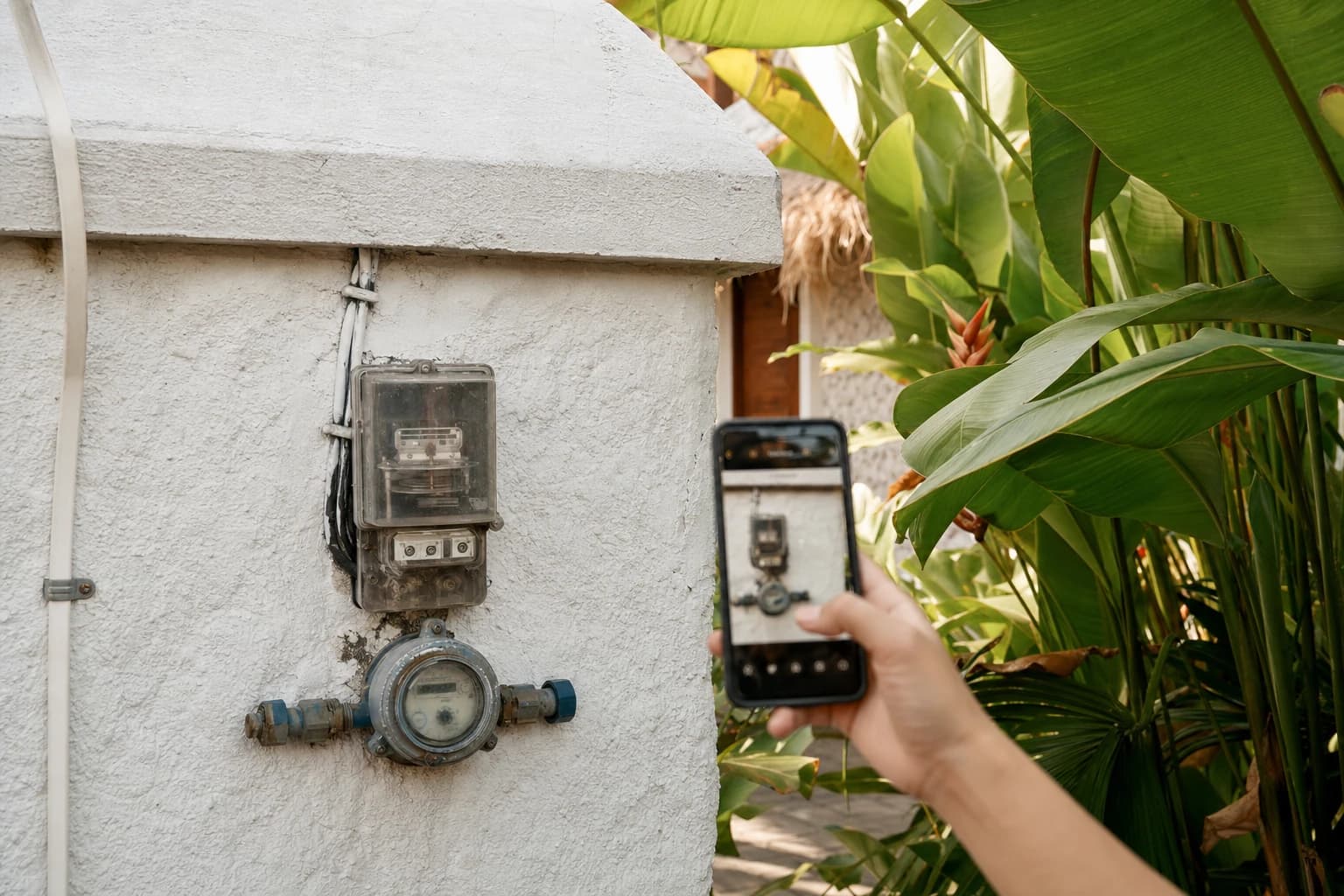
| Meters not read at handover | Inflated electricity or water bills | Photograph the meters on the day you get the keys |
| No inventory or condition report | Unjustified deductions from the deposit | Dated photos and video before you move in |
Two patterns stay harder to spot in advance: the double booking (the same property let to several people for the same dates) and the landlord with no authority — a relative, a subtenant or an "agent" with no mandate, taking your money for a property they cannot rent to you. And one clarification, to head off a frequent confusion: everything touching on buying property (forged land certificates, double sales, nominee structures, off-plan projects with no permit) is a separate subject with separate defences. This article is about renting, and only renting.
The BVRMA verification code: the most concrete tool since December 2025
This is the most useful development in the whole file, and it has barely filtered through to the guides circulating in expat groups. Since 17 December 2025 the BVRMA has run a free, public code verification page. The procedure, as set out by the page itself and by Bali.live on 21 January 2026:
1. You spot a villa (website, Instagram, WhatsApp, agent).
2. You ask the manager for their BVRMA verification code.
3. You enter that code at bvrma.org/verification-page.
4. If the code is valid, the company's contact details appear. You cross-check them against whoever is writing to you: company name, email address, phone number.
5. You pay only once that match holds up.
The warning printed on the page leaves no room for doubt: "If no details appear, please be cautious — you may be at risk. The company might not be verified as our member." In plain terms: if nothing comes up, nothing guarantees the company is a member, and you are proceeding at your own risk.
Then comes the limitation, and it matters as much as the tool. The BVRMA publishes a list of 62 verified members for 2026 — these are management companies, not individual villas. Bali.live puts it at roughly 70 companies covering around 3,000 villas. Set against the island's rental stock, that is a sliver. Not being a BVRMA member is therefore not evidence of a scam: the code is a positive signal when it is there, not a negative one when it is absent. Most private owners in Bali have no reason to hold one.
See also: Negotiating your rent in Bali: the levers that actually work
The page has two blind spots as well. There is no browsable directory — it answers a code you type in and nothing else — and no published list of known fake accounts. It validates; it does not warn.
Can you check the bank account before you transfer?
Yes, up to a point, and it is a reflex far too few expats have. cekrekening.id is presented by Kompas on 11 April 2026 as a service of the Kementerian Komunikasi dan Digital (Komdigi, formerly Kominfo), listing bank accounts reported in fraud cases. The procedure, described step by step in that same article: open www.cekrekening.id, choose "Periksa Rekening", select the type (bank or e-wallet) and then the institution, enter the account number or phone number, clear the reCAPTCHA and click "Cek Sekarang". The system returns the history of reports attached to that account. A victim can also register a fraudulent account through the "Daftarkan Rekening" section, with screenshots as supporting evidence.
One caveat, though: an account the database has never heard of is not a guarantee. It holds only what has already been reported, and a scammer opening a fresh account stays invisible in it. A second limitation, this one methodological: we could not test the service, which blocks automated requests, and the corresponding entry on the ministry's services portal returned nothing to us. What you read here is how the national business press describes it, not the result of a test of our own.
How do you check the property and the person renting it to you?
The land certificate through Sentuh Tanahku
Sentuh Tanahku, the app published by Indonesia's ATR/BPN ministry (the national land agency), lets you query a land certificate. The procedure was published by Kompas on 1 April 2026:
- Paper (analogue) certificate: open the app, create an account with an email address, go to "Cari Bidang" → "Sertifikat Analog", enter the type of right, the locality, the village (desa) and the certificate number, then "Cari Bidang Tanah".
- Electronic certificate: the same route, using a 14-digit NIBEL number.
The limitation is a serious one and rarely mentioned: for electronic certificates, Kompas notes "tidak akan ada data luas maupun nama pemilik" — neither the surface area nor the owner's name is displayed. The tool confirms that a plot exists; it does not confirm the identity of the person renting it to you. The mapping portal bhumi.atrbpn.go.id/peta helps you place the plot, but does not lift that limitation.
The on-the-ground checks, the ones that actually work
Bali Trusted, the commercial platform already mentioned, published a checklist on 24 January 2026 that relies on no online tool whatsoever:
- Visit the property in person before any payment.
- Match the name on the land certificate against the name of the person signing the contract — the single most discriminating check against a landlord with no authority.
- Ask for proof of ownership, confirm the property is genuinely vacant, talk to the neighbours.
- Document the state of the property with dated photos and video before you move in.
- Photograph the meters and get the electricity and water billing arrangements written down in black and white.
- Put everything in writing.
The Asosiasi Properti Bali, quoted by Rangka Narasi on 18 December 2025, adds checking the building permit, reading online reviews, insisting on an official rental contract and, above all, a video call before payment. If the property exists and your contact has access to it, three minutes on video costs nobody anything. If it is refused, you have your answer.
One last reflex, thoroughly down to earth: compare the rent you are quoted against what the neighbourhood actually charges. A rent far below the local market is not a bargain, it is a signal. In Canggu especially, where the gaps between micro-neighbourhoods are enormous, the reference price is set street by street.
The forged transfer receipt: a case before the Denpasar court
One real case, documented by two independent sources, shows the mirror image of the trap: the falsified proof of payment. Here the victim is the owner, not the tenant — but the mechanics of a fake document work in both directions.
| Element | Detail |
|---|---|
| Accused | Denis Vallee, 44, Canadian national |
| Victim | Nurhariani, owner of the Beelia Luxe Villa |
| Subject | One-year lease, 1 May 2025 → 1 May 2026 |
| Lease amount | Rp 5.035 billion, in two instalments of Rp 2.517 billion |
| Alleged method | Two forged transfer receipts from Canadian banks, CAD 209,420 stated each time. The money never landed in the account |
| Timeline | Viewing 20 April 2025 · signing 22 April 2025 · fake transfers 30 April and 6 May 2025 · occupancy without payment 1 to 14 May 2025 · police custody 15 May to 3 June 2025 · first hearing 31 July 2025 |
| Charge brought | Article 378 of the KUHP (fraud) |
Sources: ANTARA Bali and Detik, 31 July 2025. The two differ slightly on the spelling of the names, and Detik dates one transfer to 2024 where the rest of the timeline requires 2025. We found nothing on the outcome of the trial: nothing supports writing that the man was convicted, and the presumption of innocence stands. The operational lesson holds for everyone, tenant and landlord alike: a screenshot of a transfer is not a payment. Only money actually credited to the account counts.
What happens if you have already paid?
Let us be blunt: the odds of getting the money back are poor. Of the 101 victims the BVRMA recorded in 2025, none saw their money again. And travel insurance does not plug the hole — Bali.live puts it flatly on 21 January 2026: it "doesn't protect against scammers and won't refund your money if you transferred it to fraudsters". A transfer you made willingly to a scammer is not a covered loss.
That is no reason to skip reporting, if only to feed the databases that will protect the next person.
| Channel | What it is | Stated timeframes |
|---|---|---|
| lapor.go.id (SP4N-LAPOR!) | Indonesia's national government reporting portal, with more than 700 institutions connected | Verification and forwarding within 3 days, an answer from the institution within 5 days, a 10-day response window for the complainant |
| cekrekening.id, "Daftarkan Rekening" section | Reporting a fraudulent bank account to the Komdigi ministry | Not stated |
| patrolisiber.id, local police station (laporan polisi), OJK | Cybercrime unit of Bareskrim Polri, a conventional complaint, the banking angle | Not stated |
Let us stay precise about that table. The SP4N-LAPOR page does not say whether a foreigner can file a report; registration is required, and nothing lets us claim the system is open to non-Indonesians. As for patrolisiber.id, which also blocks automated requests, its existence is attested by the Indonesian press — we have not tested it ourselves.
What the law says since 2 January 2026
One point to keep in mind against every piece of advice you will read elsewhere: Indonesia's new criminal code (Law No. 1 of 2023) came into force on 2 January 2026, at the end of a three-year transition. Fraud is therefore no longer prosecuted under article 378 of the old KUHP, but under article 492 of the new text.
| Criterion | Old article 378 KUHP | New article 492 (Law 1/2023) |
|---|---|---|
| In force | until 1 January 2026 | since 2 January 2026 |
| Prison term | 4 years maximum | 4 years maximum |
| Fine | no alternative fine | alternative fine ("double track" system) |
On the fine, however, we give no figure, and that is deliberate. Indonesian legal commentaries disagree on which bracket applies: the Ahdan Ramdani firm goes for "category V", Logika Hukum for "category IV" — and neither converts the bracket into rupiah. The official text, published on the JDIH BPK RI portal, returned a 403 error, so we could not check the scale at source. The rupiah amounts circulating on this point in explainer articles trace back to no legal text, and we are not repeating them. The four-year term, by contrast, is undisputed.
What travel advisories do not tell you
The UK government's advice for Indonesia (GOV.UK, Indonesia — safety and security) carries a "Scams" section. It covers bank card fraud, unlicensed money changers — "only use licensed currency exchanges, identified by a Bank of Indonesia logo and a QR code" — and the rise in scams at tattoo parlours, nail bars and spas in Bali. It says nothing whatsoever about rental scams. On this particular risk, the official advice warns you of nothing: the checking is entirely on you.
What a classifieds platform changes, and what it does not
Every step in the BVRMA playbook has a common-sense counter-measure, and several amount to simply not stepping outside the written record.
- Keep the conversation in the platform's messaging. The scammer needs to pull you onto a private WhatsApp thread to get a transfer into a personal account, clear of any history.
- Never wire before you have seen it: a physical viewing, or failing that a live video call inside the property.
- Cross-check the identity. Name on the land certificate = name of the person signing the contract = holder of the receiving account.
- Insist on paper: contract, inventory, meter readings, dated condition photos.
On Lokalfinds, property listings are moderated and exchanges run through internal messaging: what was promised stays in writing, and nobody has a legitimate reason to move you onto a private thread — the exact slide that, in the playbook described above, comes just before the blind transfer.
The limits deserve the same clarity: no classifieds platform verifies land titles, checks a certificate at the BPN, or replaces a viewing. Moderation filters out listings that are obviously fraudulent; it does not certify who owns a property. The trio of viewing, matching names and written record stays with you, like the rest of your Bali moving checklist.
Frequently asked questions
How many rental scam victims have been recorded in Bali?
The Bali Villa Rental and Management Association counted 101 victims of villa rental fraud across the whole of 2025, a figure reported by Kompas Denpasar on 18 December 2025 and picked up by two other local outlets. None of those victims recovered their money. There is no public government or police statistic on this phenomenon in Bali.
How do you check that a villa rental company in Bali is legitimate?
Ask for its BVRMA verification code and enter it at bvrma.org/verification-page: if the code is valid, the company's contact details appear and you cross-check them against the person writing to you. Back that up with a live video call inside the property, a match between the name on the land certificate and the name of the person signing the contract, and a check of the receiving account on cekrekening.id.
Is a landlord without a BVRMA code necessarily a scammer?
No. The BVRMA lists 62 verified member companies for 2026, and Bali.live puts it at roughly 70 companies covering some 3,000 villas: set against the island's rental stock, that is a sliver. Most private owners have no reason to hold a code. The code is a positive signal when it is there, not a negative one when it is absent.
Can you check a landlord's bank account before you transfer money?
Yes, through cekrekening.id, a service of Indonesia's Komdigi ministry. You choose "Periksa Rekening", the account type and the institution, then enter the account number or phone number. The system returns the history of reports filed against it. One caveat: an account the database has never heard of is not a guarantee, because it holds only what victims have already reported.
Does Sentuh Tanahku show the owner's name?
Not for electronic certificates. Kompas noted on 1 April 2026 that neither the surface area nor the owner's name appears in that case. The land agency ATR/BPN's app confirms that a plot exists, not the identity of the landlord. The decisive check remains comparing the name on the paper certificate with the name of the person signing the contract.
What should I do if I have already sent money to a fake landlord?
Report the bank account on cekrekening.id, file a report on lapor.go.id — verification promised within 3 days, an answer from the institution within 5 — and file a complaint at the police station. Keep your screenshots, the contract and the transfer receipt. Of the 101 victims the BVRMA recorded in 2025, none was reimbursed: assume your report mainly protects the people who come after you.
Does travel insurance cover a rental scam?
No. Bali.live spells it out on 21 January 2026: travel insurance does not protect against scammers and will not refund an amount you willingly transferred to them. A consented transfer is not a covered loss. That is a direct argument for a traceable payment made after verification, rather than a blind transfer into a personal account.
Sources
- SP4N-LAPOR! — official — Indonesia's national reporting channel: verification within 3 days, an answer from the institution within 5, a 10-day response window for the complainant, more than 700 institutions connected.
- ATR/BPN — Bhumi mapping portal — official — the official cadastral mapping service.
- JDIH BPK RI — Law No. 1 of 2023 — official — the official text of the new criminal code, cited as the reference: the page returned a 403 error to us and could not be consulted.
- GOV.UK — Indonesia, safety and security — official — the "Scams" section, with no mention at all of rental scams.
- Kompas Denpasar (18 December 2025) — press — primary source for the 101 victims of 2025, the absence of any recovery, the launch of the BVRMA page and the aliases used by the scammers.
- Bali Post (14 January 2026) — press — the value of one booking, "puluhan hingga ratusan juta rupiah", more than 100 similar cases recorded, the modus operandi described by the BVRMA.
- BVRMA — verification page — trade association — validation by code and the official warning displayed when a code is invalid.
- BVRMA — 2026 member list — trade association — 62 verified member companies.
- Bali.live (updated 21 January 2026) — press — the five-step procedure, roughly 70 companies covering some 3,000 villas, and the absence of travel insurance cover.
- Dewata News (19 December 2025) — press — I Kadek Adnyana quoted on stolen photos and rotating aliases.
- Sightseeing Bali (14 January 2026) — press — cases rising as high season approaches.
- Kompas — cek rekening penipuan (11 April 2026) — press — the step-by-step cekrekening.id procedure, its attachment to the Komdigi ministry, and how to report an account.
- Kompas — cek sertifikat tanah (1 April 2026) — press — the Sentuh Tanahku procedure; neither surface area nor owner's name on electronic certificates.
- Bali Trusted (24 January 2026) — commercial — a commercial rental platform; on-the-ground checklist: certificate against signatory, neighbours, condition report, meters. No figures published.
- Rangka Narasi (18 December 2025) — press — recommendations from the Asosiasi Properti Bali, including the video call before payment.
- Villa Inspection (1 January 2025) — commercial — a villa inspection company; a seven-pattern typology: fake listing, bait-and-switch, deposit theft, double booking, inflated bills, unauthorised subletting, "urgent sale". No figures published.
- ANTARA Bali (31 July 2025) — press — the Denis Vallee case: lease dates, Rp 5.035 billion, forged receipts for CAD 209,420.
- Detik (31 July 2025) — press — corroboration of the case, charged under article 378 of the KUHP.
- Logika Hukum (7 January 2026) — commercial — article 492, four years, the three-year transition; goes for category IV on the fine.
- Ahdan Ramdani — 378 vs 492 — commercial — comparison of the two articles and the "double track" system; goes for category V, without putting a number on it.
Written on 22 July 2026 from sources consulted on that date. The figures quoted come from a private trade association (the BVRMA) relayed by the Indonesian press, not from government statistics, which do not exist on this subject. This content is informational and does not constitute legal advice: for any formal step, refer to the official Indonesian sources cited above or to qualified counsel.