In Bali you do not haggle a discount out of anyone: you buy it with commitment. The orders of magnitude reported by people working in the sector as of 8 September 2026: a yearly lease paid up front works out 10 to 17% cheaper per month than renting month by month; a two-year commitment settled at signing, 15 to 20%; searching in the low season (November to March), another 5 to 15%; a direct, courteous negotiation with the owner, 5 to 20% depending on the property and how empty their calendar is. These levers stack, partly — but none of them works if you are looking in July or August: the island had 47.8% more visitors in July 2026 than in March 2026 (697,809 arrivals against 472,070, BPS Bali figures), and an owner with a full diary does not negotiate. One last point, the most important one: a rent 40% below the going rate for the neighbourhood is not a win. In 2025, at least 101 people lost their money in Bali to rental listings priced abnormally low.
What each lever is worth
| Lever | Indicative discount | What it costs you |
|---|---|---|
| Yearly lease paid up front | −10 to −17% / month | The whole year settled at signing |
| Two-year commitment paid up front | −15 to −20% / month | Cash locked up, no way out |
| Searching in the low season (Nov-Mar) | −5 to −15% | Moving in during the rainy season |
| Booking 3 to 6 months ahead | −30 to −50% on the nightly rate | Deciding without having seen the place |
| Negotiating directly with the owner | −5 to −20% | Verifying ownership yourself |
| Unfurnished property | −20 to −30% | Furnishing the whole place at your expense |
Figures recorded on 8 September 2026 from Wonderful Bali Villas (page updated in August 2026), Bali Villa Realty, Knowmads Bali and Bali Apartments for Rent. Watch the baseline being compared: when an agency advertises "−45 to −55% for a yearly lease", it is comparing against the nightly rate. A two-bedroom in Kerobokan in March goes from 75 USD a night to 48-55 USD on a monthly deal and 32-39 USD on a yearly one. Measured against the monthly rate — the only comparison that means anything when you are actually moving in — the gap drops back to 10-17%.

What to check before you even open the negotiation
Negotiating with someone who does not own the place is the surest way to pay a full year to a stranger. Three checks come before any conversation about price.
Who actually owns the property. Ask for the land certificate, the Indonesian ID card (KTP) of whoever is signing, and the latest property tax notice (SPPT PBB): all three names have to match. The Ministry of Agrarian Affairs and the Land Agency (ATR/BPN) publish a free app, Sentuh Tanahku, whose plot-checking function confirms that a parcel is registered and shows its status on a map — access to certificate details requires your identity number (NIK) to be activated beforehand at the local land office.
If a company is involved, that it exists. The sector's professional association, the BVRMA, put a company-code verification page online in December 2025: you ask the agency for its code before paying, you enter it, the registered details come up, and the association advises caution if nothing appears. One caveat: the association's site (bvrma.org) returned a server error during our check on 8 September 2026 — if the tool is down, insist on the classic checks rather than going without.
What the rent actually covers. There is no standard in Bali, and the trade sources openly contradict each other. One agency lists weekly cleaning, pool maintenance, a gardener, WiFi, mains water and property tax as included in the monthly rent of a furnished villa; a rival guide lists several of those same items — electricity, internet, pool and garden maintenance, cleaning — as "often excluded". That grey zone is your negotiating room: a maintained pool and garden are worth 1 to 2 million IDR a month, roughly the size of the discount you will prise out of the rent itself.
Your immigration status sets the outer limit of the game: on a tourist visa, owners generally will not grant a yearly lease, and monthly rental is the most expensive option there is. The "duration" lever only really opens up once you hold a KITAS.
Lever 1: how long you commit for
This is the only lever that genuinely moves the price, because it answers the owner's real need: cash now and a blocked calendar. A place advertised at 50 million IDR a month goes for around 500 million IDR a year, which works out at 42 million IDR of effective monthly rent — 16% less. The steps sit at one month, six months and twelve months, with no fixed rule: this is a market of private treaty.
Pushing to two years paid up front takes the monthly discount towards 15-20%. The price of that is brutal: the up-front outlay quoted for a family villa runs from 10,000 to 25,000 USD before you move in, and there is almost never an exit clause. Once signed, the year is owed. Quarterly payment can sometimes be negotiated through an agency, but it stays rare.
Two safeguards to get in exchange for that locked-up money:
- The right to sublet with the owner's written consent, the only documented way to recover part of a prepaid rent if you leave early. Without it, an unplanned move home costs you every remaining month.
- The renewal price, fixed at signing. The increases seen run to around 10 to 15% for apartments and stay at the owner's discretion for houses. A written cap is often worth more than 5% off today.
If your horizon is uncertain, compare honestly: twelve months at 42 million IDR in one payment against six months at an in-between rate, somewhere between monthly and yearly, with your cash still available. The second scenario costs more per month, but it does not park 500 million IDR — about 24,400 EUR at the Bank Indonesia rate of 8 September 2026 — with someone you have known for three weeks.
Lever 2: the season you look in
The Bali rental market follows the tourist calendar, and the official figures make it readable. According to BPS Bali, the island received 697,809 foreign visitors in July 2026, 15.34% more than in June, with star-rated hotel occupancy at 67.29%. In March 2026, the same indicator fell to 472,070 arrivals, down 4.11% on February. The head of BPS Bali describes July as the start of the high season, driven by school holidays in the source countries, and says he is optimistic through to December.
Translated for a tenant: between November and March, outside holiday periods, owners whose calendars are emptying will come down 5 to 15% on monthly rates — more beyond a four-month stay — when occupancy drops towards 50-65%. In July, August and December, they essentially never negotiate. April to June and September to October leave a modest but real margin.
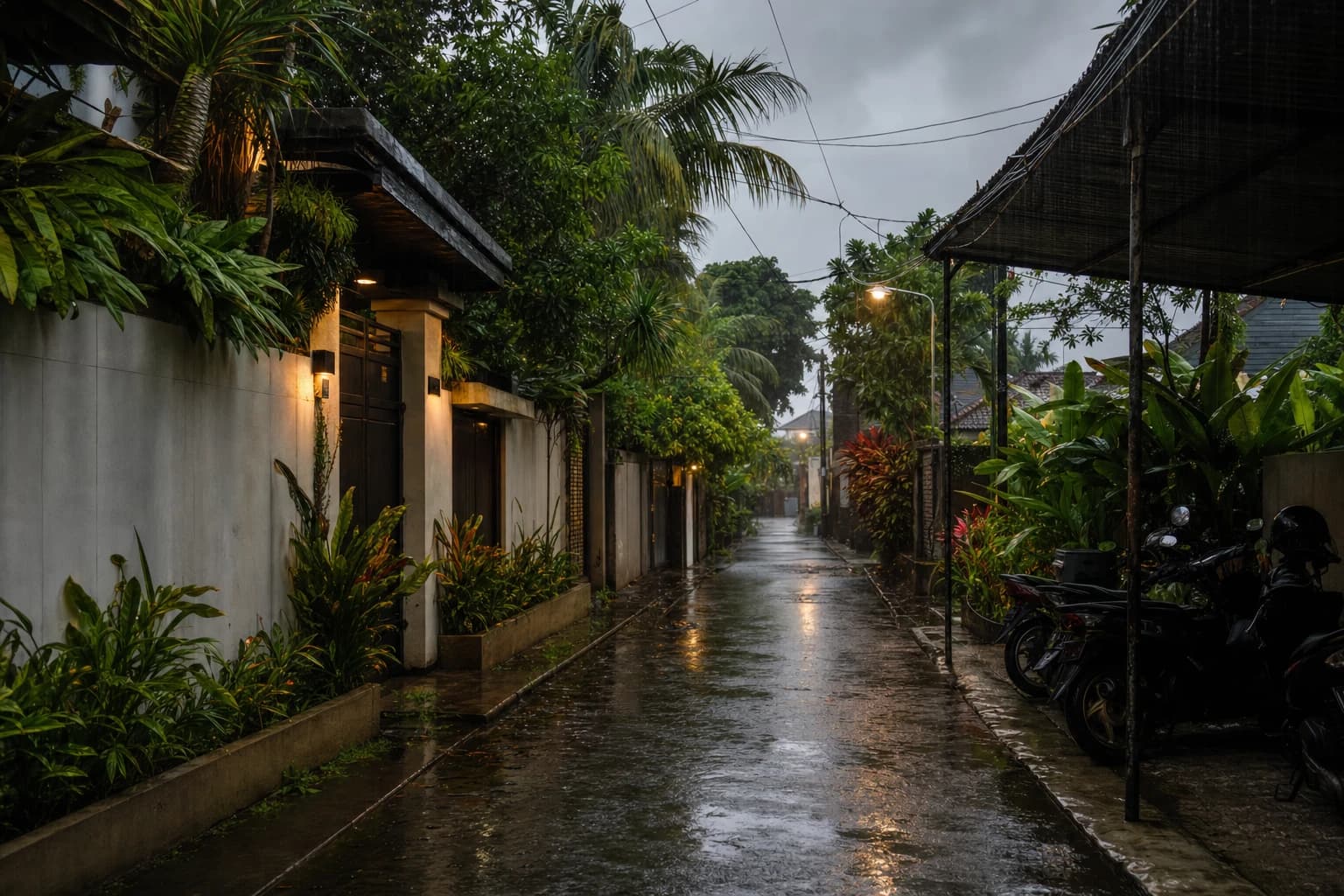
The upshot is counter-intuitive: house-hunting in the middle of the rainy season is financially rational. You view in the downpour, with an advantage that rarely gets mentioned — leaks, tired roofs and gardens that do not drain show themselves at exactly that moment, and never in August.
Lever 3: the channel you come through
Three channels coexist, with different savings and different risks.
The agency. Its commission — daily, monthly or yearly — runs from 10 to 15% of rental income: it is calculated on what the owner receives, so you do not pay it on top, but it is baked into the advertised price. In return you get someone identifiable to talk to, a drafted contract and some recourse if the place is not what was described.
The owner direct. This is where the 5 to 20% margin sits, won through courteous negotiation — one agency puts it at 10 to 20% on its own — but every check falls to you: identity, title, condition, contract.
Facebook groups and private ads. The fastest channel, and the one where fraud concentrates. Verify who is behind the listing before you transfer anything, and never send a deposit before you have seen both the property and its owner — the warning signs of a rental scam are stereotyped enough to be recognised.
A point of method: never ask an agency to "cut its commission". It will refuse, and you will lose credibility. Ask instead what the owner is willing to include — including something costs them less than an advertised drop in rent.
Lever 4: the condition of the property and what you take on
An empty or tired property negotiates better than a perfect one, on two conditions: knowing what the law already puts on the owner, and pricing what you agree to take on yourself.
The Indonesian Civil Code is explicit. Article 1550 of the KUHPerdata requires the landlord, with no clause needed, to hand over the property, to maintain it so that it stays usable for its intended purpose, and to guarantee the tenant peaceful enjoyment throughout the lease. Article 1583 puts small routine repairs on the tenant — locks, glass, shutters, according to local custom — except where they follow from deterioration of the property itself or from force majeure, in which case they fall back to the owner.
Paying more so that an owner "agrees" to maintain the roof therefore means buying what the law already gives you. Keep the discussion on what is genuinely negotiable:
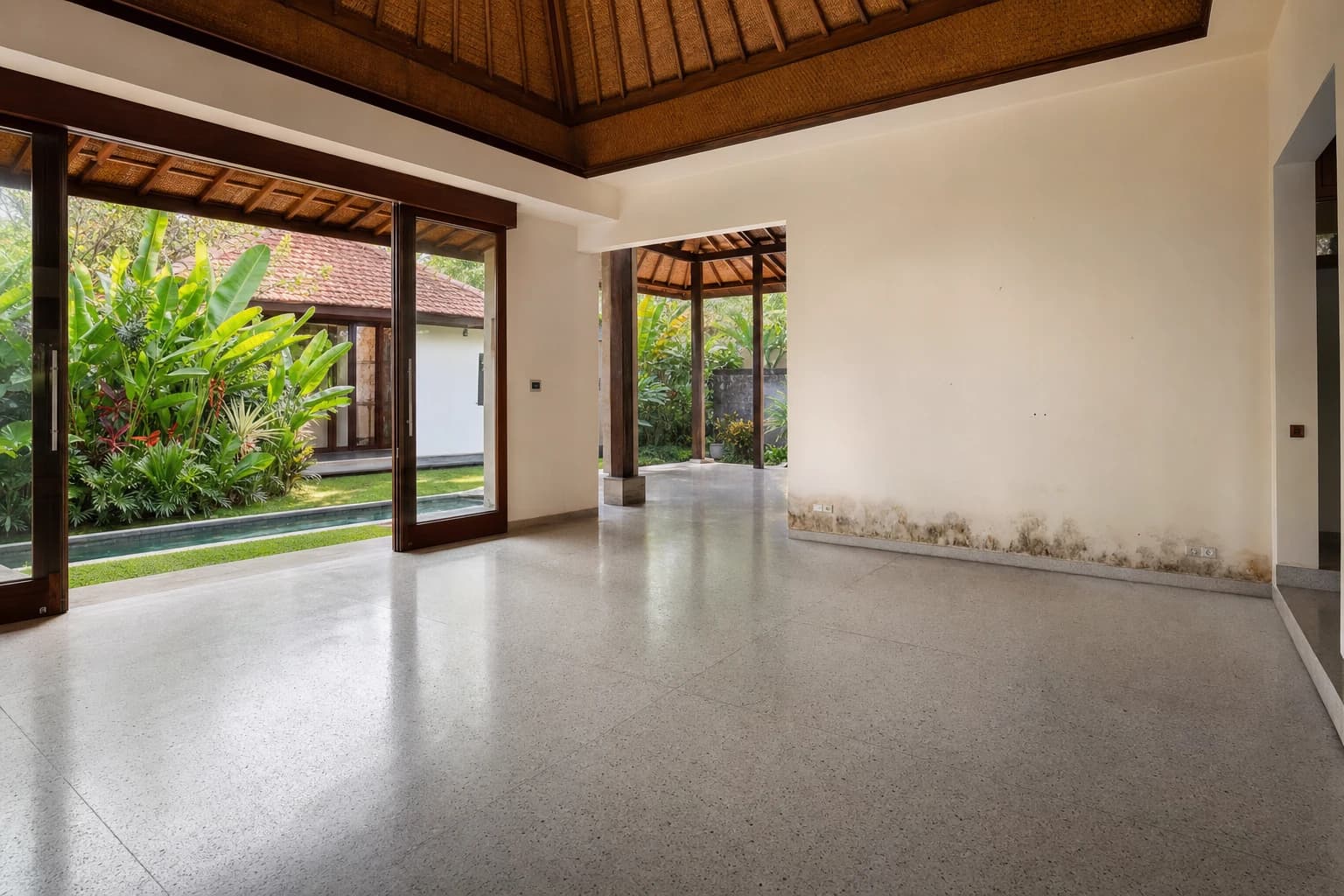
- Unfurnished, 20 to 30% cheaper. Only worth it beyond a year, since furnishing a two-bedroom villa is not a marginal expense.
- Work done before you move in, traded against a quick signature: paint, mosquito screens, pool pump, water heater.
- A retention against major repairs, worth one month's rent or 10% of the lease value, a practice long recommended on the Indonesian expat market.
- A photographed, dated inventory annexed to the contract. A classic dispute between foreign tenants and owners is the return of the deposit — 0.5 to 2 months' rent according to the agencies, up to 1 to 3 months according to one consultancy. Without photos annexed, the discussion runs on memory, and you lose it.
Lever 5: the currency and the payment method
Plenty of listings aimed at foreigners quote rents in dollars or euros. That is a commercial habit, not a payment rule: Bank Indonesia regulation PBI No. 17/3/PBI/2015, in force since 31 March 2015 for cash and 1 July 2015 for non-cash transactions, requires the rupiah on Indonesian soil, outside an exhaustive list of exceptions. Hence the principle that holds on the expat market: price advertised in foreign currency, payment in rupiah at the rate fixed at signing.
That detail is worth money: a yearly lease of 300 million IDR came to about 14,600 EUR at the Bank Indonesia reference rate of 8 September 2026 (EUR/IDR around 20,520). Writing the exact rupiah amount into the contract, rather than a euro sum to be converted "on the day of payment", saves you carrying the exchange risk for a whole year.
Three more things to lock down:
1. A transfer in IDR to an account in the owner's name. If you pay cash, insist on a signed and stamped receipt bearing their name, the amount and the address of the property.
2. The stamp duty. Since 1 January 2021, Indonesian stamp duty (bea meterai) has been set at 10,000 IDR per document, on the basis of Law No. 10 of 2020, and it applies to contracts. Its absence does not void the agreement, but it says a lot about how serious the landlord is.
3. The tax clause. Income from renting out land or a building carries a final tax of 10% of the gross amount (PP No. 34 of 2017) — 20% for a non-resident landlord without an Indonesian tax number, according to local tax firms. Gross includes everything paid to the owner, maintenance and services included. It is the landlord's tax, but Bali contracts not infrequently stipulate that it is "borne by the tenant": read that line again, it is worth 10% of the rent.
What to negotiate against: the 2026 benchmark prices
No Indonesian authority publishes a rent index. The ranges below come from agencies and listing platforms: they are advertised prices, not recorded transaction prices. Use them to place an offer, not to validate it.
| Area | Furnished 2-bed villa with pool (IDR/month) | Advertised yearly benchmark |
|---|---|---|
| Canggu | 25 to 60 M | from 170 M IDR/year |
| Berawa | — | from 180 M IDR/year |
| Batu Bolong / Echo Beach | — | from 200 M IDR/year |
| Seminyak / Petitenget | 25 to 65 M | — |
| Umalas / Kerobokan | 25 to 55 M | — |
| Pererenan | 30 to 60 M | — |
| Ubud | 20 to 55 M | — |
| Sanur | 25 to 55 M | — |
| Denpasar | 12 to 25 M | — |
Monthly rents: Wonderful Bali Villas, page updated in August 2026, except Denpasar (Visa Indonesia, 2026). Yearly benchmarks: Bali Home Immo, recorded on 8 September 2026 across 287 Canggu listings. Another guide gives tighter ranges — 20 to 35 million IDR a month in Canggu and Seminyak, 17 to 30 million in Pererenan and Umalas: the gap between sources is the gap between a standard property and a premium one on the same street. See also our survey of the real yearly rental prices and the 2026 cost of living guide.
What is not up for negotiation
| Item | Why it is closed | 2026 value |
|---|---|---|
| Price per kWh | State-regulated tariff, identical for everyone | 1,444.70 IDR/kWh at 1,300 and 2,200 VA, unchanged in Q3 2026 |
| Tax on rental income | National tax regime (PP 34/2017) | 10% of gross, 20% for a non-resident landlord without an NPWP |
| Stamp duty | Law No. 10 of 2020 | 10,000 IDR per contract |
| The landlord's maintenance obligations | Article 1550 of the Indonesian Civil Code | Apply with no clause needed |
| A yearly lease on a tourist visa | Refused by owners | Monthly rental only |
Electricity comes up constantly in these discussions: its rate is set by the state and did not move in the third quarter of 2026. What is negotiable is therefore not the price of the kWh but who pays the bill, and up to what ceiling — some monthly leases include it up to around 1 million IDR, beyond which the tenant takes over. With hard-working air conditioning, consumption reaches 2 to 4 million IDR a month, enough to wipe out a 10% discount: the detail is in our article on PLN rates and what a villa really pays.
When the discount becomes a warning sign
A price well below the going rate for the neighbourhood is not a bargain, it is grounds for extra checks. The pattern documented by the sector's professional association in December 2025 never varies: professional-looking photos and videos on social media, an abnormally low rent, pressure to pay a deposit, a trading name that changes regularly, and disappearance once the money lands. The 2025 tally: at least 101 victims, losses running into hundreds of millions of rupiah. In March 2026, the same association flagged unlicensed rental companies administering hundreds of units across the island.
The decision rule is simple: a two-bedroom villa offered at 90 million IDR a year in Canggu, when comparable listings start at 170 million, is not a successful negotiation. Look for the reason — an easement, building work next door, joint ownership, a lease about to run out — and if nobody can explain it, walk away.
The sentences that move the conversation forward
Negotiation in Bali is indirect: a blunt demand for a discount offends, while a proposal that solves the owner's problem gets somewhere. Four formulations to adapt:
- "I can sign this week and pay the year up front. At what price does that work for you?" — you are selling cash and the end of a vacancy, not making a demand.
- "The rent is fine. Could the pool, the garden and the WiFi be included at the same price?" — including things costs the landlord less than an advertised cut, and is worth 1 to 2 million IDR a month.
- "I will take it as it is if the paint and the water heater are done before I move in." — a visible defect traded against a dated commitment.
- "Could we write the amount in rupiah and fix the renewal price now?" — you secure the exchange rate and next year without touching today's rent.
One sentence never to say: "that is too expensive for a foreigner." It turns a commercial discussion into a question of status, and closes the door.
Frequently asked questions
How much can you actually knock off a rent in Bali in 2026?
Orders of magnitude given by people in the trade as of 8 September 2026: 10 to 17% moving from a monthly lease to a yearly one paid up front, 15 to 20% for a two-year commitment, another 5 to 15% by looking in the low season, 5 to 20% through direct negotiation. These are market estimates, not measured averages: no public data records the discounts actually granted.
Do you really have to pay a whole year up front in Bali?
It is the norm: yearly contracts are almost always settled in one payment before you move in, sometimes two or three years for sought-after properties. A six-monthly or quarterly payment can occasionally be negotiated through an agency, but it stays rare and comes with a higher rent. Up-front outlay quoted for a family villa: 10,000 to 25,000 USD.
When is the best time of year to negotiate?
Between November and March, outside the holidays. Visitor numbers are at their lowest — 472,070 arrivals in March 2026 against 697,809 in July 2026 according to BPS Bali — and owners whose calendars are emptying cut monthly rates by 5 to 15%. In July, August and late December, negotiation practically never works.
Is it better to go through an agency or deal direct?
Both have a case. The agency takes 10 to 15% of rental income on the owner's side, already baked into the advertised price, and brings someone identifiable to deal with and a drafted contract. Going direct leaves 5 to 20% of margin according to the agencies asked, but identity, title, condition and contract are then yours to verify.
How do you check that the person in front of you is the owner?
Ask for the land certificate, the Indonesian ID card (KTP) of the person signing and the latest property tax notice: all three names must match. The official ATR/BPN app Sentuh Tanahku confirms that a parcel is registered and shows its status, with access to certificate data requiring your NIK to be activated. If you are dealing with a company, ask the BVRMA for its verification code before paying anything.
A rent well below the market — good deal or not?
It is first of all a warning sign: an abnormally low rent is part of the documented pattern of rental scams in Bali, which claimed at least 101 victims in 2025 for losses running into hundreds of millions of rupiah. Find out what explains the gap, and pay nothing before you have visited the property and verified the landlord's identity.
Who pays for electricity, pool maintenance and the tax on the rent?
Nothing is standardised, and that is exactly where the negotiation happens. Electricity is almost always the tenant's: 1 to 3 million IDR a month, 2 to 4 million with hard-working air conditioning, at the regulated rate of 1,444.70 IDR/kWh at 1,300 and 2,200 VA in the third quarter of 2026. Pool and garden are included by some landlords and billed by others. The 10% final tax is the owner's, but some contracts pass it to the tenant.
Sources
- [OFFICIAL] Bank Indonesia — PBI No. 17/3/PBI/2015, obligation to use the rupiah (31/03/2015)
- [OFFICIAL] Bank Indonesia — Kurs Transaksi BI, reference rate on 08/09/2026
- [OFFICIAL] Directorate General of Taxes — bea meterai, 10,000 IDR since 01/01/2021 (UU 10/2020)
- [OFFICIAL] JDIH BPK — PP No. 34 of 2017, tax on income from renting land and buildings
- [OFFICIAL] Indonesian government portal — Sentuh Tanahku app (ATR/BPN)
- [MEDIA] ANTARA News Bali — BPS Bali, 697,809 arrivals in July 2026 (01/09/2026)
- [MEDIA] ANTARA News Bali — BPS Bali, 1.46 million arrivals in Q1 2026 (05/05/2026)
- [MEDIA] Kompas Denpasar — 101 rental scam victims in 2025, the BVRMA launches its verification tool (18/12/2025)
- [MEDIA] CNBC Indonesia — PLN tariffs held, full list applicable in September 2026 (08/09/2026)
- [MEDIA] Bali Post — the BVRMA denounces unlicensed rental companies managing hundreds of units (23/03/2026)
- [EXPERT] BVRMA — villa rental company verification page (bvrma.org/verification-page): site unreachable, server error, during our check on 08/09/2026; the page's existence and operation are attested by the Kompas article above
- [EXPERT] DDTC News — 10% final PPh on rents, how the withholding works (06/05/2024)
- [EXPERT] Satvika Consulting — tax on villa rentals in Bali, the non-resident landlord case (16/09/2025)
- [EXPERT] Cekhukum — Pasal 1550 KUHPerdata, the landlord's obligations
- [EXPERT] Cekhukum — Pasal 1583 KUHPerdata, small repairs
- [EXPERT] Expat.or.id — residential leasing practice in Indonesia (updated 07/08/2023)
- [EXPERT] Cekindo — preparing a rental agreement in Bali (03/07/2025)
- [COMMERCIAL] Wonderful Bali Villas — real monthly costs and yearly discounts (updated August 2026)
- [COMMERCIAL] Wonderful Bali Villas — long-stay rental guide
- [COMMERCIAL] Bali Villa Realty — discounts by duration and season
- [COMMERCIAL] Knowmads Bali — monthly costs and negotiation in 2026
- [COMMERCIAL] Bali Home Immo — advertised yearly prices in Canggu (recorded 08/09/2026)
- [COMMERCIAL] Bali Apartments for Rent — expat guide, immigration status and running costs
- [COMMERCIAL] Fullers Properties — agency commissions in Bali (25/10/2024)
- [MEDIA] Visa Indonesia — rent ranges by area in 2026