No free public tool will show you the name of a landowner in Indonesia. BHUMI (bhumi.atrbpn.go.id), the official mapping portal, and Sentuh Tanahku, the app run by the ATR/BPN ministry, both show you the parcel: its outline, its type of right, sometimes its area. Never the identity of the person holding it.
Proving the name therefore takes two steps. First, a copy of the certificate — SHM, SHGB or SHP; a Girik or a Letter C is not a certificate — set against the landlord's KTP. Then the pengecekan sertipikat at the BPN land office, around Rp 50,000 per certificate (PNBP rate checked in July and August 2026, based on PP 128/2015), run by your own notary/PPAT. Allow 1 to 2 weeks for that check alone, and 2 to 4 weeks for full due diligence. And if the "owner" is a foreigner, they almost never own the ground: in that case demand the full chain, from the Indonesian landowner's certificate through to the notarised lease (akta sewa) carrying an explicit right to sublet.
Why this check is not paranoia
Paradyse Homes, a residential property company operating in Bali, documented in 2026 how land scams targeting foreigners actually work. Three patterns dominate. Forged or duplicated certificates, often carrying hidden encumbrances. Phantom listings — properties that do not exist, or cannot legally be sold — with deposits usually demanded somewhere between USD 3,000 and 15,000. And fake agents, with no verifiable PT or CV entity behind them, who collect fees before producing a single document. The same source picks up a 2024 ABC News headline: Australians were among the alleged victims of a fake-villa scam worth around USD 120,000. Those figures come from a commercial player; take them as reported orders of magnitude, not as statistics.
Renters get no free pass. The "fake landlord" pattern turns up in every specialist guide: a stranger presents himself as the owner of an attractive property priced below market, demands a deposit to "hold" it, then disappears — or sublets the same property to several victims in parallel. InvestLand Bali, in its 2026 checklist, cites a case from 2024: foreigners are said to have lost their money in East Bali on long leases signed without a notary, on land that turned out to be zoned green, and therefore unbuildable. One check at the BPN would have shown it.
The warning signs Paradyse Homes flags come down to three: a notary introduced by the agent or the seller, the absence of any written agreement, and pressure to skip due diligence. In Bali, a yearly lease is commonly paid up front (our guide to yearly rental prices by neighbourhood sets out the sums at stake): any one of those three signs should be enough to end the conversation.
What your landlord can legally hold — and show you
Before you open any tool, know what you are looking for. Indonesian land law — the 1960 UUPA agrarian law and PP 18/2021 — ranks rights over land, and not all of them are open to everyone.
| Document shown | What the right actually is | Who may hold it | What it means for you |
|---|---|---|---|
| SHM (Sertifikat Hak Milik) | Full freehold ownership | Indonesian citizens only (UUPA, art. 21) | The standard case: the name on the certificate must match the landlord's KTP |
| SHGB (Hak Guna Bangunan) | Right to build, up to 30 years, renewable | Indonesians and legal entities under Indonesian law, including a PT PMA — never a foreign individual (PP 18/2021) | If the holder is a company, ask for the company's documents, not those of a "representative" |
| SHP (Hak Pakai) | Right of use | Open in their own name to foreigners holding a valid immigration document | A foreigner can legitimately hold it: the certificate must then be in their name |
| Hak Sewa (lease / leasehold) | Contractual rental right, with no statutory maximum term | Open to foreigners | This is not a land certificate: the proof is the lease deed, ideally notarised (akta sewa) |
| Girik / Letter C | — | — | Not a certificate: never accept it as proof of ownership |
The line to remember is the first one. Because Hak Milik is reserved for Indonesian citizens, a foreign landlord who calls himself the "owner" of a villa is almost always a head lessee subletting his leasehold. That is not illegal — it is extremely common — but it changes entirely which documents you should be asking for. We come back to it at the end of this article.
BHUMI: checking the parcel from your sofa
First reflex, free and with no account required: BHUMI, the official mapping portal of Indonesia's Ministry of Agrarian Affairs and Spatial Planning (ATR/BPN). The page, titled "Peta Interaktif BHUMI ATR/BPN", was responding normally on 3 August 2026. How to use it, as described by Kompas.com in October 2025:
1. click the magnifying-glass icon, then "Pencarian Bidang (NIB/HAK/NIBEL)";
2. select the kabupaten/kota, then the desa/kelurahan the property sits in;
3. enter the parcel identification number (NIB) or the certificate's right number (for a NIB, the last 5 digits are enough);
4. the map draws the parcel and its outline.
No certificate number to hand? The Ministry of Finance (DJKN, September 2024) describes the coordinates trick: read the property's latitude and longitude off Google Maps, feed them into BHUMI, and the parcel locates itself. The same article officially lists three free tools for the job: Sentuh Tanahku, BHUMI and Google Maps as back-up.
Let us be precise about what you will actually see. The type of right and the outline are displayed. The area depends on the tool and the version: Kompas.com mentions it on the BHUMI side in 2025, while Kompas TV could not see it in Sentuh Tanahku's "Sertifikat Analog" search the same year. One thing never varies, though: the owner's name appears nowhere.
Sentuh Tanahku: the official app in your pocket
Sentuh Tanahku is the official ATR/BPN ministry app, free, on Android and iOS; the publisher can be verified on its Google Play listing (package id.go.bpn.sentuh). The route through it, described by Kompas TV (July 2025) and Kompas.com (October 2025):
1. install the app and create an account with an email address;
2. open the "Cari Bidang" menu;
3. paper certificate → "Sertifikat Analog": enter the type of right (jenis hak), the land office (kantor pertanahan), the desa/kelurahan and the certificate number;
4. electronic certificate → "Sertifikat Elektronik": enter the NIBEL (Nomor Identifikasi Bidang Elektronik);
5. the parcel appears on the map.
That NIBEL marks a transition still under way: Indonesia has been rolling out the electronic certificate since 2023, land office by land office. According to the Indonesian press, paper certificates remain valid, the sertipikat elektronik carries the same legal force, and ATR/BPN presents it as protection against forgery. Indonesian media also report, in 2026, a redesign of the app and a secure login through the IKD digital identity (KTP Digital): second-hand information, worth re-testing in the app by the time you read this.
One trap to know about. The Brighton guide (July 2026) describes an "Info Sertifikat" menu showing ownership history, type of right and period of validity — but specifies that those details cover certificates "linked to your NIK", the Indonesian identity number, after verification (photo of the e-KTP plus a selfie). In other words, it is where you consult your own titles, not somebody else's. Without a KTP, stick to "Cari Bidang". For a foreigner, BHUMI in a browser, with no account, remains the most accessible tool anyway.
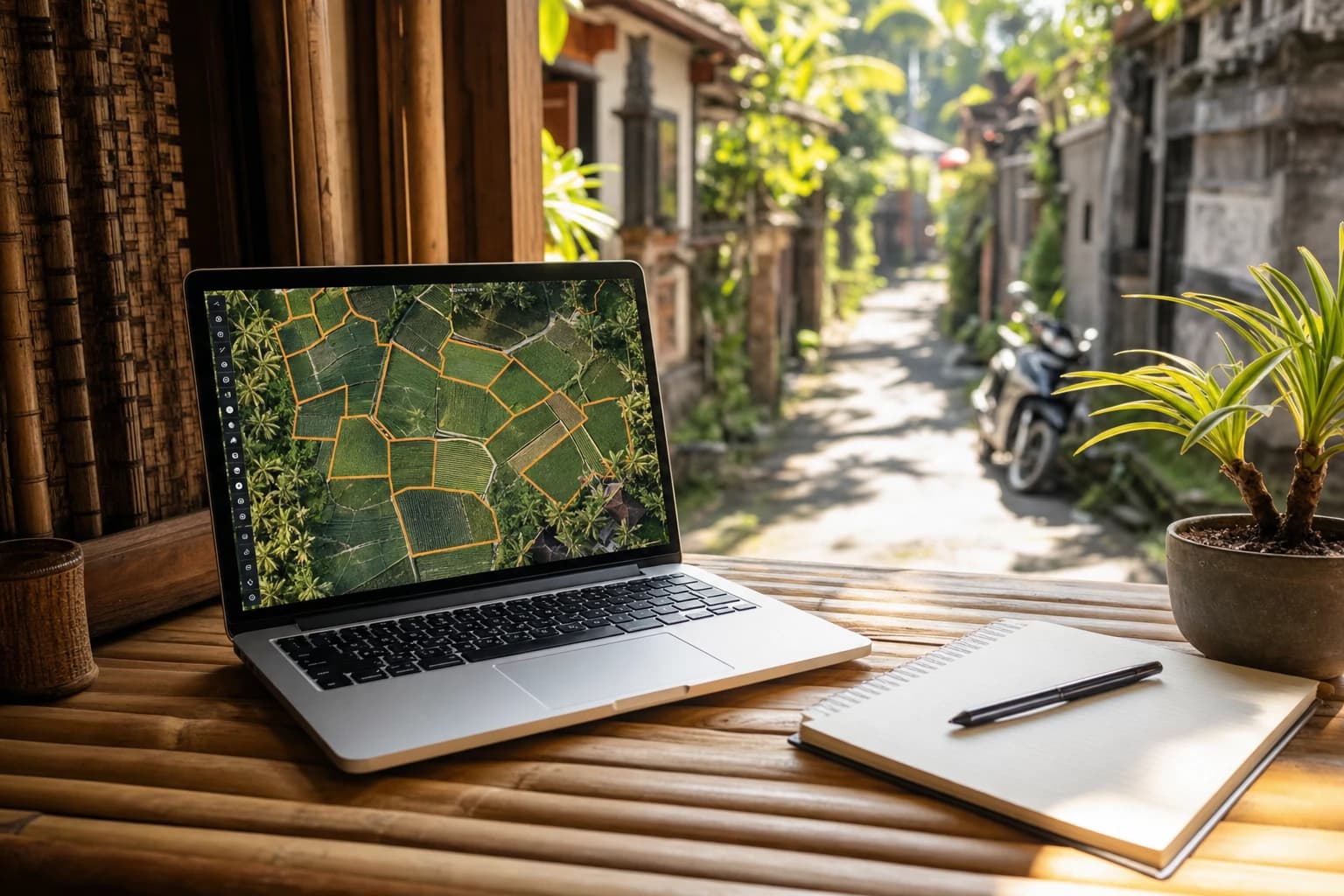
Let us recap. Rumah123 lists four verification channels in its guide, updated on 3 August 2026; here is what each one shows, and what none of them will ever show:
| Tool | Access | What you see | What you will never see |
|---|---|---|---|
| BHUMI (bhumi.atrbpn.go.id/peta) | Browser, no account | Parcel, outline, type of right, area in some cases | The owner's name |
| Sentuh Tanahku (Android/iOS) | Account created with an email address | Locates a parcel from a certificate number (paper) or a NIBEL (electronic) | The owner's name; the NIK-linked menus are out of reach without a KTP |
| Pengecekan Berkas (atrbpn.go.id → Publikasi → Layanan) | Web | Progress of a file lodged at the land office | The identity of a title holder |
| BPN office (counter or KiosK terminals) | In person, ~Rp 50,000/certificate, usually through your notary/PPAT | Whether the certificate is genuine and matches the register | Nothing: this is the only check that carries legal weight |
The structural limit: these tools check the parcel, never the person
This is the point that changes everything, and Kompas.com says it flatly: the search displays "the type of right, the area and the outline of the parcel", but "does not show the owner's name". The free tools answer three questions — does the parcel exist, is it certified, and under what type of right? — and leave the central one unanswered: is the person in front of you the title holder?
There is also a reliability caveat, and it comes from an official source. The DJKN article (September 2024) stated that the digitisation of certificates and BPN's mapping were "not 100% complete", with accuracy of the order of 50% and possible discrepancies between the apps and the original document: area, boundaries, attributes. The 2026 communications talk up finer verification thanks to the electronic certificate. Digitisation is progressing, then — but never mistake BHUMI for an exhaustive register: a missing parcel is not necessarily an uncertified one. Brighton recommends the "Lapor" function in the Sentuh Tanahku app (a sharp photo of the certificate plus the location coordinates) to report a parcel that fails to appear.
The pengecekan at the BPN office: about Rp 50,000 for the only proof that counts
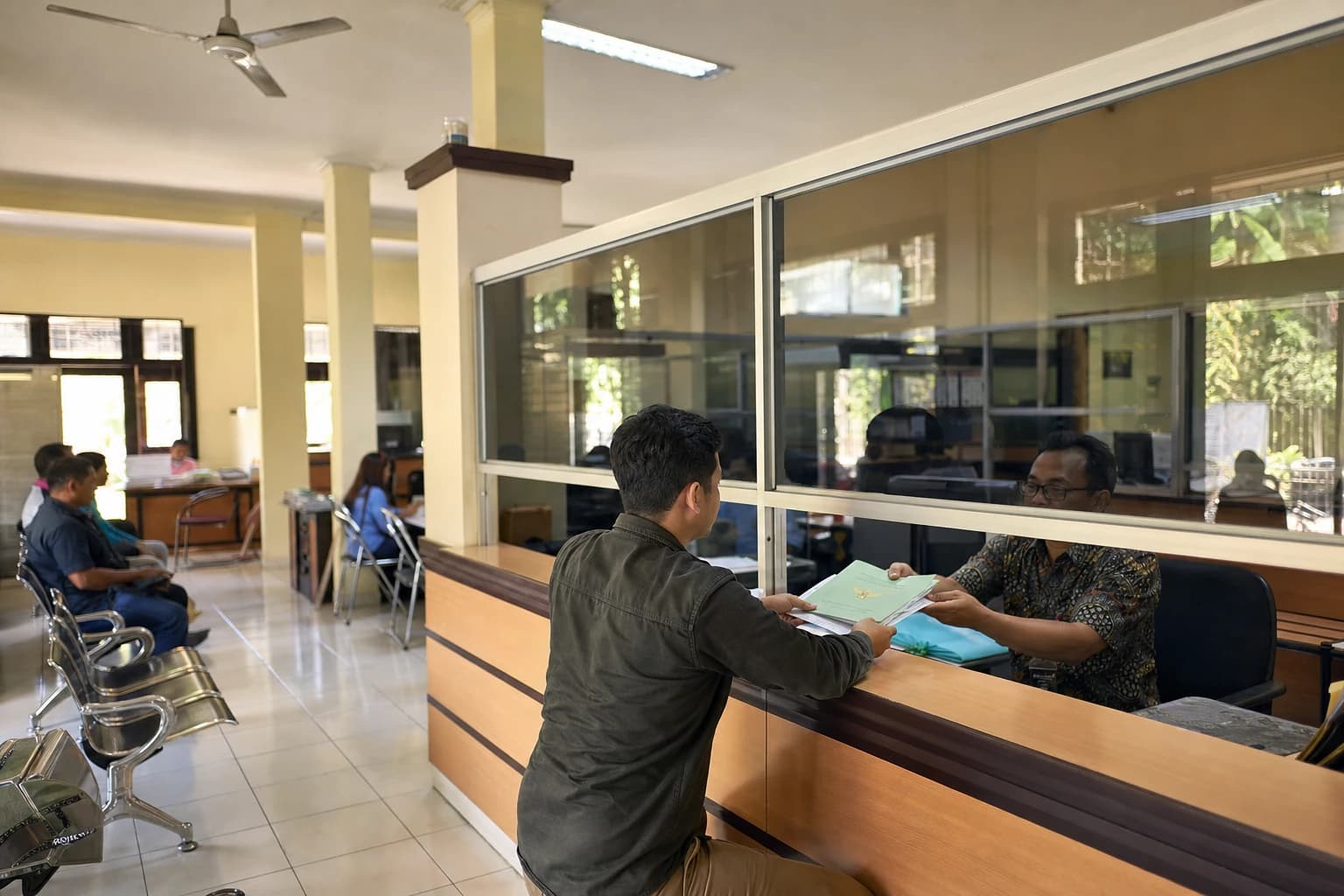
The check that carries legal weight is called pengecekan sertipikat and takes place at the land office (kantor BPN), with the original certificate, an identity document and a form. Two Indonesian guides updated in July and August 2026 give the same cost: around Rp 50,000 per certificate (Rumah123 writes "sekitar Rp50.000", Brighton "Rp 50.000 per sertifikat").
The tariff basis is Government Regulation no. 128 of 2015 on non-tax state revenue (PNBP) for the ATR/BPN ministry, showing the status "Berlaku" (in force) on 3 August 2026, supplemented by Permen ATR/BPN 25/2016. Honesty demands a caveat here: the pengecekan tariff itself sits in the annex to the regulation, whose online version is an illegible scan. Brighton explicitly ties its figure to PP 128/2015, but treat "~Rp 50,000" as a solid order of magnitude rather than a rupiah-perfect rate. The body of the text, on the other hand, does read — and the same flat fee appears in black and white: registering a transfer of rights, the "balik nama" (changing the name on the certificate), costs 1/1000 of the land value plus Rp 50,000 (art. 16). That "land value", Remax Indonesia (October 2025) equates in practice with the NJOP, the property's tax base.
One detail worth its weight in gold against scammers: these fees are state revenue. They are "paid straight into the public treasury", Brighton points out, through the banking system and its electronic billing code (kode billing). Nobody — no "agent", no "contact at the BPN" — has any business collecting them in cash, hand to hand.
You will probably not be queueing yourself: in a transaction, the pengecekan is carried out by the notary/PPAT, the public officer authorised to draw up land deeds. The due diligence checklist from Bali Property Rules (March 2026) makes it their golden rule: "never rely solely on documents provided by the seller — verify every certificate directly at the local BPN". The paperwork a seller hands you is a starting point, never the evidence itself.
Cross-checking the landlord's identity: an afternoon's checklist
The same checklist (March 2026) lists the checks that turn a hunch into a file:
- KTP = certificate. The name on the landlord's Indonesian identity card must match the certificate holder's name exactly.
- Spousal consent. Indonesian matrimonial law recognises marital community property: the title holder's spouse must consent to the deal.
- Five years of PBB receipts. Land tax paid in the title holder's name, five years running, is a strong marker of genuine ownership.
- No mortgage. A registered Hak Tanggungan encumbers the property; insist on the discharge ("roya") before you commit.
- The banjar knows. An informal check at the kelurahan or with the banjar brings unregistered disputes to the surface.
- The physical boundaries. Compare the markers on the ground with the Surat Ukur, the survey plan attached to the certificate.
Foreign landlord: demand the full chain of rights
Back to the case flagged earlier. Your landlord is a foreigner: he cannot hold Hak Milik, which makes him, in the overwhelming majority of cases, a head lessee subletting his leasehold. In that setup no single document proves anything; you need the full chain, the one detailed in the Bali Property Rules leasehold checklist (March 2026):
1. The Indonesian landowner's certificate (SHM), verified as described above, including the validity of their title.
2. Your landlord's notarised lease (akta sewa), signed with that owner. The Bali Lawyer firm (January 2024) contrasts the akta sewa — an authentic deed drawn up by a notary, and clearly recommended — with the "Perjanjian Dibawah Tangan", the privately signed agreement, which offers far less protection. Between the two sits waarmerking: a notary registering a document signed outside their office.
3. An explicit right to sublet in that lease. While you are in there, read the renewal clauses, and make sure no competing sublease covers the same property.
If a link is missing, your contract rests on nothing: that is exactly the scenario behind the unnotarised East Bali leases mentioned earlier.
The order of operations before you hand over anything
Allow 2 to 4 weeks for full due diligence, of which 1 to 2 weeks for the BPN check alone (Bali Property Rules, March 2026). And do not confuse the roles: the PPAT draws up the deed and runs the pengecekan, but stays neutral between the parties; only an independent lawyer is on your side. Hence the recommendation every expert source repeats: pick your own notary or your own lawyer, never the one the agent or the landlord introduces you to.
In order, then:
1. Ask for a copy of the certificate and the landlord's KTP before you even view the place, right from the first exchanges. On Lokalfinds, do it straight in the listing's chat: a serious landlord hands those documents over without fuss, and a repeated refusal is an answer in itself.
2. Locate the parcel on BHUMI or Sentuh Tanahku: existence, outline, type of right.
3. Set the KTP against the certificate, then work through the checklist: PBB, mortgage, banjar, Surat Ukur.
4. Foreign landlord: demand the chain — Indonesian certificate → akta sewa → right to sublet.
5. Have the pengecekan run (~Rp 50,000 per certificate) by your own notary/PPAT before you sign, and refuse to pay any "official fee" in cash.
These checks are only one stage of settling in: our full checklist for moving to Bali sets out the wider running order, and the 2026 guide to expat life in Bali the context. Two to four weeks of verification can feel long when a landlord is in a hurry. That is precisely why the fraudsters are in a hurry.
Frequently asked questions
Can you see the name of a land owner online in Indonesia?
No. BHUMI and Sentuh Tanahku, the two official ATR/BPN tools, display the type of right, the outline and in some cases the area of a certified parcel — never the name of the title holder. Kompas.com (October 2025) and Kompas TV (July 2025) agree on this. Identity is confirmed only by matching the certificate against the KTP, and by the official pengecekan at the BPN office, generally carried out by a notary/PPAT.
How much does a pengecekan sertipikat cost at the BPN office?
Around Rp 50,000 per certificate, according to two Indonesian guides updated in July and August 2026 (Rumah123, Brighton). The tariff basis is Government Regulation no. 128 of 2015 on non-tax state revenue (PNBP), still in force. Payment goes through a state banking billing code, never in cash from hand to hand. You need the original certificate, an identity document and a form; in practice the notary/PPAT handles it.
Does Sentuh Tanahku work without an Indonesian KTP?
Partly. Creating an account requires an email address (the route described by Kompas TV), and the "Cari Bidang" menu lets you search for a parcel by certificate number or NIBEL. The menus that demand Indonesian identity verification (NIK plus selfie, such as "Info Sertifikat") are out of reach without a KTP. For a foreigner, the BHUMI web portal remains the simplest tool: no account needed.
What if the parcel does not show up on BHUMI?
Do not jump to conclusions. The Ministry of Finance (DJKN) warned in 2024 of incomplete digitisation, accuracy of the order of 50% and possible discrepancies between the apps and the original document. A missing parcel is therefore not necessarily an uncertified one. Brighton (July 2026) recommends the "Lapor" function in the Sentuh Tanahku app to report a parcel that fails to appear. In every case, only the pengecekan at the BPN office is authoritative.
Are a Girik or a Letter C enough to prove ownership?
No. The Bali Property Rules due diligence checklist (March 2026) is unambiguous: only SHM, SHGB and SHP certificates prove a registered land right; a Girik or a Letter C is not a certificate. If your landlord produces nothing but that kind of document, have the file examined by a notary/PPAT or an independent lawyer before you pay anything, and have the parcel checked at the BPN office.
My landlord is a foreigner: which documents should I demand?
The full chain of rights. A foreigner cannot hold Hak Milik (UUPA, art. 21): he is almost always a head lessee on a leasehold. Ask for the Indonesian landowner's certificate, your landlord's notarised lease (akta sewa), and an explicit clause authorising him to sublet. Check the renewal clauses too, and that no competing subleases exist (Bali Property Rules checklist, March 2026).
How long should I allow to check a property before signing?
Allow 2 to 4 weeks for full due diligence, of which 1 to 2 weeks for the BPN check alone (Bali Property Rules, March 2026). The PPAT draws up the deed and runs the pengecekan, but stays neutral between the parties; an independent lawyer, by contrast, acts for you alone. So bring your own notary or your own lawyer, never the one the agent or the landlord suggests.
Sources
Official
- BHUMI — Peta Interaktif ATR/BPN — the official mapping portal, online and accessible (checked on 3 August 2026).
- DJKN / Kementerian Keuangan — three free tools for locating a certified parcel (3 September 2024) — Sentuh Tanahku, BHUMI, Google Maps; official warning on incomplete digitisation and ~50% accuracy.
- PP no. 128 Tahun 2015 — the PNBP tariff basis for the ATR/BPN ministry, status "Berlaku" confirmed on 3 August 2026; body of the text read (art. 16: transfer of rights = 1/1000 of the land value + Rp 50,000, enacted 28 December 2015); tariff annex scanned and unreadable online.
- Sentuh Tanahku Google Play listing — proof that the app is published by the Kementerian Agraria dan Tata Ruang/BPN (package
id.go.bpn.sentuh).
Indonesian national media (press)
- Kompas.com — checking a parcel online without going to the BPN office (9 October 2025) — how to use BHUMI and Sentuh Tanahku; the owner's name is not displayed.
- Kompas TV — checking a certificate via Sentuh Tanahku and BHUMI (16 July 2025) — the "Sertifikat Analog" route, account creation by email, limits of the result.
Guides and experts (commercial sources)
- Rumah123 — checking a land certificate online and offline (updated 3 August 2026) — four verification channels, "sekitar Rp50.000" at the BPN office.
- Brighton — checking a certificate through the ATR/BPN website and Sentuh Tanahku (20 July 2026) — "Rp 50.000 per sertifikat" tied to PP 128/2015, payment straight into the treasury, the "Info Sertifikat" menu (certificates linked to your own NIK), the app's "Lapor" function.
- Bali Property Rules — Bali property due diligence checklist (March 2026) — KTP-certificate match, 5 years of PBB, Hak Tanggungan/roya, banjar, Surat Ukur, 2-4 week timelines, PPAT and lawyer roles, leasehold section.
- Paradyse Homes — how Bali property scams actually work in 2026 (2026) — three scam patterns, warning signs, reported amounts (commercial source, figures presented as such).
- Bali Lawyer — how to lease a property in Indonesia (19 January 2024) — akta sewa vs privately signed agreement, waarmerking.
- Remax Indonesia — PNBP land fees (29 October 2025) — confirms PP 128/2015 as the basis for PNBP tariffs and applies the 1/1000 + Rp 50,000 formula to the NJOP (set out in art. 16 of the regulation for transfers of rights).
Items cited second-hand (source pages not directly consultable, taken from search extracts): the InvestLand Bali checklist (the 2024 case of unnotarised leases on green-zoned land), the 2026 Indonesian press articles on the Sentuh Tanahku redesign and IKD login, and the recurring "fake landlord" pattern as described in consumer guides.