Since 31 March 2026, any accommodation marketed on a booking platform (Airbnb, Booking, other OTAs) in Indonesia has had to hold its business licence: a NIB (Nomor Induk Berusaha) issued through the OSS portal, paired with a KBLI business-activity code from group 551, "short-term accommodation". The deadline was set by the Ministry of Tourism; the licensing framework is PP 28/2025, which replaced PP 5/2021, now repealed. A foreigner as a private individual can hold neither that NIB nor a tourist-accommodation licence in their own name. The "Pondok Wisata" licence (KBLI 55130, capped at 5 rooms according to the consultancies) is reserved for an Indonesian citizen who lives in the house they rent out. The only compliant route reported for an expat is a PT PMA (foreign-owned company) with an accommodation KBLI whose exact choice is still debated, a PBG building permit with a commercial function, an SLF certificate, a local tax number (NPWPD) and compatible zoning. On the tax side: up to 10% local accommodation tax that you collect yourself, plus income tax (10% of gross rent for building rental, a regime whose application to a licensed accommodation business should be confirmed with a tax adviser). The government found that 72.8% of the accommodations it inspected across five provinces, Bali included, had no NIB; as of 13 May 2026, more than 100,000 units had registered and around 470,000 were still unlicensed. Without a licence, the reported penalties run from delisting to the property being sealed, and for a foreigner as far as revocation of the KITAS.
What happened on 31 March 2026?
The statement published on 25 February 2026 on the official menpan.go.id portal sums up the operation: the Ministry of Tourism (Kemenpar) gave the platforms until 31 March 2026 to remove unlicensed accommodations, with the Ministry of Communication and Digital Affairs (Kemkomdigi) handling the sanctions on the platform side. The figure that triggered it: across five pilot provinces — Bali, Jakarta, Yogyakarta, West Java and West Nusa Tenggara (NTB) — 72.8% of the accommodations inspected had no NIB.
The government is not banning OTAs (that is the very headline of Kemenpar's official press release), but a platform that fails to cooperate risks a warning followed by having its access cut off — immediately, for an OTA not registered as an electronic system operator (PSE), as the Minister of Communication and Digital Affairs, Meutya Hafid, made clear.
| Date | What happened | Source |
|---|---|---|
| 05/06/2025 | PP 28/2025 enacted; it repeals PP 5/2021 | peraturan.go.id (official) |
| 05/10/2025 | PP 28 application date shown on the OSS portal | oss.go.id (official) |
| 10/10/2025 | Permenpar 6/2025: standards, supervision, administrative sanctions (tourism) | peraturan.go.id (official) |
| Late 2025 | Airbnb starts asking hosts for their NIB | Bali Passion (French-language media) |
| 24/02/2026 | Perda Bali 4/2026 (provincial regulation) signed: crackdown on nominees, protection of rice fields | local press |
| 25/02/2026 | Official statement: 31 March deadline confirmed; 72.8% of inspected accommodations without a NIB | menpan.go.id (official) |
| 31/03/2026 | Official deadline: removal of unlicensed accommodations from the OTAs | menpan.go.id (official) |
| 13/05/2026 | More than 100,000 accommodations registered on OSS; around 470,000 still unlicensed | Antara, Republika (media) |
| 31/05/2026 | "Final extension" according to a single consultancy, unconfirmed | Bali Corporate Services (commercial) |
After the deadline, the tally published by Antara on 21 May 2026 puts numbers on the size of the job: more than 100,000 units registered on OSS as of 13 May 2026, and around 470,000 accommodations still without a licence. The ministry is building an "ePA" system that links the platforms to its licensing data, has announced "coaching clinics" for latecomers, and a separate official press release mentions a shared API with the OTAs. The line, as summed up in Republika by Rizki Handayani Mustafa (acting Deputy for industry and investment at Kemenpar): unlicensed accommodations are to be recorded, not displayed. As for the "final extension" to 31 May 2026, only one consultancy mentions it, with no official confirmation: 31 March remains the reference date.
Which legal texts is the obligation based on?
Everything that follows was checked against the official peraturan.go.id database, where each text displays its status as "Berlaku" (in force) or "Tidak Berlaku" (repealed).
- UU 10/2009 (Kepariwisataan): the framework law on tourism, enacted on 16 January 2009 and in force; it replaced UU 9/1990.
- PP 28/2025: the regulation on risk-based business licensing, enacted on 5 June 2025 on the basis of UU 6/2023 (Cipta Kerja). Its record states that it repeals PP 5/2021: a consultancy still citing the latter is working from an outdated basis.
- Permenpar 6/2025: business standards, supervision and administrative sanctions for the tourism sector, enacted on 10 October 2025 (Berita Negara No. 793/2025), signed by the Minister of Tourism, Widiyanti Putri.
- Permenpar 18/2016 (Pendaftaran Usaha Pariwisata): in force; this is the text to which the consultancies tie the definition of the Pondok Wisata and the nationality condition; we have not re-read its body, hence rules cited without article numbers.
- PP 16/2021: the implementing regulation of the building law, enacted on 2 February 2021, replacing PP 36/2005; it is the framework for the PBG (successor to the old IMB, according to professional sources) and the SLF.
- UU 1/2022: the law on financial relations between central and regional government (5 January 2022), which carries the regional taxes, including the accommodation tax.
The OSS portal, run by the BKPM (the Ministry of Investment), is the one-stop shop that issues the NIB and classifies each activity by risk level; its homepage dates the application of PP 28 to 5 October 2025.
The Pondok Wisata: the "local" licence an expat cannot get
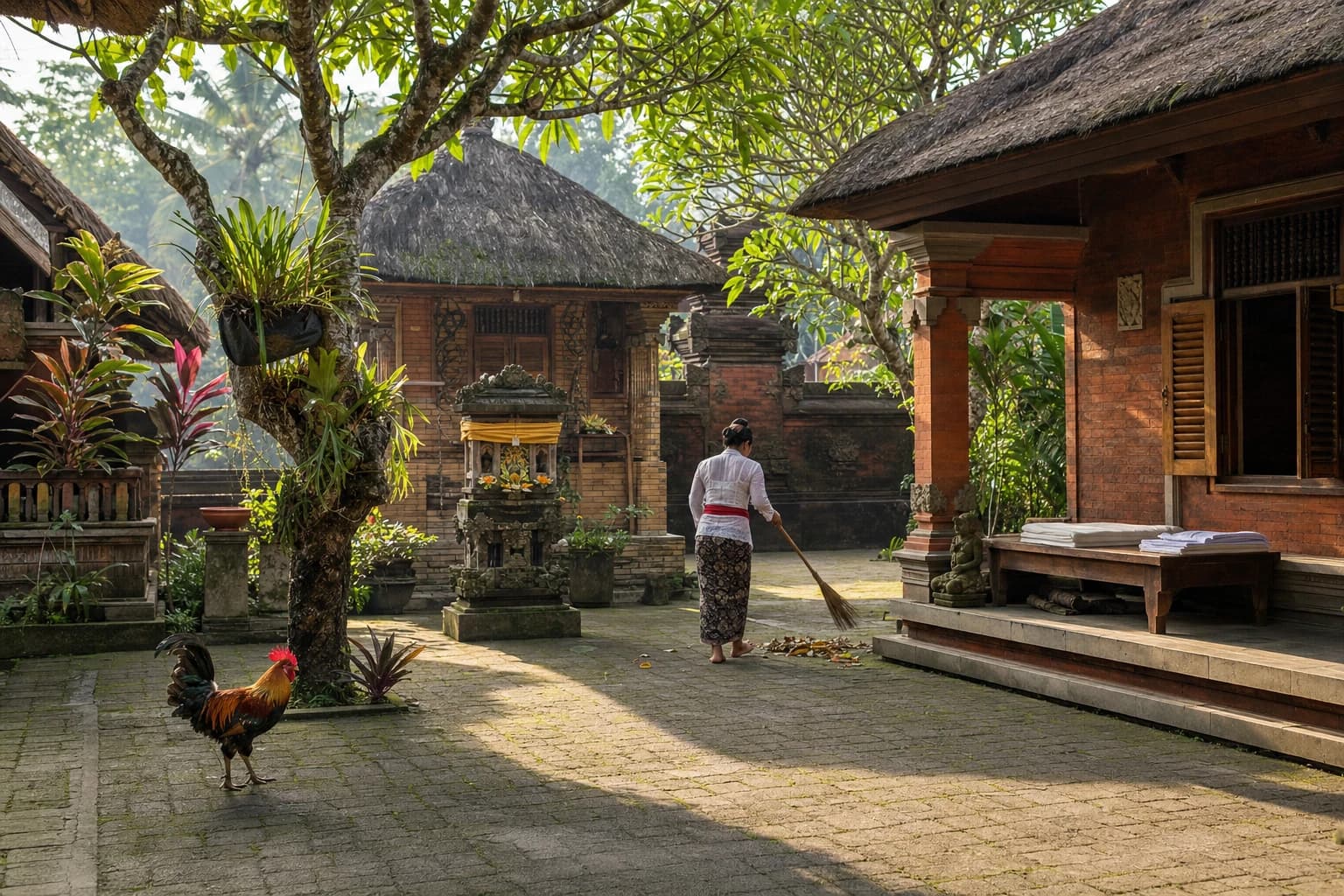
Plenty of "licensed" villas for sale or takeover rely on a Pondok Wisata: the first misunderstanding to clear up.
The Ministry of Tourism's official standard (sisupar portal) defines the Pondok Wisata as accommodation paid for by the day, run by a private individual, in a residential house occupied by its owner, part of which is rented out so that the tourist shares in the owner's daily life, with local economic empowerment as the stated purpose. Official risk level "medium-low", hence a NIB plus a Sertifikat Standar; listed requirements: SLS health certificate, self-assessment, first-aid kit and fire extinguisher, clean water, health and accident insurance for employees, written procedures.
In the KBLI classification, the Pondok Wisata carries code 55130 (sub-group 5513) of group 551, which covers accommodation "in particular by the day or by the week, in principle for a short stay", alongside star-rated hotels (5511), non-star hotels known as melati (5512) and other short-term accommodation (5519).
Two limits come from the consultancies, not from the official text we read: a maximum of 5 rooms, and a holder who must be an Indonesian citizen. Emerhub puts it this way: a community licence by design, meant to keep small tourism income with local owners, whose citizenship condition rules out foreigners, foreign-owned companies included — which Bali Property Rules confirms. One agency page dated 23 February 2026 claims the opposite, that a PT PMA could hold a Pondok Wisata: an isolated wording, incompatible with the official definition (a private individual, in a house occupied by its owner).
The practical consequence: a 4-bedroom villa "already licensed" under a Pondok Wisata carries a licence attached to an Indonesian individual who is supposed to live there — not to you, and not to your company.
Foreigners: which compliant route, and which KBLI?
Three professional sources agree: a foreigner as a private individual cannot hold a Pondok Wisata, a NIB or any other tourist-accommodation licence in their own name. The compliant route, unanimous among consultancies and agencies, is the PT PMA, an Indonesian-law company with foreign capital, "the cleanest legal path" according to one of them. The stay permits that go with it are detailed in our guide to KITAS and long-stay visas.
That leaves the thorny question: which KBLI code for a PT PMA's villa? The law firm Legal Indonesia warns that there is no universal "Airbnb KBLI": the right code depends on the property, the zoning and the structure. The sources even contradict each other on the most obvious code.
| KBLI code | Description | Who can hold it, according to the sources | Reliability |
|---|---|---|---|
| 55130 | Pondok Wisata | Indonesian citizen, private individual, living on site | Official standard + consistent consultancies |
| 55193 | Villa | PT PMA or local PT (Bali Property Rules); reserved for cooperatives and SMEs, hence closed to PT PMAs (Bali Corporate Services, kbli.co.id) | Contradictory |
| 55110 | Star-rated hotel | Suggested for PT PMAs in tourist zones (ILA Global Consulting) | Consultancy |
| 55120 | Non-star hotel (melati) | Cited by the consultancies | Consultancies |
| 55194 | Apartment hotel | Cited by the consultancies | Consultancies |
| 55199 / 55900 | Other accommodation | Conditional, depending on the property | Consultancies |
| 68111 | Owned or leased real estate | General real-estate code, which covers neither hotels nor short-term accommodation (Legal Indonesia) | Consultancy |
On 55193, no official source let us settle the matter (the OSS record for this code could not be isolated): its PMA status is debated and is decided, in practice, at the moment of the application on OSS. One consultancy lists nine possible codes for accommodation alone; another steers its clients towards the hotel code 55110.
One point, on the other hand, is clear-cut at Legal Indonesia, and consistent with the other consultancies: for a PT PMA, short-term rental of a residential property without a hotel or accommodation licence is prohibited as a matter of principle. A villa with a "residential" permit does not become tourist accommodation because it is on Booking: the building must be authorised for commercial use, and that is what the PBG is for.
Which documents do you need beyond the NIB?
Four professional sources describe the same file, give or take a few variations: the NIB is only the way in; without the building paperwork and the local tax registration, it does not hold up.
| Document | What it is for | Framework / counter |
|---|---|---|
| NIB with an accommodation KBLI (group 551) | Business identity and declared activity | OSS (oss.go.id), PP 28/2025 |
| Verified Sertifikat Standar | Certifies compliance with the business standard | OSS (medium-low risk level) |
| PBG with a commercial function | Building permit (ex-IMB) declaring commercial, not residential, use | PP 16/2021 |
| SLF | Certificate of the building's fitness for use | PP 16/2021 |
| NPWPD | Regional tax number for collecting and declaring the accommodation tax | Regional taxation, UU 1/2022 |
| Compatible zoning | The land must allow commercial accommodation | So-called pink / yellow / green zones |
| Kemenpar registration | Tourism-industry form: NIB, accommodation KBLI, e-mail address identical to the OSS one | industri.kemenpar.go.id |
One sequencing detail matters for a project planned from abroad: in Bali Property Rules' seven-step path (entity, NIB, KKPR or land-use conformity, PBG, SLF, licence, going live), the PBG and the SLF are required before the final verification of the NIB — the one that unlocks access to the platforms — and those steps, the consultancy writes, cannot be bypassed. A NIB with no commercial PBG behind it is an empty shell; a villa on a residential permit must first have the function of its PBG changed, a step none of our sources puts a price on.
Zoning and Perda 4/2026: where are you allowed to operate?
Zoning is often the last thing anyone looks at, even though it can sink an entire project. The consultancies describe three families of zones: "pink", tourist zones, where short-term rental is generally permitted and a hotel KBLI is an option; "yellow", residential or mixed, where the KBLI codes PT PMAs usually rely on for accommodation are restricted, while a Pondok Wisata run by an Indonesian resident is generally allowed; and "green", under strict restrictions, with one agency estimating that 30 to 40% of Uluwatu falls into that category — an unofficial figure.
One consultancy suggests, in yellow zones, a set-up in which the PMA invoices "marketing and consulting services" to a local company that holds the licence: an optimisation scheme, not a regulatory route, and one that runs against the provincial policy described below. We do not recommend it.
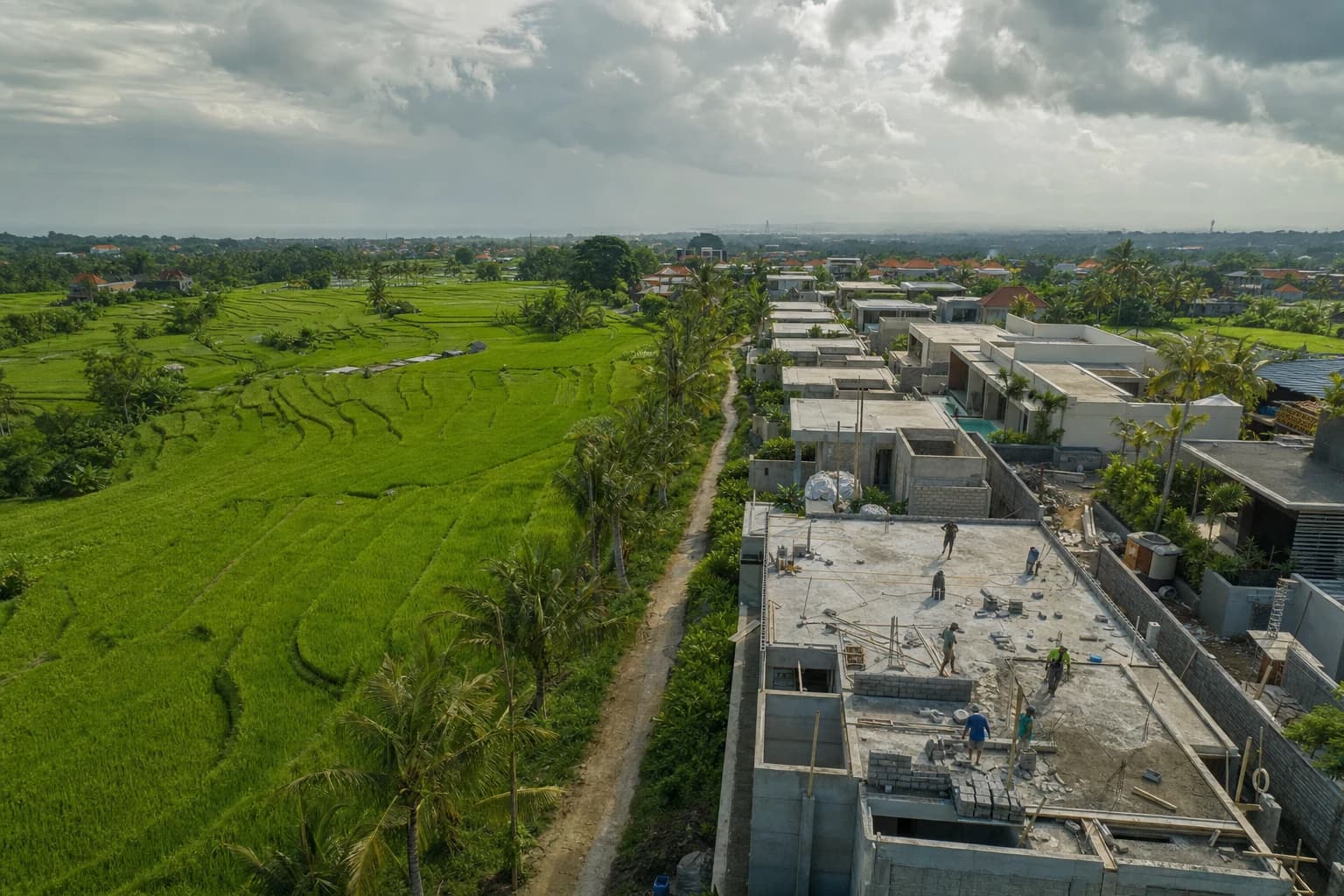
Bali has, in any case, hardened its stance. Perda Bali 4/2026, a provincial regulation signed on 24 February 2026 by Governor Wayan Koster, makes the conversion of productive rice fields into villas a criminal offence and goes after land held through a local front man (the so-called nominee arrangement); according to Lingkar News, the intermediaries and facilitators of such an arrangement are also liable to sanctions, and one consultancy adds that nominee structures holding land or a licence are void, under national law as under this Perda. We have not read the text of the Perda: these elements, which are consistent with each other, come from the Balinese press and from one consultancy.
Which taxes apply to a short-term rental?
Three separate levies come into play.
The local accommodation tax (PBJT "hotel", formerly PHR or PB1): up to 10% of the room rate, collected by the operator from the guest (UU 1/2022). According to Legal Indonesia, Airbnb neither withholds nor remits this tax: it is up to you to register (NPWPD) and file every month.
Income tax. The official page of the Directorate General of Taxes (DJP) on PPh pasal 4 ayat 2 sets a final tax of 10% of the gross amount of land or building rental, upkeep, maintenance, security and service charges included; if the tenant is an entity designated by law (a company, in particular), the tenant withholds and pays the tax, otherwise the landlord pays it themselves. Mind the classification: this regime targets the rental of a property; a licensed tourist accommodation run through a company may fall under the taxation of business income, a distinction the consultancies applying the 10% to Airbnb income do not make, and one that no official source we read settles. To be clarified with a tax adviser before the first booking.
The provincial tourist levy: 150,000 IDR per international tourist, introduced by provincial regulation 6/2023 as amended by 2/2025, payable on the Love Bali portal. Not your cost to bear, but your guests will ask about it.
What do you risk by operating without a licence?
The penalties reported by the consultancies go a long way: delisting from Airbnb and Booking, fines, the property being sealed, demolition, and for a foreigner deportation, revocation of the KITAS or KITAP and an entry ban. On top of that comes the obligation to report every foreign guest to the police (STM form) within 24 hours. The precedent that left its mark on the island: from 21 July 2025, Governor Wayan Koster had around fifty structures demolished at Bingin Beach (Uluwatu), 48 by most accounts, built in a green zone without a building permit; "none of these buildings has a permit", he declared, as quoted by ABC News.
On the platform side: an official deadline for removing unlicensed accommodations, an ePA system in development to cross-check licences against listings, and suspension of access for OTAs that drag their feet. The first penalty for a villa without a NIB is therefore not a fine: it is the listing vanishing — and the revenue with it.
For a traveller, a landlord unable to show a NIB now joins the red flags in our guide to villa rental scams in Bali.
Planning the project from abroad: where do you start?
The classic mistake: buying or leasing a villa on the promise that "you can put it on Airbnb", then discovering the zoning and the PBG once the wire transfer has gone through. The logical order is the reverse.
1. Zoning before the property. Ask for the land's zone before you visit: in a yellow or green zone, a PT PMA project starts with a handicap that no structuring can fix.
2. The building's PBG and SLF. Insist on seeing the building permit and its declared function. "Residential" means conversion; "no PBG" means regularisation before any licence.
3. The structure. A PT PMA, never a nominee: Perda 4/2026 targets precisely these arrangements, intermediaries included.
4. The KBLI. To be arbitrated by a professional in light of the property and the zone, 55193 being contested and a hotel code a possible suggestion.
5. Tax from the first month. NPWPD for the accommodation tax, and the income-tax regime clarified with a tax adviser.
6. Kemenpar registration once the NIB has been obtained.
On budget, our sources put no figure on setting up a PT PMA, converting a PBG or professional fees: get every quote in writing from the consultancy assisting you. One certainty: the March 2026 deadline has passed, and a villa put up for rent today without a NIB is exposed from its very first listing.
Renting on a yearly basis is a different subject: see our benchmarks for yearly rents in Bali; and a short-term villa can be furnished second-hand too, see how to furnish a Bali villa on a budget.
Frequently asked questions
Do you need a NIB to rent out your villa on Airbnb in Bali in 2026?
Yes. The Ministry of Tourism set 31 March 2026 as the deadline from which the platforms must remove accommodations without a business licence, meaning without a NIB issued by OSS with an accommodation KBLI. Airbnb had already been asking hosts for their NIB since late 2025. Without a NIB, the first consequence is not a fine: it is the listing disappearing.
Can a foreigner get a Pondok Wisata licence in Bali?
No, according to the sources, which agree on this point. The official standard defines the Pondok Wisata as accommodation run by a private individual in the house they live in. The consultancies add a 5-room limit and an Indonesian-citizenship condition that also applies to foreign-owned companies. One isolated agency page claims the opposite for PT PMAs, contradicting the official definition.
Which KBLI code should you choose for a short-term rental villa?
There is no universal "Airbnb KBLI": the right code depends on the property, the zoning and the structure. The status of code 55193 "Villa" for a PT PMA is contradictory across consultancies (open according to one, reserved for cooperatives and SMEs according to others), and some steer clients towards a hotel code such as 55110. The code is validated at the time of the application on OSS; have a professional arbitrate the choice.
What is the PBG and why does it need to be commercial?
The PBG is the building permit which, according to professional sources, replaced the old IMB (PP 16/2021). For tourist accommodation, it must state a commercial function, not a residential one, and come with an SLF, the certificate of the building's fitness for use. One consultancy spells out the sequence: the PBG and SLF are required before the NIB is verified, so a villa on a residential permit must be converted before any licence.
Which taxes do you pay on a short-term rental in Bali?
Three levies. The local accommodation tax, up to 10% of the price, which the operator collects and declares themselves after registering for a NPWPD, since Airbnb does not withhold it. Income tax: the DJP's official page provides for a final tax of 10% of gross rent for building rental, but its application to a licensed accommodation business run through a company is not settled by any official source we read. Finally, the provincial tourist levy of 150,000 IDR, paid by the visitor.
What do you risk by renting out without a licence in Bali?
The consultancies report a scale that runs from delisting and fines to the property being sealed and demolished, with, for a foreigner, deportation, revocation of the KITAS or KITAP and an entry ban. The best-known precedent: the demolition of around fifty unpermitted structures (48 by most accounts) at Bingin Beach, from 21 July 2025. On the platform side, an OTA that fails to cooperate risks having its access suspended.
Was the 31 March 2026 deadline extended?
Officially, no. The date of 31 March 2026 is confirmed by the statement of 25 February 2026 published on menpan.go.id; a "final extension" to 31 May 2026 is mentioned only by one Bali consultancy, with no official confirmation. Antara's tally of 21 May 2026 shows, moreover, that the clean-up was still going on after March.
Sources
- (official) peraturan.go.id, PP 28/2025: risk-based business licensing, enacted 05/06/2025, status "Berlaku", repeals PP 5/2021.
- (official) peraturan.go.id, PP 5/2021: status "Tidak Berlaku", repealed by PP 28/2025.
- (official) peraturan.go.id, UU 10/2009: tourism framework law, 16/01/2009, in force.
- (official) peraturan.go.id, Permenpar 6/2025: standards, supervision and administrative sanctions for the tourism sector, 10/10/2025.
- (official) peraturan.go.id, Permenpar 18/2016: registration of tourism businesses, in force.
- (official) peraturan.go.id, PP 16/2021: implementing regulation of the building law (PBG, SLF), 02/02/2021.
- (official) peraturan.go.id, UU 1/2022: central-regional financial relations, regional taxes, 05/01/2022.
- (official) OSS, BKPM portal: NIB, risk-level classification, application of PP 28 from 05/10/2025.
- (official) OSS, KBLI classification, group 551: short-term accommodation, sub-groups 5511/5512/5513/5519.
- (official) Kemenpar, Pondok Wisata standard (sisupar): definition, medium-low risk level, requirements.
- (official) menpan.go.id, 25/02/2026: 31/03/2026 deadline, 72.8% without a NIB, Kemkomdigi sanctions.
- (official) Kemenpar, press release "Pemerintah Tidak Melarang Kehadiran OTA": only the headline readable, body corroborated by the press.
- (official) Kemenpar, press release on the API system with the OTAs: only the headline readable.
- (official) Kemenpar, industry register, operator form: NIB, accommodation KBLI, OSS e-mail.
- (official) DJP, PPh pasal 4 ayat 2: final tax of 10% of gross on land and building rental.
- (official) Love Bali, Bali Province: 150,000 IDR tourist levy, Perda 2/2025 amending Perda 6/2023.
- (media) Antara, 21/05/2026: more than 100,000 accommodations registered as of 13/05/2026, around 470,000 unlicensed, ePA system, coaching clinics.
- (media) Republika, 21/05/2026: same figures, quote from Rizki Handayani Mustafa.
- (media) Lingkar News, 12/03/2026: Perda 4/2026 signed on 24/02/2026 by Wayan Koster, rice-field conversion made a criminal offence, sanctions for nominee intermediaries.
- (media) ABC News, 22/07/2025: Bingin Beach demolitions begun on 21/07/2025 on Governor Koster's orders, lack of permits and green zone cited, around fifty structures targeted.
- (media) Bali Passion, 18/02/2026, in French: Airbnb requesting the NIB since late 2025, sanctions.
- (media) Bali Dream Living: obligation tied to PP 28/2025, estimate of the green zones in Uluwatu.
- (media) Bali Property Real Estate, 23/02/2026: no personal NIB for a foreigner, PT PMA "cleanest path"; disputed wording on the Pondok Wisata.
- (commercial) Emerhub: Pondok Wisata KBLI 55130, 5 rooms, Indonesian citizen, PT PMAs excluded.
- (commercial) Bali Property Rules, villa licensing and short-term rental compliance: PBG/SLF sequence before the NIB, KBLI 55193 open to PT PMAs, sanctions, Bingin July 2025.
- (commercial) Bali Corporate Services: 55193 reserved for cooperatives and SMEs, compliance file, unconfirmed extension to 31/05/2026, nominee void.
- (commercial) Legal Indonesia: no universal Airbnb KBLI, PT PMA prohibition on residential property, 10% PHR not remitted by Airbnb, KBLI 68111 described as general real estate outside accommodation.
- (commercial) ILA Global Consulting: pink/yellow zones, steer towards KBLI 55110.
- (commercial) Short Stay Bali, 06/05/2026: NIB, commercial PBG, SLF, NPWPD, PB1 10%.
- (commercial) LMI Consultancy: Sertifikat Standar, PBG, SLF, PHR 10%, "no universal Airbnb licence".
- (commercial) kbli.co.id, 55130: Pondok Wisata labelled SME-reserved, same label shown for 55193 Villa.