Yes. A foreign national (warga negara asing, WNA) can register a car or a scooter in their own name in Indonesia, and therefore in Bali, on one condition: holding a stay permit. Either a KITAP (permanent stay permit), or a KITAS (temporary stay permit) together with an SKTT, the certificate of residence issued by the Disdukcapil, the regency's civil registry office — free of charge in Badung, according to the official service sheet. The text that says so is national police regulation Perpol 7/2021 on vehicle registration, in force since May 2021: its Article 10, paragraph 6, lists those two combinations as the accepted proof of identity for a foreign private owner. A tourist visa or a visa on arrival is not enough. Once your file is accepted, you receive the STNK (registration certificate, renewed every year), the BPKB (ownership book issued by the police) and the plates. Budget for 2026: 240 to 300 million IDR for a new Toyota Avanza, 17 to 20 million for a new Honda Beat 110, then an annual tax of roughly 160,000 to 200,000 IDR for that scooter and 2 to 3 million for that Avanza. On a used vehicle, the change of registered owner (balik nama) at the Samsat takes 2 to 4 weeks as a rough guide; a quote taken at the Badung Samsat on 24 July 2024 came to 3,250,000 IDR all in. A nominee arrangement, by contrast, costs 1 to 3 million IDR a year and does not make you the legal owner of the vehicle.
What exactly does Indonesian law say?
The reference text is the Peraturan Kepolisian Negara Republik Indonesia Nomor 7 Tahun 2021 on the registration and identification of motor vehicles, promulgated on 5 May 2021 (Berita Negara 2021 No. 476). Its status is Berlaku — in force — on both of the state's legal portals, peraturan.go.id (which records the repeal of the Perkap 5/2012 it replaces) and peraturan.bpk.go.id (that of Perkap 4/2006 on vehicle numbering); the full PDF is hosted by Korlantas, the traffic police's website. It sits within the framework of Law 22/2009 on road traffic, still in force, which requires every vehicle to be registered and underpins the STNK, the BPKB and the plates.
Article 4, paragraph 1, lists the categories of owner whose vehicles get registered: private individuals (perorangan), government bodies, businesses, foreign state representations, international organisations and foreign legal entities with a permanent office in Indonesia. The "private individual" category comes with no nationality condition attached.
Article 10, paragraph 6, sets out the proof of identity for a private owner. Here it is as reproduced by the legal website Hukumonline: "Kartu Tanda Penduduk (KTP) bagi warga negara Indonesia (WNI), atau WNA yang memiliki izin tinggal tetap dan dilengkapi dengan kartu izin tinggal tetap. Bagi WNA yang memiliki izin tinggal terbatas, wajib melampirkan surat keterangan tempat tinggal dan dilengkapi dengan kartu izin tinggal terbatas."
| Your situation | Accepted proof of identity (Art. 10, para. 6) | Vehicle in your name |
|---|---|---|
| Indonesian citizen (WNI) | KTP | Yes |
| Foreigner holding a KITAP (permanent stay) | KTP issued to foreigners on a permanent stay + KITAP card | Yes |
| Foreigner holding a KITAS (temporary stay) | SKTT + KITAS card | Yes |
| Tourist visa, visa on arrival, other short stay | No document provided for in the text | No |
The Hukumonline lawyer concludes, in an answer published on 25 November 2025, that no provision prohibits a foreigner from buying a vehicle in Indonesia in their own name. The police read it the same way: on 10 April 2026, Kompas Otomotif reported the remarks of AKBP Prianggo Malau, head of the Regident sub-directorate of the Central Java traffic police, who relies on that very Article 10, paragraph 6.
A note on method: the official PDF is a scan whose text cannot be extracted; the word-for-word text of Articles 4 and 10 comes from Hukumonline, cross-checked against Kompas, with no discrepancy between the two. As of 3 September 2026, we found no regulatory change specific to foreigners.
Which stay permit do you need, and what should you sort out before you leave?
Five private sources, checked on 3 September 2026, say the same thing: balivisa.co (11 December 2025), which cites Perpol 7/2021 and writes that "You must hold a Limited Stay Permit (KITAS) or a Permanent Stay Permit (KITAP) to register a vehicle in your own name"; bali.live (29 July 2024), which states that without those permits legal ownership is not possible; villabalisale.com (17 April 2026); the community site expat.or.id (an older page); balizero.com (17 February 2026). None of them knows of any exception for tourists.
For anyone planning the move from abroad, the upshot is clear: you cannot buy the car in your name until you have the stay permit in hand, so not from overseas. The order follows from the documents required: get the KITAS that fits your situation, report to the police to obtain the STM (Surat Tanda Melapor), have the SKTT issued by the Disdukcapil, and only then sign. In the meantime, you rent.
What you can sort out before you arrive:
- Your budget in rupiah, based on the 2026 ranges given further down.
- Your passport and copies of it: Badung's SKTT sheet asks for a legalised passport, and the dealer wants the original plus a copy.
- A sponsor: the SKTT sheet requires the KTP and family card (KK) of a sponsor domiciled in the regency. Know who will play that role.
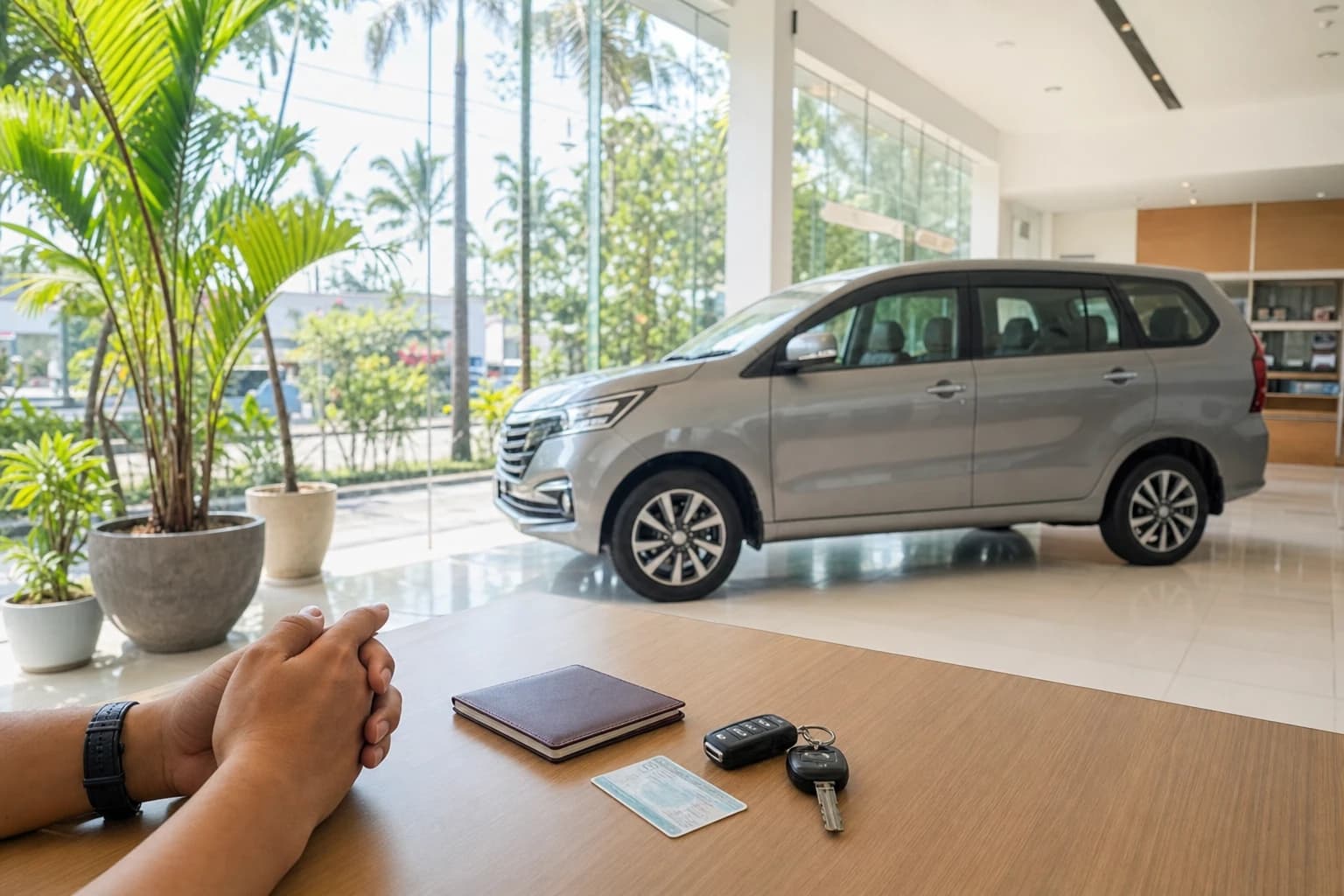
The SKTT: the document every KITAS holder needs (free in Badung)
The Surat Keterangan Tempat Tinggal is the certificate of residence for foreigners on a temporary stay. The SKTT is not issued by Immigration but by the Dinas Kependudukan dan Pencatatan Sipil (Disdukcapil), the regency's civil registry. The official sheet for Badung — the regency (kabupaten) that covers Canggu, Seminyak, Kuta, Jimbaran and Nusa Dua — states that there is no charge for the service: "Pelayanan tidak dikenakan biaya (Gratis)". You collect the document from the Disdukcapil office once it has been printed.
The documents listed on the sheet: a legalised passport (the sheet refers to legalisation by the consulate); a KITAS legalised by Immigration; a letter of introduction from the neighbourhood head (Kepala Lingkungan or Kelihan); the STM, the police reporting receipt; the IMTA, the permit to employ a foreign worker; the electronic KTP and family card (Kartu Keluarga) of a sponsor domiciled in Badung; two 2 × 3 cm passport photos; forms F1.08 and F1.62, plus form F1.09 (power of attorney) if someone else is handling the application for you.
Three caveats. The IMTA is a document tied to employment: for a KITAS that has nothing to do with a job, ask at the counter which document stands in for it. The sheet requires a sponsor domiciled in Badung: in Denpasar, Gianyar or Tabanan, it is your own regency's Disdukcapil (or the city's, for Denpasar) that has jurisdiction, and its list of documents may differ. Finally, the sheet provides for a renewal — it then asks for the old SKTT — but displays no validity period. The one-year renewable validity that gets passed around does not appear on the official page: ask at the counter.
New car: what paperwork does the dealer need?
For a first registration, Article 10, paragraph 1, of the Perpol sets the minimum: the SRUT (type-approval certificate), proof of legal ownership (the invoice), the physical inspection of the vehicle (cek fisik), the owner's proof of identity, the factory's chassis number (VIN) certificate and a power of attorney if someone else files on your behalf. In practice, the dealer puts the file together; your share boils down to the personal documents.
The file asked of a foreigner, as described by balizero.com in February 2026: original KITAS plus a copy, original passport plus a copy, the SKTT — or, according to that source, a Surat Domisili — and a "recommended" NPWP. Two nuances are in order. First, the Perpol names the SKTT, not a simple letter of domicile. Second, on the NPWP, the Indonesian tax number, the sources contradict each other: a scooter rental company (balibestmotorcycle.com, undated page) presents it as compulsory, balizero as merely recommended, and the list in Article 10 does not mention it. In practice, it is a document that often gets asked for (by the dealer, for financing); in law, the text does not require it.
At the end of the process, you receive the three documents described in our guide to vehicle papers in Bali: the STNK, which stays in the vehicle and is renewed every year; the BPKB, "a book issued by the police's Satlantas traffic unit as proof of ownership of the motor vehicle" in Korlantas's definition; and the TNKB, the plates. The official BPKB page does not deal with the case of foreigners — the identity rule, for its part, sits in the Perpol.
Used car: the balik nama at the Samsat
With a used vehicle, buying is not enough: you need the BPKB and the STNK transferred into your name at the Samsat counter, through the balik nama procedure. The balizero.com site gives an indicative timeframe of 2 to 4 weeks and restates the rule that governs everything else: "The person named on the BPKB is the legal owner", whoever paid. One dated, located example: for the transfer of a 2000 Honda estate car, bali.live reports a total quote of 3,250,000 IDR taken at the Badung Samsat on 24 July 2024.
On the transfer tax, the sources diverge. bali.live's guide (2024) mentions a registration tax of 10 to 20% of the purchase price; balizero (2026) puts the BBNKB at around 1% of the assessed value. Yet Law 1/2022, Article 12, paragraph 1, subjects only a vehicle's first transfer to the BBNKB: on a used vehicle, it does not apply, as oto.detik.com explained on 13 April 2025. Bali has also applied, since 5 January 2025, a 24% discount on the BBNKB (Pergub 30/2024, announced on the province's website). The "10 to 20%" in all likelihood corresponds to the BBNKB on a new vehicle, before the discount: do not count it in a used-vehicle balik nama. What remains payable, according to oto.detik.com: the official fees (PNBP) under PP 76/2020, namely 100,000 / 200,000 IDR for the STNK (two-wheeler / car), 60,000 / 100,000 IDR for the plates and 225,000 / 375,000 IDR for the BPKB, plus the SWDKLLJ accident contribution (35,000 / 143,000 IDR) and the annual PKB tax. The Badung quote, 3.25 million all in, gives the order of magnitude.
How much does it cost in 2026?
These figures come from commercial sources or local media, not from an official tariff: treat them as orders of magnitude.
| Item | Range observed | Source and date |
|---|---|---|
| New Honda Beat 110, OTR (on-the-road) price in Bali | 17-20 M IDR (~1,060-1,250 USD) | balizero, 17 Feb 2026 |
| New Yamaha NMAX 155 | 30-35 M IDR | balizero, 17 Feb 2026 |
| New Toyota Avanza | 240-300 M IDR (~15,000-18,750 USD) | balizero, 17 Feb 2026 |
| Scooter | 8-15 M IDR (~500-1,000 USD) for a used scooter; 18-40 M IDR for an NMAX- or Vario-type scooter, condition unspecified | balivisa, 5 Jan 2025; villabalisale, 17 Apr 2026 |
| Annual PKB tax | ~160-200 k IDR (new Honda Beat), 2-3 M IDR (new Avanza), 4-7 M IDR (new Fortuner), decreasing with age; other sources: ~1.5-2% of the assessed value per year | balizero, 17 Feb 2026; balivisa, 11 Dec 2025; villabalisale, 17 Apr 2026 |
| Insurance | 2.5-3% of the value per year | villabalisale, 17 Apr 2026 |
| Balik nama, actual quote | 3,250,000 IDR all in (2000 Honda estate car, Badung Samsat, 24 Jul 2024) | bali.live, 29 Jul 2024 |
| Nominee arrangement, to avoid | 1-3 M IDR/year (~70-200 USD) + 0.5-2 M IDR in taxes and registration fees | balivisa, 5 Jan 2025 |
The two scooter ranges do not measure the same thing: balivisa prices a used scooter, villabalisale an NMAX- or Vario-type scooter without saying whether it is new. For a new Avanza, insurance at 2.5-3% of the value comes to 6 to 9 million IDR a year on 240 to 300 million — our arithmetic, not a figure from any source.
The nominee: a vehicle you paid for, owned by someone else
Without a KITAS or a KITAP, the workaround that gets passed around is a bad one: registering the vehicle in the name of an Indonesian or an agency — name lending, or a nominee arrangement. A visa agency that describes the set-up (balivisa.co, 5 January 2025) gives its rates: for a typical used scooter selling for between 8 and 15 million IDR, a nominee fee of 1 to 3 million IDR a year, plus 0.5 to 2 million in taxes and registration fees. It recommends a notarised agreement, presented as the way to keep control of the vehicle.
The problem is not the price: the legal owner is the person named on the BPKB, and that is not you. The same agency spells it out eleven months later: "If they decide to sell the car, take a loan against the BPKB, or simply disappear, you have very little legal recourse" (11 December 2025). A property agency adds: "If the nominee sells the vehicle or passes away, you have no legal standing to claim the asset", and flags possible insurance refusals (villabalisale.com, 17 April 2026). If a stay permit is within your reach, the maths is quick: rather than 1 to 3 million a year for fictitious ownership, better a KITAS and an SKTT — free in Badung — that put you, and nobody else, on the BPKB.
Owning is not driving
The Perpol governs registration, not the right to get behind the wheel, which requires a valid licence — an Indonesian SIM or an international permit — and is a separate file altogether. Korlantas runs an official portal for the international SIM; our guide to driving licences in Bali walks through the options for your situation.
Buying through a classified ad: the checks before you pay
Before handing over a single rupiah for a used vehicle, on Lokalfinds or anywhere else:
- Insist on seeing the BPKB and check that the name on it is the seller's, against their ID. If the book is in a third party's name (a nominee, a former owner whose title was never transferred), you are not buying from the legal owner.
- Ask for an up-to-date STNK.
- Budget for the balik nama from the moment you make an offer, and allow 2 to 4 weeks: until it is done, nothing identifies you as the owner of the vehicle.
- Get your own identity file ready — KITAP, or KITAS and SKTT — before you close.
A seller who refuses to show the BPKB or suggests "leaving the papers as they are" ticks the first box on our list of classified-ad scams in Bali. No BPKB in the seller's name, no sale.
Frequently asked questions
Can a foreigner really register a car in their own name in Indonesia?
Yes. Perpol 7/2021 provides, in Article 10, paragraph 6, for the proof of identity of a foreign private owner: the KTP with the KITAP card for a permanent stay, or the SKTT certificate of residence with the KITAS card for a temporary stay. Hukumonline concludes that no provision prohibits a foreigner from buying a vehicle in their own name; a traffic police officer quoted by Kompas in April 2026 relies on the same article.
Can you buy a car in Bali on a tourist visa or a visa on arrival?
Not in your own name. Perpol 7/2021 provides no proof of identity for a foreigner without a stay permit, and all five private sources we checked require a KITAS or a KITAP. The workaround that gets passed around is the nominee arrangement: an Indonesian or an agency appears on the BPKB in your place, and you are not the legal owner of the vehicle you paid for.
What is the SKTT and how much does it cost?
The Surat Keterangan Tempat Tinggal is the certificate of residence for foreigners on a temporary stay, required by Perpol 7/2021 alongside the KITAS card. It is issued by the Disdukcapil, the regency's civil registry; Badung's official sheet states that the service is free and lists the documents: legalised passport, KITAS legalised by Immigration, letter from the neighbourhood head, police reporting receipt (STM), IMTA, KTP and family card of a sponsor domiciled in the regency, two 2 × 3 cm photos, forms F1.08, F1.62 and F1.09.
Is an NPWP compulsory to buy a car in Bali?
The sources do not agree: a scooter rental company (undated page) presents the Indonesian tax number as compulsory, balizero.com (February 2026) as merely recommended, and the list of documents for a first registration in Article 10 of Perpol 7/2021 does not mention it. Treat the NPWP as a document a dealer or a finance company will often ask for, not as a condition set by the text.
How much does the balik nama on a used car cost in Bali?
The only dated, located example we found: a total quote of 3,250,000 IDR taken at the Badung Samsat on 24 July 2024 for a 2000 Honda estate car (bali.live), with an indicative timeframe of 2 to 4 weeks according to balizero.com. The "10 to 20% of the purchase price" put forward by a 2024 source in all likelihood corresponds to the BBNKB on a new vehicle: Law 1/2022 subjects only the first transfer to the BBNKB, and Bali applies a 24% discount to it (Pergub 30/2024). What remains are the PP 76/2020 fees, the SWDKLLJ accident contribution and the annual tax.
What are the risks of buying a vehicle through a nominee?
The legal owner is the person named on the BPKB, not the one who paid. If the nominee sells the vehicle, takes out a loan secured on the BPKB, dies or disappears, you have "very little legal recourse" according to balivisa.co and "no legal standing to claim the asset" according to villabalisale.com, which also flags possible insurance refusals. The arrangement additionally costs 1 to 3 million IDR a year, plus 0.5 to 2 million in taxes and registration fees; a notarised agreement does not change the name written on the BPKB.
Can you prepare the purchase from abroad before arriving in Bali?
Prepare, yes; buy in your own name, no: Perpol 7/2021 requires the KITAP, or the KITAS together with the SKTT, and the SKTT can only be obtained once you are in the country, after reporting to the police and with a sponsor domiciled in the regency. From abroad, set your budget in rupiah (17 to 20 million IDR for a new Honda Beat, 240 to 300 million for a new Toyota Avanza, plus the annual tax), get your passport and copies ready, and choose the sponsor whose KTP and family card will be used for the SKTT.
Sources
- (official) Perpol 7/2021, full text (PDF), Korlantas Polri, 5 May 2021, Berita Negara 2021 No. 476.
- (official) Perpol 7/2021 record, peraturan.bpk.go.id: status Berlaku, Berita Negara 2021 No. 476, repeal of Perkap 4/2006.
- (official) Perpol 7/2021 record, national JDIH: status Berlaku, repeal of Perkap 5/2012.
- (official) UU 22/2009 on road traffic, BPK.
- (official) Panduan BPKB, Korlantas Polri.
- (official) Penerbitan SKTT (WNA pemegang KITAS), Pemkab Badung: free service, documents, forms.
- (official) UU 1/2022, BPK: Article 12, paragraph 1, the BBNKB covers only a vehicle's first transfer.
- (official) 24% discount on the BBNKB, Pergub 30/2024, Bali province.
- (official) PP 76/2020, BPK: PNBP fees.
- (official) SIM internasional portal, Korlantas Polri.
- (media) Hak WNA atas kepemilikan kendaraan dan apartemen di Indonesia, Hukumonline, Muhammad Raihan Nugraha, S.H., 25 November 2025: verbatim text of Articles 4 and 10 of Perpol 7/2021.
- (media) Polisi jelaskan kenapa bayar pajak kendaraan harus lampirkan KTP, Kompas Otomotif, 10 April 2026.
- (media) Bea balik nama kendaraan bekas gratis, ini dasar aturannya, oto.detik.com, 13 April 2025: UU 1/2022 Art. 12, remaining fees.
- (media) A foreigner's guide to buying a car in Bali, bali.live, 29 July 2024: balik nama quote of 3,250,000 IDR (Badung Samsat, 24/07/2024), mention of a 10-20% tax that in all likelihood refers to the BBNKB on new vehicles.
- (media — expat community site, older page) Buying a car, expat.or.id: secondary confirmation, no figures used.
- (commercial) Buying a vehicle in Indonesia as a foreigner, balizero.com, 17 February 2026: 2026 OTR prices, PKB, dealer paperwork, balik nama 2-4 weeks.
- (commercial) Can foreigners safely buy cars in Indonesia for long-term use?, balivisa.co, 11 December 2025.
- (commercial) How to buy a motorbike or car in Bali without a KITAS, balivisa.co, 5 January 2025: nominee rates.
- (commercial) Buy a vehicle in Bali as a foreigner, villabalisale.com, 17 April 2026: PKB ~2%, insurance 2.5-3%, scooters 18-40 M IDR (condition unspecified).
- (commercial) Indonesian vehicle docs guide for foreigners: BPKB, STNK, indonesiavisas.id, 24 June 2025.
- (commercial, undated) Buy a motorbike in Bali as a foreigner, balibestmotorcycle.com: NPWP presented as compulsory.