A safe secondhand meetup in Bali comes down to five rules. Meet in a busy public place, ideally one with cameras (a café, a hotel lobby, a supermarket car park, or the forecourt of a police station for anything expensive), in daylight, with someone alongside you. Inspect everything before any money changes hands, never the other way round. For a phone: dial *#06#, then put your own SIM card into the handset on the spot, because an unregistered IMEI gets no network at all in Indonesia. For a scooter: the frame and engine numbers stamped into the metal must match the STNK and the BPKB exactly, and any doubt means a trip to the Samsat together. For cash: Bank Indonesia's "3D" method, Dilihat, Diraba, Diterawang (look, feel, hold to the light). If things go wrong, call 110, the national police hotline, free and staffed 24/7, then file at the station's SPKT desk: it costs nothing and you leave with an official receipt, the STTLP. No remote deposits, no SMS codes shared, no exceptions. Checklist verified on 3 August 2026, official sources at the end of the article.
Why does a simple meetup deserve a checklist?
The Indonesia travel advice published by France Diplomatie, the French foreign ministry, updated on 22 July 2026, flags "a resurgence of petty crime (bag snatching)" in tourist areas, worse around major holidays, along with cases of bank card fraud. Nothing specific to classified ads, and that is the real problem: no public statistic measures theft or fraud during a private sale in Bali. The recent figures doing the rounds measure something else entirely. The 301 criminal cases involving 309 foreign nationals recorded by Polda Bali between January and October 2025 (state news agency ANTARA, 31 October 2025) count foreigners as offenders, not as victims. Recycling them as "buyer risk" would be a fabrication.
Two indirect markers do exist. The local expat press (baliexpat.com, 24 June 2025, citing Polda Bali) notes, on the subject of cases involving foreigners, that most offences cluster around the seasonal peaks: June, July and the end of the year. Numbeo, meanwhile, puts the feeling of safety walking alone at 61.4/100 in daylight against 45.8/100 at night: crowdsourced perception (93 contributors, data as of 29 October 2025), not an official statistic. Both markers point the same way. Meet in daylight, and raise your guard in high season.
One last piece, and this one is dated: a December 2020 Coconuts Bali report documented how badly petty crime goes unreported on the island. People judged the process pointless without evidence, worried about their immigration status, or simply wrote off low-value items. The real volume stays invisible, which is all the more reason to lock down the meetup rather than count on whatever comes after it. Even the help centre at Leboncoin, France's dominant classifieds platform, concentrates on securing online payment and says nothing about the physical handover. That is exactly the gap this checklist fills.
See also: Marketplace scams in Bali: buyer traps, seller traps, and where to report
Where and when should you meet?
The most recent police guidance we found is dated 27 July 2026. The Fairfax County Police Department sets out ten tips, and the hard core comes down to five moves: public place, daylight, bring someone, inspect the item before the transaction, and walk away if the other person seems off or the offer looks "too good to be true". Security firm Avast (8 September 2025) fills in the setting, recommending "a safe public place, such as a busy café or a shop car park", and warning against isolated spots and late meetings alike.
American "Safe Exchange Zones", police station car parks under 24/7 camera surveillance, have no documented institutional equivalent in Indonesia. Here is the Bali translation:
| Place | Why it works | Best for |
|---|---|---|
| Busy café or warung | People, staff, witnesses | Phones, small items, clothes |
| Hotel lobby | Cameras, security staff, a power socket to test with | Higher-value electronics |
| Supermarket car park | Cameras, constant traffic, an address that is easy to give | Furniture, appliances, scooter test rides |
| Outside a police station | Maximum deterrent; an honest counterpart will not object | Expensive items, large sums |
A refusal tells you as much as an agreement. The spokesman for Springfield police (Massachusetts, 11 February 2025) puts it plainly: if the deal is legitimate, the person will show up; if they rule out the station and push for somewhere else, "that's a red flag". Add two habits from the French consumer site Radin Malin (updated 5 October 2025): tell someone close to you about the meetup, who and where and when, and favour a place with cameras.
Practically speaking, agree the place and time in writing inside the platform's messaging. On Lokalfinds, the timestamped exchange is your record if things go sideways, and a dodgy profile can be reported in two clicks.
Phones and electronics: the SIM test that settles it
In Indonesia, a phone whose IMEI is not registered gets no cellular network at all: no calls, no texts, no data. Telkomsel, the country's largest operator, says it flatly. Unregistered IMEI, unusable phone. So a stolen handset, or one imported without being declared, can run perfectly on Wi-Fi during the demo and turn into a brick the moment you leave the café.
See also: IMEI Registration in Indonesia: 60 Days to Register, 90 Before the Cut-Off
The catch in 2026 is that the public online check no longer exists. The Ministry of Industry portal (imei.kemenperin.go.id), still recommended by most tutorials, now shows access as "closed to the public", confirmed on 3 August 2026; only a corporate account still opens the door. The customs alternative cited in a few recent articles did not respond during our checks, so we are not passing it on here. The only robust test happens at the meetup, in three moves:
1. Dial *#06#: the IMEI appears. Check it matches the one in the settings and on the box.
2. Put your own local SIM card into the handset, there and then.
3. Wait for signal: no bars after a few minutes means the IMEI is unregistered or blocked. Put the phone down and leave.
And Avast's rule cuts across every category of item: pay only after inspecting in person, never before, never remotely.
Scooters and motorbikes: the stamped numbers are what count
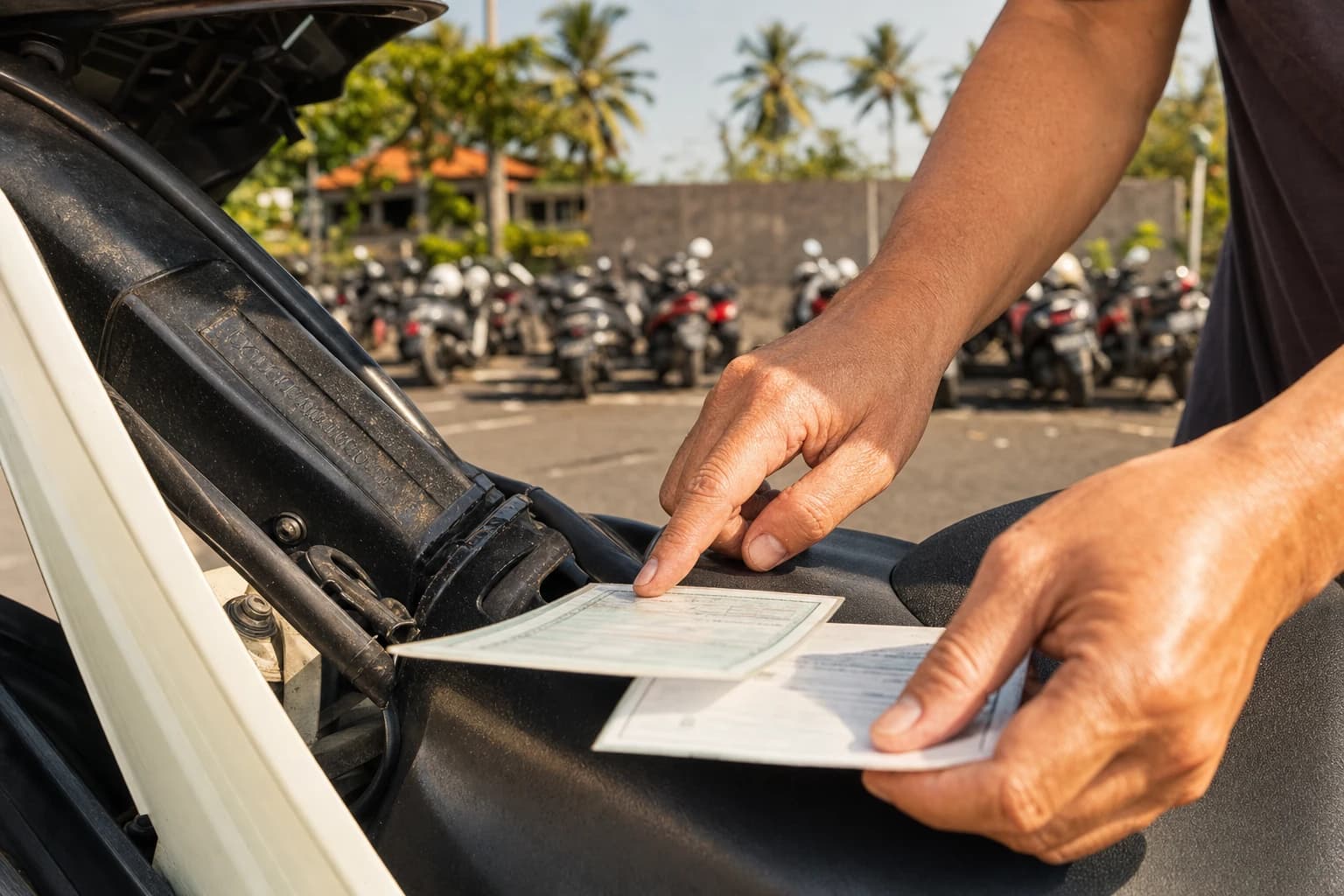
On a two-wheeler, everything hangs on the paperwork and on two sets of digits stamped into the metal. Indonesian motoring outlet detikOto (8 February 2024) lays out the method for not riding home on a stolen bike. What you can check at the meetup, with no tools:
- Everything must match. The frame and engine numbers stamped on the vehicle have to be identical to those on the STNK (registration certificate) and the BPKB (proof of ownership). Go through the make, colour, engine size and plate listed on the STNK against the bike in front of you, point by point.
- A genuine BPKB. Glossy cover, and a hologram that stays grey when held to the light; if it shifts colour, it is a fake. Serial number under the hologram, raised print you can feel with a fingertip.
- Re-stamped, filled or irregular numbers. Uneven digits, inconsistent stamping depth, traces of filler or welding: the tampering signs detailed by a national police registration officer to CNN Indonesia (7 September 2023), with a blunt instruction attached. Walk away, however attractive the price.
- "The BPKB is coming, it's being processed." Flat refusal. A bike sold without the BPKB in hand is either still under finance, in which case the lender can repossess it even after you have paid the seller, or stolen, and seizable by the police with no compensation. The warning comes from Indonesian pawnbroker Pandai Gadai, a commercially interested source whose account matches detikOto's.
If any doubt remains, detikOto recommends taking the STNK and the vehicle to the Samsat, the official vehicle registration office, for an officer to check. Before purchase, that means going there with the seller. Anyone who refuses that detour has already given you their answer. From a phone, the official SIGNAL (Samsat Digital Nasional) app also lets you register a vehicle via its plate number (NRKB) and pay the annual tax, useful from the day after you buy.
For the paperwork and the tax in detail, see our guide to the STNK, the BPKB and the annual tax; for the mechanical inspection and the pricing traps, the one on buying a used scooter.
Furniture, appliances, sports gear: test it before any money moves
Two classics of the secondhand market come up again in Avast's typology: the hidden fault, meaning the "as new" item that dies the same evening, and the stolen item, moved fast and well below market price. Leboncoin's help centre sums up the price defence in one line: "be wary of offers that are too attractive on price". In practice, at the meetup:
- Plug it in, switch it on, run it in front of the seller. This is exactly why a place with a socket matters.
- Photograph the item from every angle at the moment of the transaction. Radin Malin recommends photos as proof of condition, for buyer and seller alike.
- For anything valuable, have a bill of sale signed (item, price, date) and ask to see the other party's ID, as Radin Malin advises. Seeing it is enough. Do not photograph it and do not send yours: Leboncoin's rule, never share your identity documents, cuts both ways.
To furnish a whole villa on the cheap, our guide to furnishing your villa secondhand lists where to look and at what price.
How do you pay, and take, cash without getting burned?
Police guidance and cybersecurity specialists alike (Fairfax, Avast) recommend a traceable payment method over cash. On the ground in Bali, cash still dominates private sales. Rather than settle that argument, take the real case: banknotes changing hands.
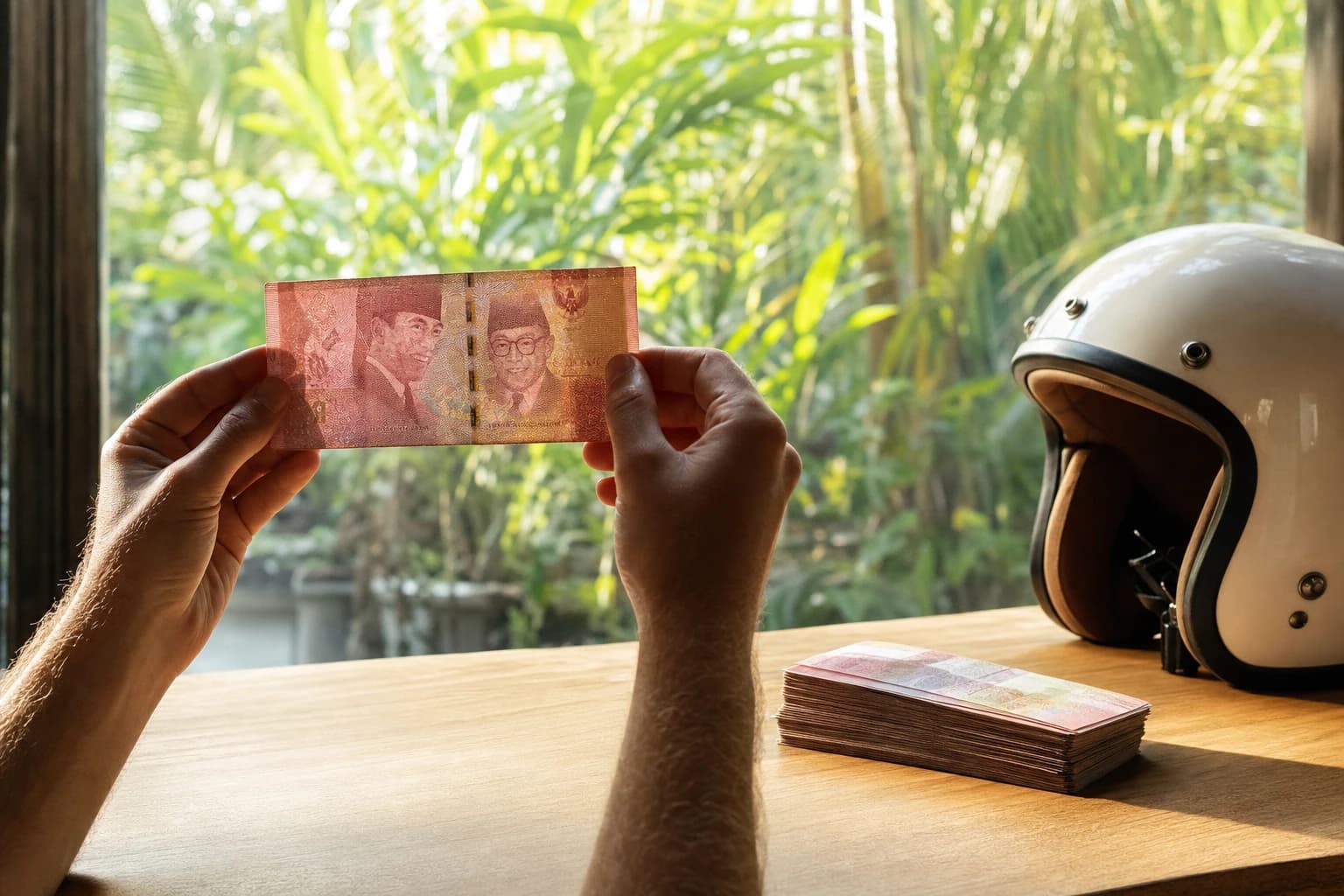
Bank Indonesia promotes an official method for spotting counterfeits, known as "3D", relayed on 22 June 2024 by Tribrata News, the national police's news service:
| Step | What you do | What should appear |
|---|---|---|
| Dilihat (look) | Note flat, in good light | Vivid, crisp colours; a security thread embedded in the paper, woven through, that changes colour |
| Diraba (feel) | Fingertip across the numerals, the lettering, the Garuda and the main portrait | The rough relief of intaglio printing, obvious under the finger |
| Diterawang (hold to the light) | Note raised towards a light source | Watermark portrait of a national hero; the BI logo on both sides completing itself exactly when seen through |
A UV light or a magnifier sharpens the check, but all three moves work bare-handed at a café table. Then count the stack note by note, twice: Radin Malin quotes a seller who ended up €50 short after counting too fast. A 10 million IDR payment in 100,000 IDR notes means 100 notes to check, so allow five minutes and feel no awkwardness about it. Nobody honest takes offence at being counted.
Two automatic refusals, both documented by Avast: the deposit paid remotely to "reserve" something, a classic on vehicles, and any payment before inspection. And if the other party offers a bank transfer at the moment of handover, the item only moves once the money is visible in your own account.
Selling: the mirror rules
The rules on place and company apply identically when you are the one selling. Five more habits go with them:
- The 3D method applies to taking money. The seller is the one receiving the notes, and therefore any fakes.
- Photograph the item before handing it over (condition, serial number). That is your proof against a bogus claim.
- A signed bill of sale for anything valuable. Radin Malin's recommendation protects both sides.
- Three requests that should send you running, all documented by Avast: the overpayment followed by a request to refund the difference; the verification code received by SMS "to confirm" (it exists to hijack an account, not to confirm anything); and the QR code or payment app the buyer insists on.
- No sensitive data. Fairfax makes the point about never sharing personal information; Leboncoin bans sending bank details and identity documents.
A precise, complete, well-photographed listing already filters out part of the dodgy crowd. See our five tips for selling fast.
It went wrong: what do you actually do?
The number to remember is 110, the call centre of the Indonesian National Police (Polri), free and open 24/7. 112 circulates as a single national emergency number, but we could not confirm its actual coverage in Bali, so in practice dial 110. Polri also runs an official app (POLRI Super App, iOS and Android) and an online complaint channel.
The report itself is filed at the SPKT (Sentra Pelayanan Kepolisian Terpadu), the front desk of the police station covering the place where it happened. It is free. IBLAM School of Law (23 April 2026) sets out how it runs: you leave with an official receipt, the STTLP, attached to a numbered Laporan Polisi, and you can ask the investigator for the SP2HP, the case progress note. You can file even without a complete file, but bring as much as you can:
- photo ID (passport);
- a written timeline of events;
- printed evidence: screenshots of the listing and the conversation, payment receipt;
- contact details for any witnesses, starting with the friend who came along.
Two honest caveats. First, the classification: a theft or a fraud produces a Laporan Polisi, meaning an investigation, whereas simply losing an item or your papers falls under the SKTLK, the loss declaration, also free, which is what you need for replacement paperwork. The dedicated page from the Polres Metro Tangerang Kota spells that out. Second, lived experience: the report is free and properly framed, but the 2020 Coconuts Bali piece already showed residents giving up on declaring, judging the process heavy for small amounts. Both realities coexist, and the STTLP receipt remains essential, whether for an insurer or simply to give the events a legal existence.
| Situation | Channel | What you get |
|---|---|---|
| Emergency, theft or assault in progress | 110 (free, 24/7) | Response, guidance |
| Confirmed theft or fraud | SPKT at the station covering the location | Free report, STTLP receipt, SP2HP follow-up |
| Simple loss (papers, item) | SPKT | SKTLK, the loss declaration |
| Suspicious bank account to check or flag | cekrekening.id (Komdigi portal) | The account's history of reports |
| Cybercrime | patrolisiber.id (cyber police) | Online report |
| Complaint against a public body | lapor.go.id or SMS to 1708 | Verification within 3 days, answer within 5 |
Two reservations about that table. The cekrekening.id and patrolisiber.id portals block automated access, so we could not check their content before publication: open them in your own browser. And SP4N-LAPOR! remains an administrative complaints desk connected to more than 700 institutions. It does not replace filing a criminal report at the SPKT.
The checklist at a glance
Before the meetup
- Negotiation and location agreed in writing in the platform's messaging.
- Someone close to you told: who, where, when.
- Price compared with the market. An offer that is too good is a signal, not a bargain.
- No remote deposit, no SMS code shared, no identity document sent.
On the spot
- Busy public place, cameras, daylight, someone with you.
- Phone:
*#06#, box and settings match, your SIM in, signal confirmed. - Vehicle: frame and engine identical to the STNK and the BPKB; any doubt means the Samsat, together.
- Item: tested running, photographed.
Payment
- After inspection, never before.
- Notes: Dilihat, Diraba, Diterawang, then count twice.
- Anything valuable: signed bill of sale.
If it goes wrong: 110, then a free report at the SPKT, with the STTLP receipt in hand before you leave.
Frequently asked questions
What number do you call in Bali after a theft or a scam during a sale?
110, the call centre of the Indonesian National Police (Polri): free and open 24/7, confirmed on polri.go.id. You then file the report at the SPKT desk of the police station covering the place where it happened. 112 is presented as a single national emergency number, but its effective coverage in Bali could not be verified, so in practice remember 110.
Does filing a police report in Indonesia cost anything?
No. Filing at the SPKT is free, as confirmed by the procedure set out by IBLAM School of Law (23 April 2026). You receive an official receipt, the STTLP, attached to a numbered Laporan Polisi, and you can ask for the SP2HP, the case progress note. Bring your passport, a written timeline of events, printed evidence such as screenshots and the payment receipt, and contact details for any witnesses.
How do you check the IMEI of a secondhand phone in Indonesia?
Dial *#06# to display the IMEI and check it matches the settings and the box, then insert your own SIM card: if no signal appears, the IMEI is not registered and the phone will get no calls, no texts and no data (confirmed by Telkomsel). The imei.kemenperin.go.id portal has closed its public access, confirmed on 3 August 2026, so the on-the-spot SIM test is the only reliable check left.
How do you spot a fake rupiah note when you pay?
With Bank Indonesia's official "3D" method. Dilihat, look at the vivid colours and the security thread that changes colour. Diraba, feel the rough relief of the printing on the numerals, the lettering and the main portrait. Diterawang, hold the note to the light to check the watermark portrait of a national hero and the BI logo on both sides completing itself through the paper. A UV light or a magnifier sharpens the check. Then count the stack twice, note by note, in front of the other party.
Which documents should you check before buying a used scooter in Bali?
The STNK and the BPKB, and every detail on them has to match the vehicle: the frame and engine numbers stamped into the metal must be identical to those on both documents (detikOto, 8 February 2024). On the BPKB, the hologram must stay grey when held to the light; if it changes colour, it is a fake. If in doubt, go and check together at the Samsat. A seller who refuses, or who says the BPKB will "follow later", ends the meetup.
Where should you hand over an item sold in Bali?
In a busy public place, ideally one with cameras: a lively café or warung, a hotel lobby, a supermarket car park. For anything expensive, arrange to meet outside a police station, which is the principle behind American "Safe Exchange Zones" and something you have to improvise yourself, since Indonesia has no documented equivalent. In daylight, with company, and with someone close to you told in advance. A counterpart who refuses a public place is a red flag recognised by police forces.
Should you pay a deposit to "reserve" an item or a scooter you saw in a listing?
No, never remotely. The reservation deposit is a scam technique documented by Avast, particularly on vehicles: the item does not exist, or it disappears along with your money. The rule every one of our sources agrees on is payment only after inspecting in person, at the meetup. An offer that is too good combined with pressure to pay quickly is the classic cocktail. Walk away.
Sources
- Official — Polri, official site of the Indonesian National Police — the 110 number (free of charge confirmed on the Call Center 110 page), SPKT, online complaints, POLRI Super App.
- Official — Polri (Humas), Call Center 110, free emergency service 24/7 — official confirmation of "gratis 24 jam".
- Official — Polres Metro Tangerang Kota, laporan kehilangan (SKTLK) — free SKTLK, issued at the SPKT, used to replace lost documents.
- Official — France Diplomatie, Indonesia travel advice, French foreign ministry (updated 22 July 2026) — resurgence of petty crime, bank card fraud.
- Official — Fairfax County Police Department, Shop Smart, Meet Safe (27 July 2026) — public place, daylight, bring someone, inspect before the transaction, Safe Exchange Zones under 24/7 video surveillance.
- Official — Tribrata News (Polri), citing Bank Indonesia (22 June 2024) — the 3D banknote checking method.
- Official — imei.kemenperin.go.id — direct confirmation that public access to the IMEI check has closed (3 August 2026).
- Official — SIGNAL, Samsat Digital Nasional — official app: registering a vehicle by its plate number (NRKB) and paying the tax (accessed 3 August 2026).
- Official — SP4N-LAPOR! — official administrative complaints platform, SMS 1708, verification within 3 days and an answer within 5.
- Academic institution — IBLAM School of Law, filing a police report: steps, evidence, rights (23 April 2026) — filing is free, STTLP, SP2HP, documents to bring.
- Press — Yahoo News, Springfield police offer safe spot for online exchanges (11 February 2025) — "if the deal is legitimate, the person will show up; if not, that's a red flag" (Ryan Walsh, Springfield police spokesman).
- Commercial — Avast, marketplace scams (8 September 2025) — choosing the meeting place, paying after inspection, scam typology (deposits, SMS codes, QR, overpayment).
- Press — detikOto, how to check a genuine BPKB and STNK (8 February 2024) — hologram, frame and engine number matching, checking at the Samsat.
- Press — CNN Indonesia, police explain how to detect falsified frame and engine numbers (7 September 2023) — filler, irregular stamping, welding marks: drop the purchase.
- Commercial — Pandai Gadai, buying a motorbike without a BPKB (Indonesian pawnbroker, commercially interested source) — the risks of a "BPKB menyusul": leasing collateral, stolen bike, police seizure without compensation.
- Commercial — Telkomsel, checking an IMEI — an unregistered IMEI means no network at all in Indonesia (its reference to the public online check is now out of date).
- Press (state agency) — ANTARA, Bali police: 309 foreigners involved in crimes (31 October 2025) — Polda Bali 2025 statistics, foreigners as offenders.
- Press — Bali Expat, Rising crime among foreigners (24 June 2025) — seasonality of offences: June, July, end of year.
- Community — Numbeo, crime in Bali (data as of 29 October 2025) — crowdsourced perception (93 contributors), safety by day versus by night.
- Press — Coconuts Bali (21 December 2020) — under-reporting of petty crime, in a dated pandemic context.
- Commercial — Leboncoin, securing your purchases — wariness of offers that are too good, documents never to share.
- Press — Radin Malin, common scams and how to avoid them, French consumer site (updated 5 October 2025) — telling someone close to you, the bill of sale, counting the notes.