To stay legal with a vehicle in Bali, three documents run the show: the STNK (the registration card, renewed every year at the same time as the tax), the BPKB (the famous blue book, the only real proof of ownership — without it, you're not buying anything) and a valid license that explicitly covers two-wheelers. Good news since January 2025: the national reform scrapped the BBNKB II, so transferring a used vehicle into your name (the balik nama) now costs only around IDR 445,000 to 535,000 in fees for a motorbike, excluding the year's tax. The annual tax (PKB + SWDKLLJ) is then settled in a few minutes through the SIGNAL app; let it slide for more than two years and the vehicle can be struck off the register. Here's the complete playbook for the papers and the taxes.
Why this guide is the essential companion to the purchase
Choosing the right scooter, spotting a scam, negotiating the price: all of that is covered in detail in our article Buying a Used Scooter in Bali: Every Trap to Avoid. Here, we focus on what comes right after the handshake: the paperwork. Because a well-chosen but badly transferred vehicle — with an unpaid tax or the wrong license — can turn into a financial sinkhole, or into a vehicle seized at a checkpoint. Whether you're buying a Vario, an NMAX or a small family car, the documents and deadlines described below are exactly the same.
See also: Driving Licence in Bali: International Permit or Indonesian SIM?
STNK and BPKB: the two documents that carry authority
A vehicle in Bali rests on two official documents. Mixing them up, or overlooking one, is the most costly mistake a newcomer makes.
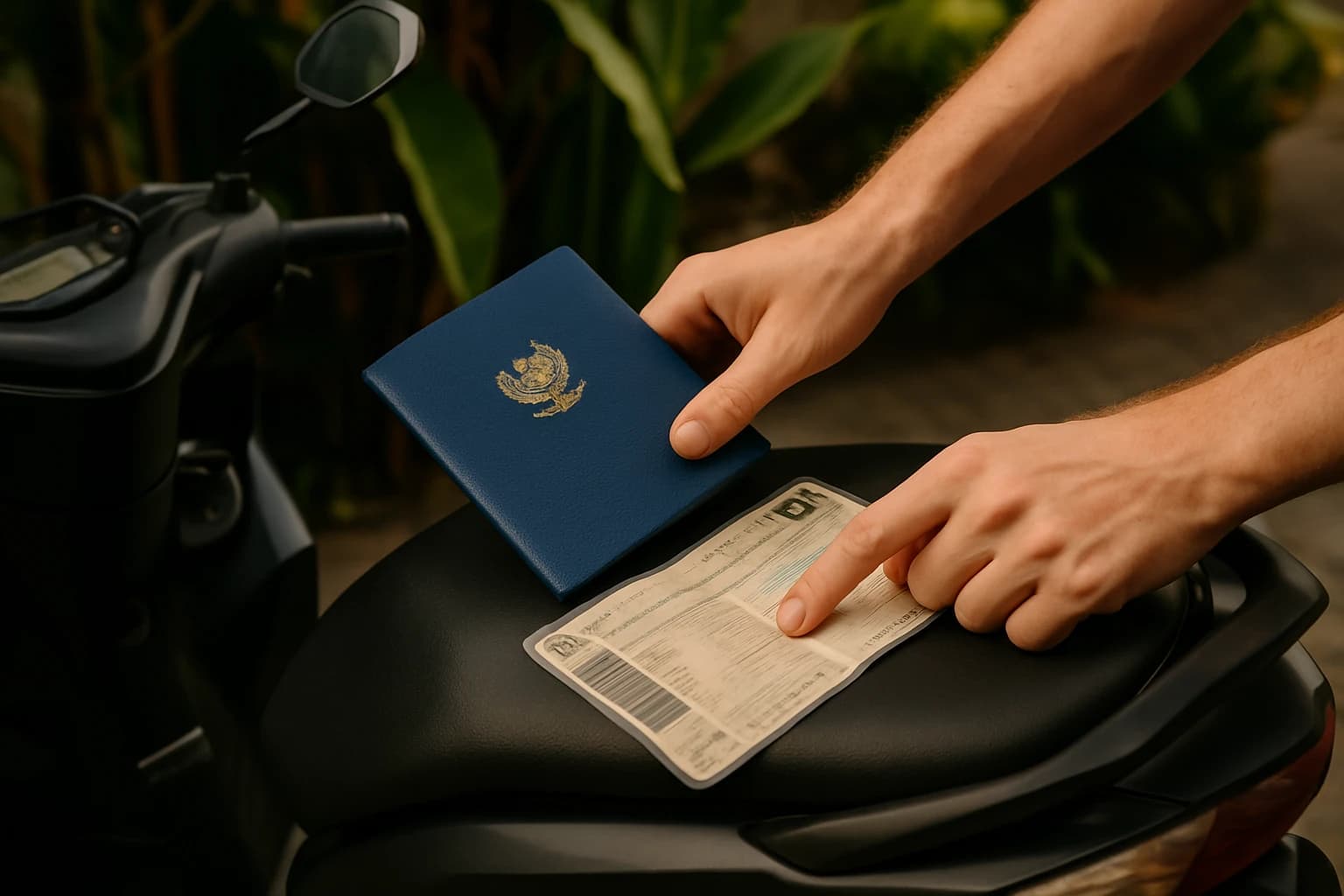
The STNK (Surat Tanda Nomor Kendaraan) is the equivalent of the registration card. It identifies the vehicle and its registered owner, and above all it certifies that the annual tax has been paid. It's a living document: it's renewed every year and undergoes a full reissue every five years. The direct consequence for a buyer: if the tax is overdue, it's the current owner — meaning you, once the vehicle is in your hands — who pays the penalty, not the previous holder. The validity date printed on the STNK is therefore the first thing to check before any purchase.
The BPKB (Buku Pemilik Kendaraan Bermotor), the blue book, is the ultimate proof of ownership. Whoever's name appears on the BPKB is the vehicle's legal owner, full stop. The golden rule, hammered home by the whole expat community, comes down to one phrase: no BPKB, no deal. A seller who "left the book at home," or who promises to "send it to you later," is selling you a problem, not a scooter.
One last reflex, valid for any used vehicle: the plate number, the engine number and the chassis number must match exactly across the STNK, the BPKB and the physical stampings on the vehicle. The slightest mismatch flags a forged document or a vehicle with a shady past.
The balik nama: putting the vehicle in your name
The balik nama is the official transfer of ownership: it moves the STNK and the BPKB into the new owner's name. Plenty of foreigners skip it and keep the vehicle in the local seller's name. It's common, but it's a bad bet, for two reasons: the resale value drops 20 to 30% when the papers aren't in your name, and above all any fine or unpaid tax traces back to the person listed on the BPKB. Doing the transfer means buying yourself peace of mind.
A foreigner can absolutely register a vehicle in their own name provided they hold a passport and a valid stay permit (KITAS or KITAP), often supplemented by proof of address (surat domisili) and sometimes a tax number (NPWP). On a tourist visa, the transfer is usually done through a trusted local or a sponsor.
This is where the big 2026 change comes in. The BBNKB II — the transfer duty that used to apply to used vehicles — has been abolished at the national level, effective since 5 January 2025 under Law UU No. 1/2022 (HKPD). In concrete terms, that duty now only applies to the first transfer (a new vehicle): on a used one, it drops to zero, a saving of around 1% of the vehicle's price compared with the old system. One caveat, though: "BBNKB II abolished" does not mean "free balik nama." A set of fixed administrative fees (the PNBP) still has to be paid.
Here's the breakdown of the remaining fees for a motorbike, as a rough guide and excluding the year's tax:
| Item | Amount (IDR) |
|---|---|
| PNBP — issuing the new STNK | 100,000 |
| PNBP — license plate (TNKB) | 60,000 |
| PNBP — issuing the new BPKB | 225,000 |
| Physical inspection (cek fisik, chassis/engine imprint) | 25,000 – 50,000 |
| SWDKLLJ (contribution to the accident fund) | 35,000 |
| Mutasi keluar (if the vehicle comes from another district) | 150,000 |
| Total fees (excluding the year's PKB) | ~445,000 – 535,000 |
On top of that, count the current year's PKB (the tax, see below) and allow for some lead time: the transfer usually takes one to two weeks, longer if the BPKB has to be "repatriated" from another province (mutasi), with a lead time of around ten working days. Plenty of expats hand the legwork to an agent (calo or biro jasa) who queues at the Samsat in their place, for a fee.
The annual tax (pajak tahunan) via the Samsat
Owning the vehicle isn't enough: you have to keep it up to date administratively every year. The annual tax breaks down into two distinct parts.
The first is the PKB (Pajak Kendaraan Bermotor), the vehicle tax proper, which amounts to roughly 2% of the official assessed value (the NJKB) of the vehicle. It's therefore tapering: the older the model, the less you pay. The second is the SWDKLLJ, a mandatory contribution to the public accident-compensation fund (Jasa Raharja): it's a flat rate, on the order of IDR 35,000 a year for a motorbike and IDR 143,000 for a car (indicative amounts). The total appears on your STNK.
Good news on the practical side: paying this tax is no longer a chore. Several channels exist:
- SIGNAL, the official app of the national digital Samsat: STNK validation and annual tax payment from your phone, in a few minutes.
- e-Samsat (regional), via partner portals or bank counters.
- The Samsat Keliling, a mobile counter-bus that tours the neighborhoods.
- The Samsat Corner, a counter found in certain shopping malls.
One crucial point to know: these channels only handle the annual tax, never the five-year renewal (which requires the physical presence of the vehicle — see the next section).
If you let it drag on, the penalty (denda) climbs by a precise formula: PKB × 25% × (number of months overdue / 12), to which a SWDKLLJ penalty is added (around IDR 32,000 for a motorbike). To give you a sense of scale: on a PKB of IDR 400,000, one month overdue works out to about IDR 8,300 in PKB penalty plus IDR 32,000 in SWDKLLJ. The penalty is generally capped at 24 months. But the real danger lies further out: a vehicle whose tax stays unpaid for more than two years can be struck off the register. It then becomes bodong — permanently outlaw, unsellable and impossible to re-register. That's the sanction to avoid at all costs.
The 5-year milestone: plate and physical inspection
On top of the annual appointment, every vehicle goes through a heavier step every five years. This is the pajak 5 tahunan, which includes the plate change (ganti plat), a full reissue of the STNK and a mandatory physical inspection (cek fisik): an officer takes the imprints of the chassis and engine numbers on the vehicle itself. There's no doing it remotely: you have to bring the vehicle to the Samsat office. That's precisely why apps like SIGNAL don't cover this milestone.
On the budget side, count around IDR 185,000 in administrative fees for this operation (STNK issuance 100,000 + plate 60,000 + endorsement 25,000), on top of the annual tax due that same year. Nothing insurmountable, but a date to mark in your calendar so you don't end up with an expired plate.
To see it clearly, here's the calendar of the three appointments to keep in mind:
| Milestone | What to do | Where | Possible online? |
|---|---|---|---|
| At the used purchase | Balik nama (transfer into the buyer's name) | Samsat office | No |
| Every year | Annual tax (PKB + SWDKLLJ) + STNK validation | SIGNAL, e-Samsat, Samsat Keliling / Corner | Yes (SIGNAL) |
| Every 5 years | New plate + STNK reissue + physical inspection | Samsat office (vehicle present) | No |
The license: tourist IDP vs local SIM
Having the vehicle's papers in order counts for nothing if you don't have the right to ride it. And on this point, two very different situations exist.
If you're a tourist, your national license isn't enough on its own. You have to pair it with an International Driving Permit (IDP) whose category explicitly covers two-wheelers. This is the most common trap: an IDP limited to cars does not authorize you to ride a scooter, not even a little 110-125cc. Before you leave, double-check that the two-wheeler category is clearly marked on the document — it's the category that counts, not the comfort of assuming "the car license will do."
If you're a resident (KITAS or KITAP), you can — and in time must — get the local Indonesian license, the SIM. Watch out for a vocabulary trap: on the Indonesian SIM, a motorbike corresponds to SIM C and a car to SIM A — a letter logic that's different from the IDP's. Here again, go by the category (two-wheelers) rather than the letter, so you don't get tangled up.
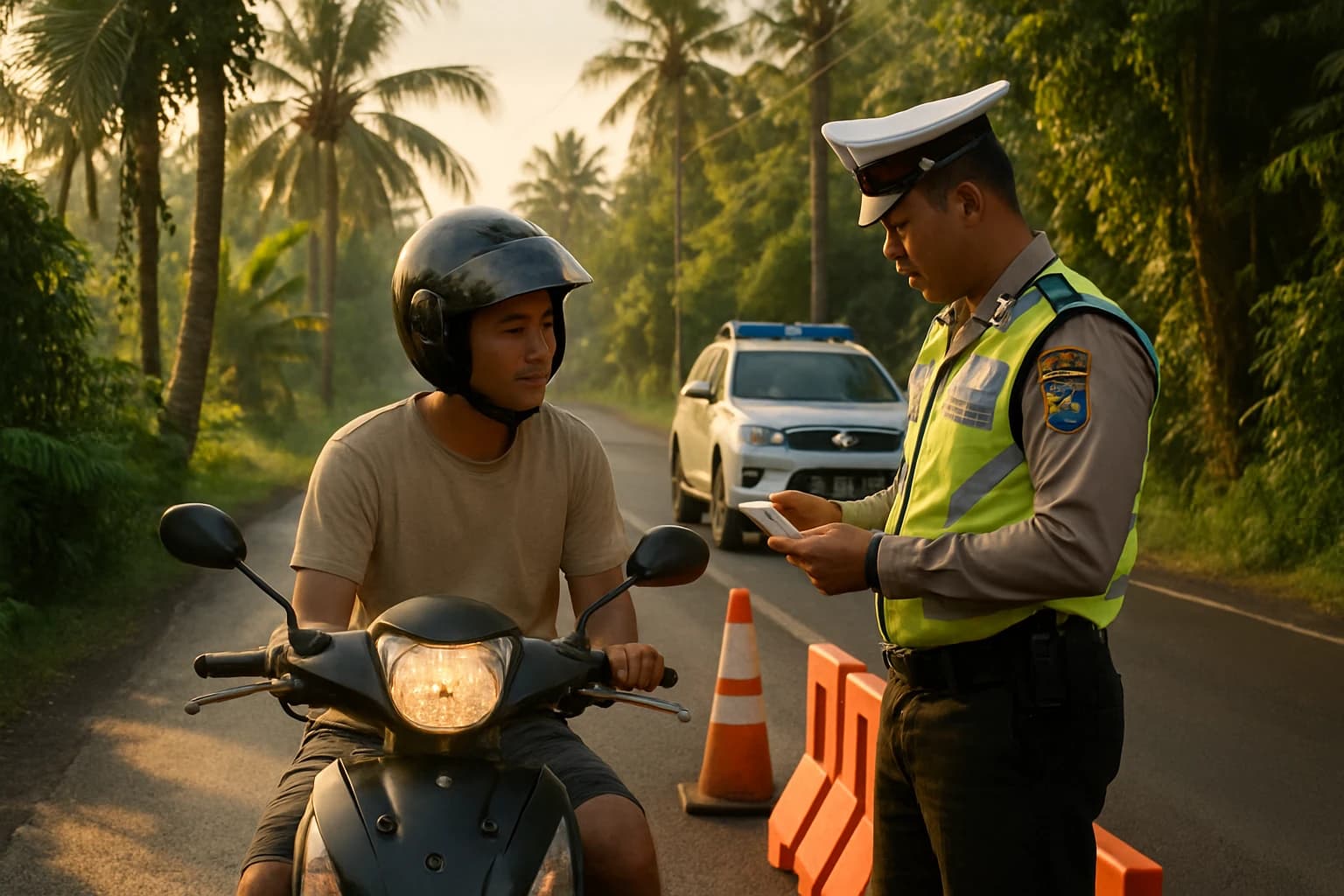
The consequences of the wrong license are concrete. A missing document at a check by the traffic police (Polantas) typically costs IDR 300,000 to 500,000 per document, and a photo of your license on your phone is almost never accepted: carry the physical booklet. More serious still: riding without a valid license for the right category can void your travel insurance coverage in the event of an accident. Most insurers refuse to pay if the rider was committing an illegal act at the time — and a hospital stay after a serious scooter accident can exceed USD 20,000, entirely at your expense. The right license isn't a formality; it's an insurance policy in its own right.
A word on insurance, while we're at it: no private insurance is legally mandatory in Indonesia. The SWDKLLJ you pay with the annual tax is a contribution to a public accident fund, not damage coverage. For long-term use, a private policy — at minimum in Total Loss Only form (theft / total loss), ideally comprehensive — remains strongly recommended, even if it stays optional.
Recap: your papers budget
In short, a used vehicle properly made legal in Bali involves three types of expense: the transfer fees once (around IDR 445,000 to 535,000 for a motorbike since the BBNKB II was abolished), the annual tax (PKB ≈ 2% of the vehicle's value + flat SWDKLLJ), and the five-year fees (around IDR 185,000 every five years, on top of the tax). On top of that comes the cost of the right license. Modest amounts next to the vehicle's price, but skipping them — especially the unpaid tax over more than two years — ends up costing infinitely more.
To find a vehicle whose papers are clean and whose seller is identifiable, browse the listings in the Vehicles category and, more specifically, Scooters & motorbikes on Lokalfinds. Buying from another expat who's selling up before they leave, with the original BPKB in hand, remains the surest way to avoid nasty administrative surprises.
Frequently asked questions
What's the difference between the STNK and the BPKB?
The STNK (Surat Tanda Nomor Kendaraan) is the annual registration card: it identifies the vehicle and proves the tax is paid. It's renewed every year and fully reissued every five years. The BPKB (Buku Pemilik Kendaraan Bermotor), the blue book, is the definitive proof of ownership: whoever's name appears on it is the legal owner. The two must match the vehicle (chassis and engine numbers) and each other. Without the original BPKB, never buy.
How much does the balik nama cost for a motorbike in Bali in 2026?
Since the BBNKB II was abolished on 5 January 2025, transferring a used motorbike involves only fixed administrative fees: around IDR 445,000 to 535,000 in total (STNK 100,000, plate 60,000, BPKB 225,000, physical inspection 25,000-50,000, SWDKLLJ 35,000, plus 150,000 of mutasi if the vehicle comes from another district), on top of which comes the annual PKB tax. These figures are indicative and vary slightly by region.
Can a foreigner register a vehicle in their own name?
Yes. A foreigner holding a passport and a KITAS or KITAP can do the balik nama into their own name, often by also providing proof of address and sometimes an NPWP. On a tourist visa, most go through a trusted local or a sponsor for the BPKB. In every case, doing the transfer protects your resale value (20 to 30% more) and prevents fines from tracing back to the previous owner.
How do I pay the annual tax on my scooter?
The annual tax (PKB + SWDKLLJ) is settled very simply through the official SIGNAL app (national digital Samsat), the regional e-Samsat, a Samsat Keliling bus or a Samsat Corner counter in a shopping center. These channels only handle the annual tax, though: the five-year renewal, for its part, requires physically presenting the vehicle at the Samsat office.
What happens if I don't pay the tax on time?
A penalty (denda) applies by the formula PKB × 25% × (months overdue / 12), plus a SWDKLLJ penalty of around IDR 32,000 for a motorbike; it's generally capped at 24 months of arrears. Above all, a vehicle whose tax stays unpaid for more than two years risks being struck off: it becomes bodong, unsellable and impossible to re-register. Better to never let it slide.
What license do I need to ride a scooter in Bali?
As a tourist, you need an International Driving Permit (IDP) whose category explicitly covers two-wheelers, alongside your national license: an IDP limited to cars doesn't cover a scooter. As a resident (KITAS/KITAP), you get the local Indonesian license, the SIM — a motorbike corresponds to SIM C and a car to SIM A. A missing document costs IDR 300,000 to 500,000 per item at a checkpoint.
Does riding without the right license void my insurance?
Yes, and it's a very real risk. Most travel and health insurers refuse to cover a claim that arose while the rider was committing an illegal act — for example riding a scooter on a "car-only" IDP. In a serious accident, the medical bills, which can exceed USD 20,000, would fall entirely on you. The right license isn't just a matter of a fine: it's what keeps your insurance valid.