Bali recorded 66,760 bites from animals capable of transmitting rabies in 2025, and 16 human deaths, against 55,767 bites and 7 deaths in 2024 (Dinas Kesehatan Bali, the provincial health service, known locally as Dinkes). For January to May 2026 the provincial counter stands at 29,317 bites and 4 deaths — roughly 194 reported bites a day.
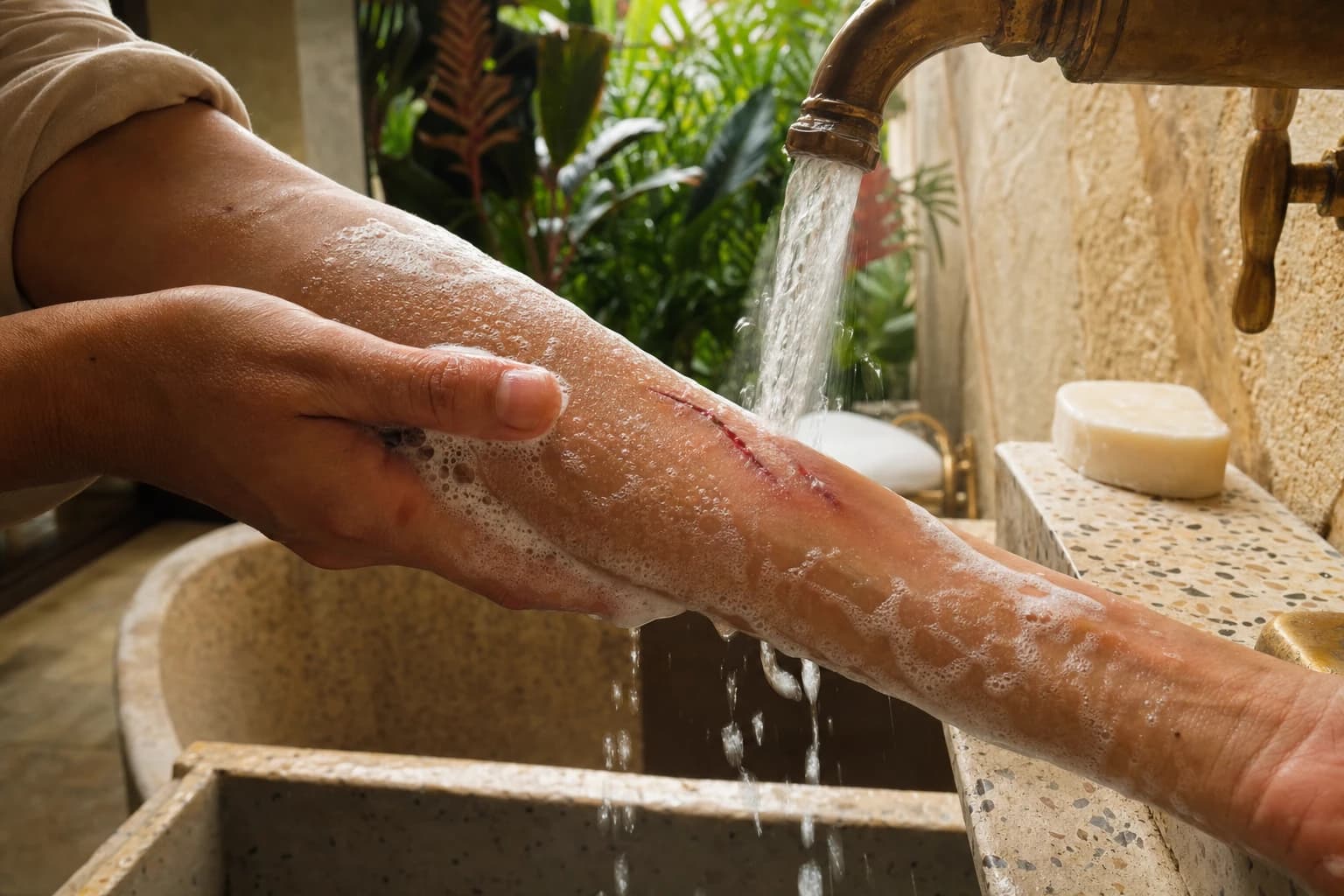
If you are bitten, scratched or licked on an open wound, the response comes down to three moves. Wash under running water with soap for at least 15 minutes: the WHO, the Indonesian health ministry and the province of Bali all print the same duration. Disinfect with povidone-iodine or 70% alcohol. Then present yourself the same day at a public rabies centre — the island has more than 120 — or at a private clinic open 24/7. Whatever you do, do not wait to see whether the animal dies: Dinkes Bali blames the 7 deaths of 2024 on delayed treatment, those patients reaching hospital an average of three months after the bite. Once symptoms appear, rabies is fatal in 100% of cases; given in time, post-exposure prophylaxis prevents those deaths (WHO).
How many bites, how many deaths? The full series
Bali's figures come out piecemeal, published by Dinkes and picked up by the local press. They count GHPR (gigitan hewan penular rabies) — bites inflicted by an animal capable of transmitting rabies, not confirmed rabies cases.
| Period | Reported bites | Human deaths | Source |
|---|---|---|---|
| 2024 (full year) | 55,767 | 7 | ANTARA Bali, 07/01/2025 |
| 1 Jan → 20 July 2025 | 34,845 | 12 | BPBD Bali, 23/07/2025 |
| 1 Jan → 26 Sept 2025 | 49,094 | 12 | The Bali Times / detik, Oct 2025 |
| 2025 (full year) | 66,760 | 16 | Dewata News, 10/01/2026 |
| 1 Jan → May 2026 | 29,317 | 4 | IDN Times / Dinkes Bali, 07/06/2026 |
| Jan → early July 2026 | "nearly 30,000" | 5 | SCMP, 05/07/2026 |
Four independent sources land on the same order of magnitude: 175 to 183 reported bites a day in 2025. The raw ratio for January to May 2026 (29,317 bites over 151 days) works out at about 194 a day; that is our arithmetic, not an official figure.
Two warnings about the death counts. For 2025, the tally sat frozen at 12 from 20 July to 26 September before reaching 16 for the year: always pin a death figure to its cut-off date. For 2026, Dinkes Bali counts 4 deaths for January to May (one in Buleleng, one in Jembrana, one in Gianyar, one in Karangasem), while the South China Morning Post had 5 as of 5 July 2026. No source reconciles the two, and no half-year provincial report has been published for 2026.
On post-bite vaccination, Dinkes Bali administered 47,887 doses of VAR (the rabies vaccine) in 2025, then 21,807 from January to May 2026 — around 74% of the bite victims recorded over that period. Put another way, close to one bitten person in four never appears in the vaccination statistics. The provincial stock announced for 2026 is 88,599 vials.
To place Bali in the national picture: health ministry circular no. HK.02.02/C/508/2025 of 19 March 2025 counts 185,359 bites and 122 deaths across Indonesia in 2024, and classes 26 of the 38 provinces as endemic. That same year, Bali's 55,767 bites made up 30% of the national total — from a single province out of 38.
Where is the risk concentrated?
Bad news for the expat community: the worst-hit kabupaten — Indonesia's regency, the administrative tier closest to a county — is also the one most foreigners live in.
| Kabupaten / Kota | Bites, 1 Jan → 26 Sept 2025 |
|---|---|
| Badung (Canggu, Seminyak, Kuta, Jimbaran, Nusa Dua) | 8,664 |
| Denpasar | 6,949 |
| Gianyar (Ubud) | 6,054 |
| Tabanan | 5,921 |
| Karangasem | 5,709 |
| Buleleng | 5,307 |
| Jembrana | 4,550 |
| Klungkung | 3,218 |
| Bangli | 2,722 |
The 13 October 2025 reading confirms the pecking order (Badung 9,495, Denpasar 7,488): Badung tops every release. If you live in one of Canggu's micro-neighbourhoods, you live in the most exposed regency on the island by volume.
Authorities also declare "red zones" (zona merah). The official definition, restated in July 2025: an area where the virus is actively circulating and urgent intervention is required — a single confirmed case in one village is enough to trigger it. Kuta Selatan (South Kuta) was named explicitly; a longer list recorded in October 2025 adds Nusa Dua, Tanjung Benoa, Jimbaran and Canggu.
Be wary of the marketing version of the same idea. A private clinic page dated 27 November 2025 redefines a "red zone" as any area with a high density of stray animals or recently reported cases, without citing a single official source or figure. That is not the provincial criterion.
Two local readings from 2026 give the temperature:
- Gianyar: 4,545 bites from January to June 2026, an average of 756 a month, against 8,413 for the whole of 2025 (~701/month) and 7,654 in 2024 (~638/month) — three straight years of increase. The regency has budgeted 600 million IDR for vaccine and 166,735,225 IDR for rabies immunoglobulin in 2026.
- Bangli: of 129 samples taken from biting dogs between January and July 2026, 28 came back positive for rabies — about 22%. On 13 July 2026 a village dog bit a resident of the Sedit neighbourhood (Kelurahan Bebalang), then two more people — one of them a Chinese tourist — after fleeing to Kelurahan Kawan; the laboratory confirmed it positive.
Dog, cat or monkey: which animal should worry you?
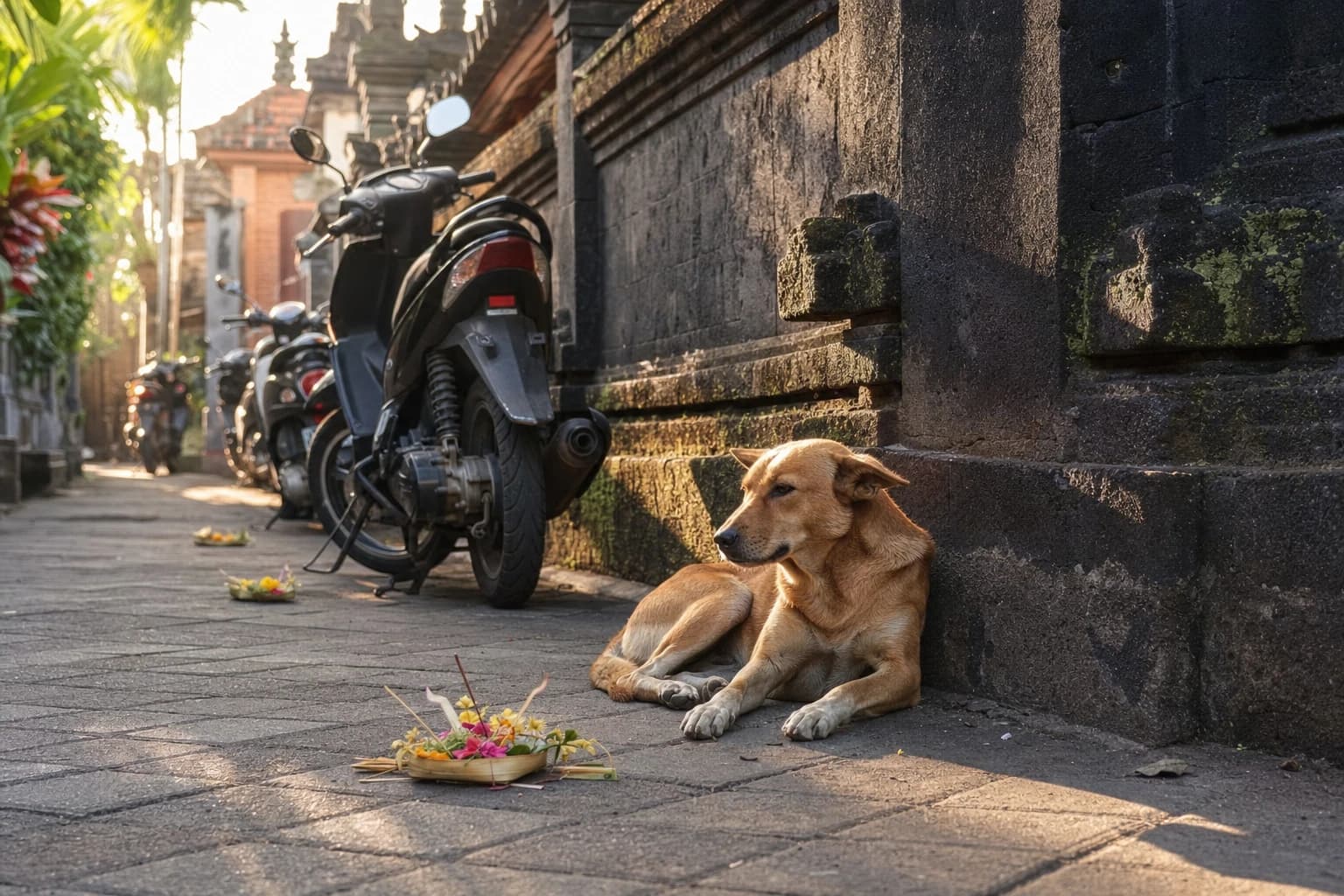
Indonesia's health ministry (Kemenkes) defines HPR (hewan penular rabies, rabies-transmitting animals) as dogs, cats and monkeys. Across Indonesia, dogs account for 98% of cases; cats and monkeys share the remaining 2%. Worldwide, the WHO attributes 99% of human cases to dog bites and scratches.
Those percentages have bred a dangerous reflex: "it's only a cat". The documented death of May 2026 says otherwise. A 38-year-old woman, bitten by a stray cat while hanging out her washing in Jembrana, in the west of the island, died a few weeks later. A cat or a monkey is still an official HPR: the response is exactly the one you would give a dog bite.
Monkeys deserve some precision, because a lot of articles make a mess of it. In April 2025 the head of Gianyar regency's animal health centre issued a warning to sanctuary visitors: don't touch or hold the macaques, and seek treatment immediately if bitten. At the same time, no rabies case has been confirmed in the macaques of Ubud's Monkey Forest since it opened in 1960: dead monkeys are analysed by the regional veterinary centre and the results, according to the park, always come back negative. In practice: no infection is documented there to date, but a monkey bite still triggers the full protocol — and, as you will see below, the island's most publicised medical bill came from exactly that, a macaque bite.
The first 15 minutes: the one step everyone agrees on
Three authorities write exactly the same thing, which is rare enough to be worth pointing out. The WHO recommends thorough flushing and washing of the wound with soap and water for at least 15 minutes, immediately after exposure. Kemenkes specifies soap or detergent under running water for 15 minutes, followed by an antiseptic. The province of Bali's official portal gives the same duration. Dinkes Bali names the antiseptic: povidone-iodine or 70% alcohol.
Fifteen minutes is a long time. Use a watch. It is the first step of the WHO protocol, and the only one you can carry out on your own, without a medical opinion.
What comes next depends on the exposure category defined by the WHO:
| WHO category | What it covers | Recommended response |
|---|---|---|
| I | Touching or feeding an animal, licks on intact skin | Wash the exposed skin, no prophylaxis |
| II | Nibbling of uncovered skin, minor scratches or grazes without bleeding | Wound washing and immediate vaccination |
| III | Transdermal bites or scratches, contamination of a mucous membrane | Washing, immediate vaccination and rabies immunoglobulin |
A transdermal bite to the face, neck or hands is classed category III and treated as high risk: that is where the route to the central nervous system is shortest. The doctor does the classifying, not you — but knowing the grid tells you why you are being offered immunoglobulin, or why you are not.
Report the animal to the local authorities as well (your banjar, the regency veterinary service): that report is what triggers sampling and, where warranted, a red-zone declaration.
Where to get treated: public network or private clinic?
Bali has a dedicated public network. WHO Indonesia counted 103 rabies centres in 2023; a named directory published in September 2025, addresses and phone numbers included, lists 121: Buleleng 23, Badung 14, Gianyar 14, Karangasem 14, Tabanan 12, Denpasar 12, Bangli 12, Jembrana 11, Klungkung 10. The published breakdown actually adds up to 122, a one-unit gap the source does not explain. These are puskesmas (community health centres) and public hospitals (RSUD). The full list with phone numbers deserves a screenshot on your phone: at three in the morning, hunting for the nearest open puskesmas, that is not the moment to discover you have no signal.
On the private side, four operators publicly document rabies treatment:
| Provider | Locations | Availability and response times |
|---|---|---|
| Hydro Medical | 7 sites: Subak Sari, Batu Bolong, Berawa and Bumbak (Canggu), Batu Belig, Seminyak, Lippo Mall Kuta | 24/7, phone line |
| Unicare Clinic | Ubud, Kuta (Central Parkir), Nusa Dua, Uluwatu | 24/7 advertised at all four sites |
| Trishnanda Care Centre | Mobile call-out | Around 60 min to Seminyak, Canggu and Kuta; 90 to 120 min to Ubud and Uluwatu |
| Bali International Hospital | Sanur | 24/7 rabies emergencies, WhatsApp +62 812 1166 1127, emergency line 150 919 |
The pinch point is not the vaccine, which is available more or less everywhere, but rabies immunoglobulin (RIG / SAR), essential in category III. A detailed first-hand account published in September 2025 describes poor HyperRAB availability in Indonesia: the patient ended up considering a Bali-Surabaya round trip, some 1.3 million IDR in flights, to track down a single vial. Several clinics advertise permanent stock in 2026 — a commercial claim, unverifiable by a third party. The practical rule fits on one line: phone before you travel, and ask explicitly whether the immunoglobulin is in stock that day.
What it actually costs
First observation: price opacity is the norm in Bali's private sector. Several clinics publish pages titled "full cost of the rabies vaccine" that contain no amount whatsoever and send you to WhatsApp. The only usable figures we found:
| Item | Amount recorded | Source and date |
|---|---|---|
| Vaccine, single dose (mobile clinic) | 935,000 IDR | Trishnanda Care Centre, 17/05/2025 |
| Four-dose package, nursing fees included | 2,900,000 IDR | Trishnanda Care Centre, 17/05/2025 |
| Vial of Verorab | ~750,000 IDR | Patient first-hand account, 22/09/2025 |
| Vial of HyperRAB (immunoglobulin) at a clinic, injection included | 6,300,000 IDR | Patient first-hand account, 22/09/2025 |
| Vial of immunoglobulin through the public system (1 ml) | 1,650,000 to 1,960,000 IDR | Government source quoted by the same patient |
| Vial of HRIG billed to a 12-year-old patient | ~3,200,000 IDR × 4 vials | detik, 23/09/2025 |
Note the inconsistency in the Trishnanda package: 935,000 × 4 = 3,740,000 IDR, while the advertised total is 2,900,000 IDR. Take it for what it is — a commercial package, not a price list.
The case that went round Indonesia gives you the scale of the worst-case scenario. In September 2025 a 12-year-old Australian tourist was bitten on the neck at Ubud's Monkey Forest: a category III wound. The family announced a bill of 69,286,452 IDR; the clinic disputes that and says the patient paid 48,686,452 IDR. Nobody has arbitrated between the two versions. The breakdown given by the clinic: human immunoglobulin at around 3.2 million IDR a vial, four vials needed given the child's weight, plus procedure fees and consumables. Hold on to the principle: the immunoglobulin dose is calculated by body weight. The bill for an 80 kg adult has nothing in common with a child's.
And in the public system? State-supplied vaccine is bought out of provincial and regency budgets — Gianyar is putting 600 million IDR into it in 2026 — and it is routinely described as distributed free of charge at puskesmas and RSUD. No official Indonesian page we were able to open says so in writing, and none spells out whether foreigners qualify. So do not assume it will be free for you. Go to the rabies centre without waiting; and if you fall back on a private clinic, ask for a quote before the injection.
Then there is insurance. Two private clinics state that a "comprehensive" travel insurance policy generally covers the whole treatment, immunoglobulin included (Hydro Medical, 4 December 2025; Unicare, updated 21 July 2026). Plausible — but these are sales arguments, not contractual guarantees. Check your policy now, not at the emergency-room desk: it is exactly the sort of line to tick off on the Bali moving checklist.
Two vaccination schedules coexist in Bali: don't mix them
This is the least known piece of safety information on the whole subject. Depending on whether you enter the Indonesian public system or an international private clinic, you will not be given the same schedule. The public regimen — two doses on day 0, one in each arm, then one dose on day 7 and one on day 21 — is the one published by the Buleleng regency health service, relaying the health ministry.
| What changes | Indonesian public network | Bali's international private clinics |
|---|---|---|
| Schedule | D0: 2 doses — D7: 1 dose — D21: 1 dose | D0 — D3 — D7 — D14 (sometimes + D28) |
| Route / dose | 0.5 ml intramuscular, deltoid (anterolateral thigh in infants) | Intramuscular, deltoid |
| If you are already vaccinated | To be assessed on site | 2 booster doses, D0 and D3 |
| Immunoglobulin (RIG/SAR) | On the day of exposure, infiltrated around the wound | As soon as possible, no later than 7 days after the 1st dose |
Both regimens are recognised protocols. The trouble starts when you begin at a puskesmas and continue at a private clinic, or the other way round: the appointments do not fall on the same days, and no source we consulted documents the transition from one schedule to the other.
In practice: pick one channel and stay in it. Keep your record card, your prescriptions and the brand name of whatever was injected — in Bali the most frequently cited vaccine is VERORAB and the immunoglobulin HYPERRAB at 300 IU/ml. And if you do have to change provider, produce those documents and have the schedule confirmed by the doctor taking over the file.
Why do people still die of rabies in Bali?
Not for want of vaccine. In January 2025 the head of Dinkes Bali put the 7 deaths of 2024 down to delayed treatment: those patients turned up at hospital an average of three months after the bite, while the province was sitting on 80,000 vials of vaccine. The bottleneck was elsewhere — 600 vials of immunoglobulin, and not one more.
That delay is not irrational: the biology of the virus is perverse. Incubation typically runs 2 to 3 months, with extremes from one week to one year according to the WHO; Dinkes Bali puts it at 2 to 8 weeks in most cases, with extremes ranging from 10 days to 2 years. Throughout that time, nothing happens. The wound heals, the incident is forgotten. Then come fever, nausea, sore throat, violent headaches, agitation, hydrophobia (fear of water) and photophobia (fear of light). At that stage, the disease is fatal in 100% of cases: there is no effective treatment. The WHO puts the global toll at 59,000 deaths a year, 40% of them children under 15.
Hence the only rule that counts: time is not your friend, and an animal that "looked fine" proves nothing. Government travel advice says as much — France's foreign ministry tells travellers to see a doctor immediately even if their rabies vaccination is up to date (page updated 22 July 2026). Check your own country's advisory for the equivalent line.
The root of the problem: dog vaccination
Human rabies in Bali is a symptom; the disease itself is canine. The story starts in 2008 with the first documented human death on the island; by mid-2010 the virus had reached the whole territory. The FAO points out that mass dog culling failed to control the epidemic and even helped it spread, while mass vaccination campaigns cut human cases to a fraction of their peak from 2013 onwards. The strategy adopted since, known as Integrated Bite Case Management, rests on a coordinated response between veterinary and human health services. It is the One Health approach, aligned with the international "Zero by 30" goal: no more human deaths from dog-transmitted rabies by 2030.
That leaves a paradox the official data does not resolve. The province's official portal restates the benchmark: 70% canine vaccination coverage to break transmission. Yet Bali reports 85.35% in 2025 — 482,868 animals vaccinated out of an estimated population of 565,737 — after 79.43% in 2024, with Karangasem at 96.25% and Jembrana at 64.92%. The threshold is cleared on paper, and bites and deaths keep rising anyway.
Nobody has settled it publicly. Three hypotheses circulate, never brought together in a single analysis: a real dog population larger than the estimates; a distinctively Balinese form of ownership, the dog that has an owner but is left to roam (berpemilik tapi diliarkan); and better reporting of bites, with awareness campaigns pushing more victims to seek treatment. The Gianyar authorities explicitly put part of the rise down to that last factor. In other words, some of the increase may be statistical rather than epidemiological — and no source lets you measure how much.
Adopting an animal in Bali: the checks that are not negotiable
Plenty of expats adopt a dog or a cat locally, often through a listing or a shelter. Three habits follow directly from everything above:
- Ask for the rabies vaccination record and the date of the last booster before you take the animal home, wherever it comes from. It is the first line to check in a Pets listing, on Lokalfinds and anywhere else.
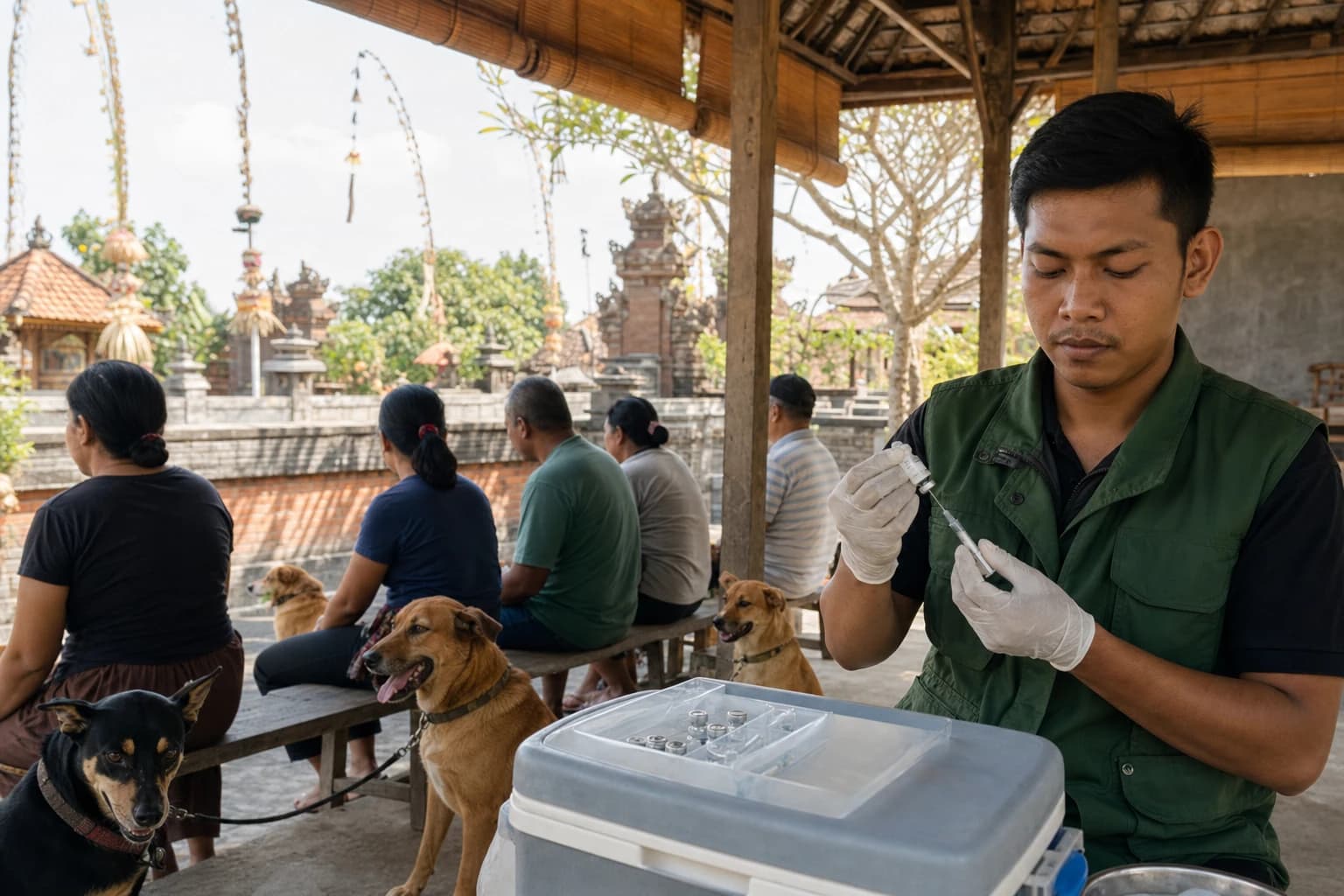
- HPR vaccination is free during the province's mass campaigns, run by Bali's Dinas Pertanian (the agriculture service). If the animal is not up to date, getting it there can cost nothing at all — only a little organising.
- A roaming dog is not necessarily an ownerless dog. That is the heart of Bali's problem, and it is also what makes reporting a biting animal useful: it triggers sampling and vaccination in the household concerned.
For an injured, sick or aggressive animal in the street, the NGO BAWA (Bali Animal Welfare Association), based in Lodtunduh (Ubud), runs a 24/7 emergency line and an animal ambulance. It claims more than 22,000 emergency call-outs and 9,000 animals vaccinated against rabies a year, and is among the partners in the provincial agriculture service's mass vaccination campaigns. Up-to-date contact details are on its contact page. If you are doing the opposite — bringing your own animal in from abroad — the full health pathway is set out in our guide to bringing your dog or cat to Bali.
Before you go: pre-exposure vaccination and numbers to save
Government travel-health advice — the French foreign ministry's Indonesia page is the version we checked — states that pre-exposure rabies vaccination may be advisable depending on the type of stay, and particularly for young children from the moment they can walk; under-15s account for 40% of deaths worldwide according to the WHO. Bali's clinics do not all use the same pre-exposure schedule either: 2 doses, D0 and D7, at Hydro Medical and Trishnanda; 3 doses, D0, D7 then D21 or D28, at Unicare. A pre-exposure course never removes the need to be seen after a bite: it lightens the protocol, which then usually comes down to two boosters (D0 and D3), with no immunoglobulin.
Three numbers to save before you need them: your own consulate in Bali — the French consular agency in Denpasar, for example, is on +62 811 39601401 — the police in Bali, 911, and the public rabies centre nearest to where you live. Add the switchboard of the private clinic in your neighbourhood if you have one close by. For everything else about settling in, it is all in our guide to life in Bali in 2026.
Frequently asked questions
What should I do immediately after a dog bite in Bali?
Wash the wound under running water with soap for at least 15 minutes, watch in hand: the WHO, the Indonesian health ministry and the province of Bali all recommend precisely the same thing. Then disinfect with povidone-iodine or 70% alcohol, and present yourself the same day at a public rabies centre or a private clinic. Finally, report the animal to the local authorities.
How much does the rabies vaccine cost in Bali?
In the private sector, the rare published prices from 2025-2026 sit around 935,000 IDR a dose, with one package advertised at 2,900,000 IDR for four doses. Immunoglobulin changes the scale: from 1,650,000 to 1,960,000 IDR a vial through the public system, up to 6,300,000 IDR at a clinic. Most clinics publish no price list at all and send you to WhatsApp: ask for a written quote before the injection.
Is the vaccine free in Bali's public hospitals?
The vaccine is bought out of public budgets — Gianyar is putting 600 million IDR into it in 2026 — and it is routinely described as distributed free of charge at puskesmas and RSUD. No official Indonesian page we were able to open states this explicitly, and none spells out whether foreigners qualify. Go to the rabies centre without waiting, but do not assume it will be free for you.
How long do I have to get vaccinated after a bite?
The same day. No official source sets a safe window, and incubation can be as short as a week according to the WHO. Dinas Kesehatan Bali blames the 2024 deaths on delayed treatment: those patients presented an average of three months after the bite. If immunoglobulin is indicated, it must be given no later than seven days after the first vaccine dose. Do not sit and watch the animal in the meantime.
Does a cat scratch or a monkey bite justify the protocol?
Yes. The Indonesian health ministry classes dogs, cats and monkeys as rabies-transmitting animals. The documented death of May 2026 in Bali followed a stray cat bite. No rabies case has been confirmed in the macaques of Ubud's Monkey Forest since 1960, but a monkey bite still calls for immediate medical attention.
How many bites and deaths have been recorded in Bali in 2026?
Bali's health authorities recorded 29,317 bites from rabies-transmitting animals and 4 deaths from January to May 2026, against 66,760 bites and 16 deaths for the whole of 2025. The South China Morning Post counted 5 deaths as of 5 July 2026. No half-year provincial report has been published for 2026 so far: always date the figure you quote.
Should I get a rabies vaccination before travelling to Bali?
Government travel-health advice — France's foreign ministry, in the version we checked — says pre-exposure vaccination may be advisable depending on the type of stay, and particularly for young children from the moment they can walk. Bali's clinics use either a two-dose pre-exposure schedule (D0 and D7) or a three-dose one (D0, D7, then D21 or D28). That schedule does not remove the need to be seen after an exposure: it lightens the protocol, usually down to two boosters with no immunoglobulin. A decision to take with a doctor.
Sources
- (official) WHO, Rabies fact sheet, 5 June 2024: washing for ≥ 15 minutes, exposure categories I/II/III, incubation, 100% lethality, 59,000 deaths a year, 40% children under 15.
- (official) Kemenkes, Mengenal Penyakit Rabies, 2 June 2023: definition of HPR (dogs, cats, monkeys), 98% dogs, symptoms, 15-minute wash.
- (official) Kemenkes, circular HK.02.02/C/508/2025, 19 March 2025: 185,359 bites and 122 deaths in Indonesia in 2024, 26 endemic provinces.
- (official) Dinas Kesehatan of Buleleng (Bali), 18 March 2019, following the health ministry: public schedule D0 (2 doses, one in each arm), D7 and D21 (1 dose), immunoglobulin infiltrated around the wound at D0, 15-minute wash.
- (official) Dinas Kesehatan of North Sulawesi, rabies factsheet: VAR dose of 0.5 ml, intramuscular in the deltoid (anterolateral thigh in infants), same D0 ×2 / D7 / D21 schedule.
- (official) Love Bali, the province's official portal, 15 October 2025: protocol, 70% canine coverage threshold.
- (official) Dinas Kesehatan Bali, Waspada Rabies, 23 August 2023: antiseptic after washing, VAR/SAR criteria.
- (official) BPBD Bali, position as of 20 July 2025: 34,845 bites, 23,705 VAR doses, 12 deaths, 183 cases a day.
- (official) WHO Indonesia, 16 July 2023: rabies centres, Zero by 30 goal.
- (official) FAO, One Health Bali: 2008-2013 history, failure of culling, Integrated Bite Case Management.
- (official) Dinas Pertanian Bali: mass HPR vaccination campaign "at no charge", launched on 6 May 2025 at Nusa Dua, with BAWA among the partners.
- (official) France Diplomatie, Indonesia health advice and useful contacts, updated 22 July 2026: pre-exposure vaccination, Denpasar consular agency, police 911.
- (press) ANTARA Bali, 7 January 2025: 2024 figures (55,767 bites, 7 deaths), arrival at hospital "an average of three months" after the bite, 80,000 vials of VAR and 600 of SAR in stock, I Nyoman Gede Anom (Dinkes Bali).
- (press) Dewata News, 10 January 2026: 2025 figures (66,760 bites, 16 deaths, 47,887 VAR doses, 88,599 vials for 2026).
- (press) IDN Times, 7 June 2026: 29,317 bites, 21,807 VAR doses and 4 deaths from January to May 2026.
- (press) SCMP, 5 July 2026: nearly 30,000 bites and around 21,000 people vaccinated from January to May 2026, 5 deaths, the fatal case of May 2026 caused by a stray cat in Jembrana.
- (press) The Bali Times, 3 October 2025: 49,094 cases as of 26 September 2025 and the breakdown by kabupaten.
- (press) BaleBengong, 26 October 2025: reading of 13 October 2025 (Badung 9,495, Denpasar 7,488), 175-180 bites a day, 70-80% target not met, dogs "berpemilik tapi diliarkan".
- (press) Bali Post, 5 February 2026: canine coverage of 85.35% in 2025 (482,868 / 565,737), 79.43% in 2024.
- (press) Kilas Bali, 21 July 2026: Gianyar, 4,545 cases from January to June 2026, VAR and SAR budgets.
- (press) Bali Post, 15 July 2026: Bangli, 28 dogs positive out of 129 samples between January and July 2026; positive dog that bit three people on 13 July at Bebalang then Kawan (I Wayan Sarma, Dinas PKP Bangli).
- (press) SCMP, 22 July 2025: official definition of red zones, South Kuta.
- (press) Garda Animalia, 7 October 2025: named red zones (Kuta Selatan, Nusa Dua, Tanjung Benoa, Jimbaran, Canggu).
- (press) The Bali Sun, 29 April 2025: warning from Dr Nyoman Arya Dharma (Gianyar animal health), no rabies case in the Monkey Forest macaques since 1960, dead monkeys systematically analysed.
- (press) detik Travel, 23 September 2025: bill of 48,686,452 IDR (clinic's version) against 69,286,452 IDR (family's version), HRIG at ~3.2 million IDR a vial.
- (press) IDN Times, 27 September 2025: directory of Bali's 121 rabies centres with addresses and phone numbers.
- (community) Matthew Brealey, 22 September 2025: first-hand account, Verorab and HyperRAB prices, supply shortages.
- (community) BAWA, Bali Animal Welfare Association: 24/7 emergency line and animal ambulance, based in Lodtunduh (Ubud); claimed figures on the NGO's site (22,000+ emergency call-outs and 9,000+ animals vaccinated a year).
- (commercial) Saline Bali, 6 February 2026: D0/D3/D7/D14 schedule, VERORAB, HYPERRAB 300 IU/ml, immunoglobulin deadline.
- (commercial) Unicare Clinic, updated 21 July 2026: RIG dose by weight, infiltration, seven-day deadline, travel insurance.
- (commercial) Hydro Medical: 24/7 locations, post-exposure protocol (D0/D3/D7/D14) and pre-exposure protocol (D0/D7), no prices published.
- (commercial) Hydro Medical, "Rabies treatment cost & insurance", 4 December 2025: claims most comprehensive travel insurance policies cover the entire treatment, vaccine and HRIG included — page contains no amounts at all.
- (commercial) Hydro Medical, "Bali rabies red zones", 27 November 2025: example of a marketing redefinition of the "red zone" (density of stray animals), with no official source or figure — not to be confused with the provincial criterion.
- (commercial) Trishnanda Care Centre, 17 May 2025: 935,000 IDR a dose, 2,900,000 IDR package, call-out times.
- (commercial) Bali International Hospital, 17 September 2025: 24/7 emergency care (cleaning, vaccine, immunoglobulin if needed), contacts; facility located in Sanur.