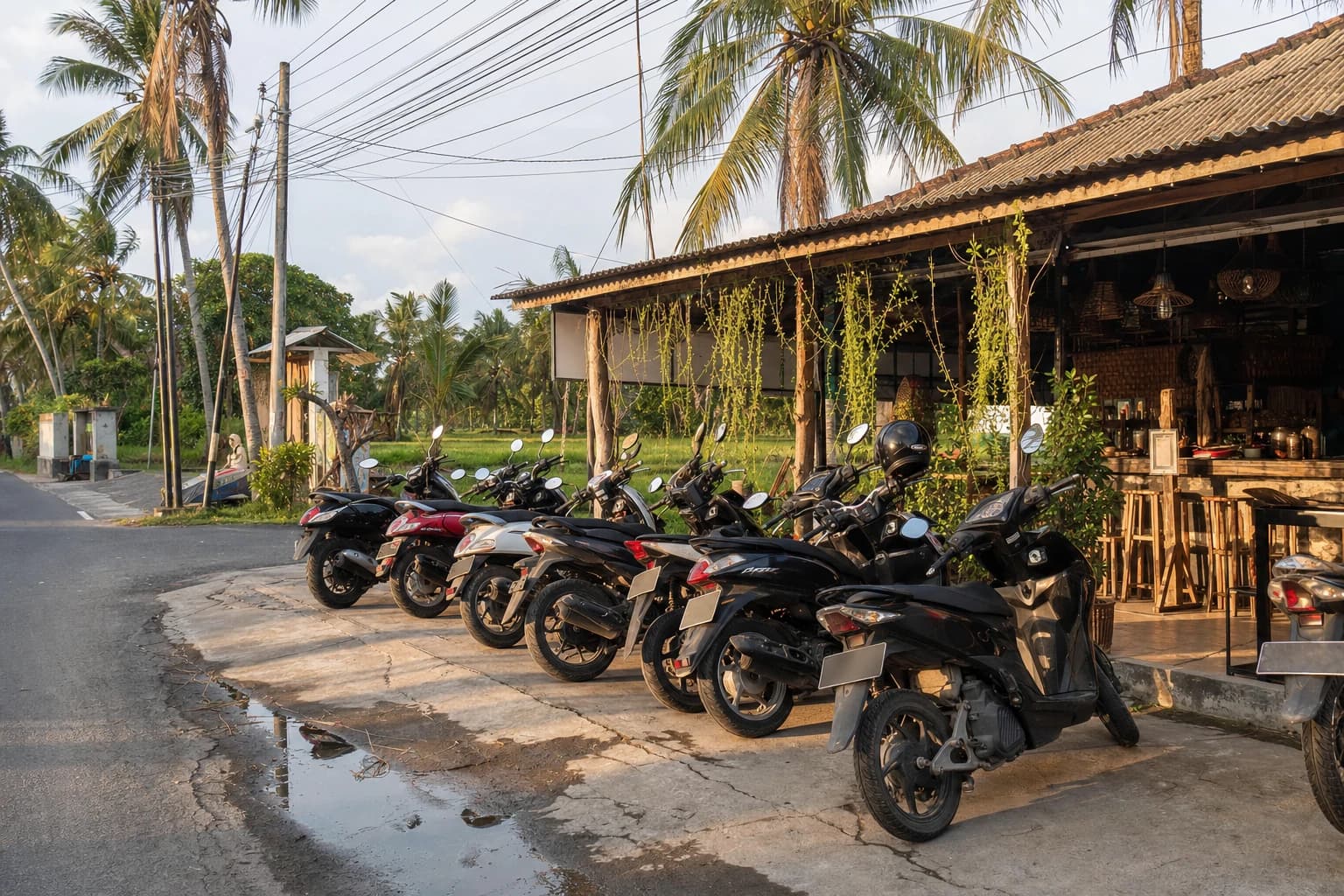
Leaving Bali cleanly means four jobs that cannot be improvised in the final week. The first one is set by Indonesian customs: motor vehicles, their spare parts, speedboats and aircraft are explicitly excluded from the "barang pindahan" regime, the personal-effects rules that cover a household removal — so your scooter is not going into the container, and you will have to sell it here. The second is contractual: in Bali the annual rent is paid in one lump sum up front, and most leases refund nothing for the months you do not use. The third is logistical: international movers truck the freight overland to Tanjung Perak, the port of Surabaya, and from there you are looking at 30 to 45 days at sea to Europe and 12 to 18 days to Australia. The fourth is the one that costs you most if it slips your mind: with a KITAS or a KITAP still valid, you have to apply for an Exit Permit Only (EPO), issued in three to four working days, after which you have a maximum of seven days to leave the country.
Two things to unlearn if you are reading older guides. Since 1 July 2026, buying more than USD 10,000 of foreign currency against rupiah in a single month requires supporting paperwork — the threshold has come down from 100,000 to 50,000, then 25,000, then 10,000 in the space of a year. And the dormant-account freeze that caused so much noise in 2025 was lifted over the summer of 2025: the 31 million or so blocked accounts were reopened. Facts checked on 27 August 2026; the figures and lead times below are planning benchmarks, and only your own contract and a recent quote are binding.
The countdown: from D-60 to departure day
No public statistic tells you how long a scooter or a houseful of furniture takes to find a buyer in Bali, so the schedule below is an editorial recommendation rather than a standard. What it is built on, though, is verifiable: IndiHome's 14 working days' notice, three to four working days for the EPO and then seven days to fly, 30 to 45 days at sea to Europe.
| Deadline | What to do | The constraint driving it |
|---|---|---|
| D-60 | List the vehicle and the furniture; ask for shipping quotes; open the pet file | Freight to Europe takes 30 to 45 days port to port, preparation aside |
| D-45 | Tell the landlord or the agent; look for someone to take over the lease if the contract allows it | Prepaid rent only comes back if the lease is passed on |
| D-30 | Give notice on the internet line; book the freight; fix the flight | IndiHome requires 14 working days' notice |
| D-15 | Close the sales; notify the Samsat of the transfer; settle the accounts | Cut off any residual liability on the vehicle |
| D-7 | File the EPO application; return the modem; hand back the property | The EPO takes three to four working days depending on the office |
| D-day | Fly out, KITAS closed | An EPO obliges you to leave within seven days of issue |

Selling what you cannot take with you
The vehicle: banned from the container, sold on the island
The rule that catches leavers out comes from customs, not from the shipping lines. The Indonesian Directorate General of Customs and Excise names motor vehicles, speedboats, aircraft and their spare parts among the goods excluded from the personal-effects regime for a household removal. The freight forwarders based in Bali repeat the same list: "cars, motorcycles, scooters and their spare parts" sit among the refused items, whatever visa you hold. Nobody is going to load your two-wheeler, then. The only way out is to sell it before you fly.
A clean sale rests on three documents and one declaration: the BPKB (the blue book, your proof of ownership), the STNK (the registration certificate, with the annual road tax paid up), the faktur (the original invoice) if you still have it, and above all the notification of transfer to the Samsat.
That last step is the one people skip, and it is the riskiest one to skip. Sell without transferring ownership — the balik nama — and if the buyer collects speed-camera fines (ETLE) or lets the tax run unpaid, the trail leads straight back to the name printed on the BPKB, which is yours. Hence the case for arranging the balik nama into the buyer's name or, at the very least, signing a dated kwitansi (a receipt of sale) and having the old STNK blocked.
The transfer moves the price as well: a vehicle whose registered name was never changed sells for 20 to 30% less. Putting it right barely costs anything any more: since 5 January 2025 the BBNKB transfer tax has been scrapped on second-hand vehicles, as Indonesia's traffic police corps confirmed in October 2025. On a motorbike, what is left to pay is roughly IDR 385,000 of issuance fees (STNK, plate, BPKB) and IDR 35,000 of compulsory insurance, annual road tax aside. The paperwork in detail is in our guide to the STNK, the BPKB and the annual road tax.
When it comes to setting a price, only a handful of ranges are genuinely documented, and they do not line up perfectly: a 2025 reading puts the Vario and the Scoopy between 9 and 14 million IDR, while the 2026 readings nudge the second-hand Scoopy up a notch.
| Model | Range observed | Source and date |
|---|---|---|
| Common Honda Vario or Scoopy, decent condition | IDR 9 to 14 million | balivisa.co, June 2025 |
| Second-hand Honda Scoopy | IDR 12 to 18 million | baliexploring.com, 2026 |
| Yamaha XMAX | IDR 35 to 45 million | baliexploring.com, 2026 |
We are not publishing a price for other models, or for cars: no verifiable source puts a 2026 figure on them. The "paperwork" discount, on the other hand, remains the first thing a buyer will lean on. For the same market seen from the other side of the deal, read buying a used scooter in Bali.
Furniture, white goods, decor: ship it or sell it?
Not one of the forwarders we looked at publishes a rate card; every one of them quotes after a site visit and a volume calculation. The method, though, is simple: get it costed, then compare with what the piece is worth locally. For everyday furniture, white goods and decor, the sums almost always come down on the side of selling here, and only items with real sentimental value or that would be genuinely hard to replace earn the voyage.
The rest finds a buyer on the island, at second-hand prices. Furnishing a Bali villa on a budget describes the market from the point of view of whoever will be buying your things, and choosing a second-hand surfboard does the same for sports kit. Our tips for selling fast work just as well on a whole house cleared at once.
Cancelling cleanly: lease, internet, bank
The lease
In Bali the annual rent is almost invariably paid in one instalment, in advance, for the full term of the lease: that is the local norm, confirmed by the agencies and by the legal guides written for expats alike. Leaving early therefore usually entitles you to no refund at all on the unused portion, and the contract is the only thing that decides. Your one practical lever is to find someone to take the lease over, or to sublet the remaining months, if the contract allows it and the landlord agrees.
The security deposit generally runs to one to three months' rent. In principle it comes back when the lease is not renewed, but plenty of contracts allow a deduction for "damage" with no independent inspection: read that clause before you count on the money. Where the abuse is blatant, Indonesian civil law does offer a route. A somasi, a written formal demand, is the step required by articles 1238 and 1243 of the KUHPerdata before any action for wanprestasi, as the legal note published by Indonesia's Supreme Audit Board for Bali sets out. It is a real remedy, but a slow one: do not pin a departure three weeks away on it. Prices and market practice are covered in renting in Bali by the year.
Internet: what the IndiHome contract actually says
IndiHome, Telkomsel's fixed-line offer, publishes terms that leave little room for argument. The contract carries a minimum term of 12 months, and ending it early triggers an early-termination penalty of IDR 1,000,000. Cancelling means 14 working days' notice filed at a GraPARI branch, outstanding bills settled and the operator's equipment returned (modem, router, set-top box). Once the minimum term is behind you and the kit is back, cancelling costs nothing.
The other providers (Biznet, MyRepublic and the rest) work on similar logic — a commitment period, a possible penalty, notice, kit returned — but we found no comparable published terms for them: do not assume IndiHome's figures apply, open your own contract.
The bank: two myths worth correcting
First correction: there is no automatic freeze on accounts after three months of inactivity. The PPATK, Indonesia's financial intelligence unit, did block some 31 million dormant accounts in May 2025, using the suspension power granted to it by Law No. 8 of 2010 on money laundering. But in the face of the public backlash, and after the president stepped in, those accounts were reopened over the summer of 2025 — in July according to the SSEK law firm, in August according to The Jakarta Post. More to the point, Indonesian law sets no dormancy threshold at all: each bank applies its own policy, most often 6 to 12 months without a transaction. Closing the account properly is still the tidier option, but the three-month panic you will read in so many guides is not a thing.
Second correction, and this one matters more to your money: what many guides describe as a transfer cap is in fact a paperwork threshold. Since 1 July 2026, any purchase of foreign currency against rupiah above USD 10,000 per customer per month requires a document evidencing the underlying transaction — an invoice, school fees, medical costs, a debt repayment. For transfers abroad, the equivalent threshold sits at USD 25,000. Above those lines nothing is forbidden: it simply has to be documented. The currency threshold has dropped three times in a year, so check it before you repatriate anything substantial.
Closing an account, by contrast, gives nobody any trouble: bring the balance to zero, then ask the bank to close it. Some charge a fee for the privilege and require a minimum balance to cover it — the amount varies from one bank to the next, so ask your own branch rather than trusting a figure you found online.
| Item | What binds you | The thing to watch |
|---|---|---|
| Lease | The signed contract | Prepaid rent rarely refunded; a replacement tenant is the only real lever |
| Security deposit | The deduction clause | One to three months; "damage" deductions often made with no independent inspection |
| IndiHome | 12-month minimum term | IDR 1,000,000 if you break it early; 14 working days' notice; equipment to return |
| Bank account | Your bank's own terms | Closing fees vary; no automatic freeze, dormancy set bank by bank |
| Foreign currency | Bank Indonesia regulations | Above USD 10,000 a month of currency purchases, a supporting document is required |
Shipping what you keep: the Surabaya detour
The forwarders who specialise in moves out of Bali all describe the same route: sea freight travels overland to Tanjung Perak, the port of Surabaya in East Java, and the sailings to Europe, Australia, the Americas and Asia leave from there. One honest caveat: the detour is not a geographical inevitability, since Bali has a port of its own, Benoa, in Denpasar. But no public source documents a regular deep-sea service out of the island for this kind of freight, and the movers route household effects through Surabaya. That is the pattern to plan around.
On port-to-port transit times, budget 30 to 45 days to Europe (Le Havre, Marseille, Rotterdam) and 12 to 18 days to Australia, with groupage adding 5 to 10 days of consolidation and deconsolidation compared with a full container.
Two questions are worth settling early. Format first: LCL (groupage) bills only the volume you occupy inside a shared container, packing usually included, and is the obvious choice whenever the load does not justify a container of its own; FCL (full container) comes as a 20-foot (roughly 33 m³), a 40-foot (roughly 67 m³) or a 40-foot high cube (roughly 76 m³), packing generally not included. Then the timber formality, which too many people discover too late: wooden products exported from Indonesia fall under the SVLK system and require a V-Legal document issued by an accredited body, while packing crates and pallets must carry the ISPM 15 mark certifying heat treatment or fumigation. A teak sideboard with no V-Legal, and the container does not sail.
A forwarder handles the packing, export clearance, the Bali-Surabaya road leg, the crossing and the transport document, with a correspondent at the other end. Import duties, port handling, storage and demurrage at destination are billed separately: get it costed when you are ready to go, and ask explicitly what the quote includes.
Immigration: whatever you do, do not forget the EPO
If you hold a KITAS or a KITAP that is still valid and you are leaving for good, the Exit Permit Only (Izin Keluar) is compulsory: it closes and cancels your stay permit. The application has to be filed before that permit expires, or you will be recorded as an overstayer.
Each office publishes its own processing times and its own fee. The Yogyakarta immigration office advertises processing in three working days at most and charges nothing; Samarinda says the permit is collected four working days after a complete file is submitted, free of charge except for Golden Visa holders (IDR 100,000); Kendari posts IDR 100,000 for everyone. Plan on three to four working days, then, and check the fee with the office that issued your permit, because that is where the application is handled.
What really matters comes after collection, and the deadline is not negotiable: an EPO holder must leave the country within a maximum of seven days from the date of issue. So do not file too early, and make sure your outbound ticket fits inside that window.
Forgetting it is expensive. A permit left open follows you around: it surfaces at immigration control the next time you land, and until it is closed it blocks any new visa or new KITAS. Already left without one? Regularising is handled by the office that issued the permit, remotely and usually through an agent on the ground. For the full picture of the statuses, see KITAS and long-stay visas.
Leaving with a pet
Here the obstacle is regulatory, and it is provincial. Bali Governor Regulation No. 88 of 2008 temporarily closes — a "temporarily" that has now lasted since 2008 — both the entry and the exit of dogs, cats, monkeys and other rabies-susceptible animals, into and out of the province of Bali. That is where the absence of any direct export from Denpasar airport comes from.
The route the specialist agencies describe therefore runs through a permit from the national quarantine agency (Barantin), an overland and ferry transfer to Jakarta, then the international flight out of Jakarta, plus whatever the destination country demands (a rabies antibody titration if you are heading to France, hard quarantine if you are heading to Australia). Almost every price published online covers the opposite direction, Jakarta to Bali: do not read them across, ask a specialist agency for a quote. Allow several months of preparation — it is all set out in our guide to bringing a pet to Bali (and taking it home again).
Frequently asked questions
Can I ship my scooter or my car out of Bali?
No. Indonesian customs explicitly excludes motor vehicles, boats, aircraft and their spare parts from the personal-effects regime for a household removal, and the Bali forwarders refuse those items whatever visa you hold. The only option is to sell locally, hand the buyer the BPKB, the STNK and the faktur if you have it, and notify the Samsat of the transfer so that fines and road tax stop being your problem.
Will I get my rent back if I leave before the lease ends?
Usually not. In Bali the annual rent is paid in one instalment in advance, and most contracts refund nothing for the unused period: the contract is what decides. The only real lever is finding someone to take the lease over, if your contract allows it and the landlord agrees. The security deposit, typically one to three months, is in principle returned when the lease is not renewed, but read the clause covering deductions for "damage".
How much does it cost to cancel IndiHome early?
One million rupiah. The terms published by the operator set a minimum term of 12 months and an early-termination penalty of IDR 1,000,000 before that point. Cancelling also requires 14 working days' notice filed at a GraPARI branch, payment of outstanding bills and the return of the modem and the rest of the equipment. Once the 12 months are up and the kit is back, it is free.
Will my Indonesian bank account be frozen if I leave it dormant?
Not automatically, not any more. The PPATK did block around 31 million dormant accounts in May 2025, before those accounts were reopened over the summer of 2025 following the public backlash and the president's intervention. In any case Indonesian law sets no dormancy threshold: each bank applies its own, generally 6 to 12 months without a transaction. Closing the account properly is still the better move — balance to zero, then closure at the bank, asking for the exact fee, which varies by institution.
Is there a cap on taking my money out of Indonesia?
It is not a cap, it is a paperwork threshold. Since 1 July 2026, buying more than USD 10,000 of foreign currency against rupiah in a month means producing a document evidencing the underlying transaction; for transfers abroad, that threshold is USD 25,000. Above those levels the operation is still possible, simply documented. The currency threshold has come down three times in a year, so check it before repatriating anything.
How long does it take to ship my things to Europe?
Thirty to 45 days port to port to Europe, and 12 to 18 days to Australia, according to the forwarders that specialise in moves out of Bali. Groupage adds 5 to 10 days, and the freight travels overland to the port of Surabaya. Deal with the timber formality early: wooden furniture requires a V-Legal document issued under the SVLK system, and packing crates need the ISPM 15 mark.
What is the EPO, and what happens if I forget it?
The Exit Permit Only formally closes your KITAS or KITAP when you leave Indonesia for good. It takes three to four working days depending on the office, the application has to be filed before the permit expires, and the holder must leave the country within a maximum of seven days of issue. Forget it and you leave a permit open, which resurfaces at immigration control on your next trip and blocks any new visa or KITAS until it is closed.
Sources
- Directorate General of Customs and Excise (Bea Cukai), "Barang Pindahan" (official, Ministry of Finance): definition of personal effects for a household removal and explicit exclusion of motor vehicles, boats, aircraft and their spare parts; conditions and documents.
- Imigrasi Samarinda, "Exit Permit Only (EPO)" (official, Directorate General of Immigration): list of documents, collection four working days after a complete file is submitted, free of charge outside the Golden Visa (IDR 100,000), and the obligation to leave Indonesia within seven days of issue.
- Imigrasi Yogyakarta, "Exit Permit Only" (official, immigration): processing in three working days at most, no fee, documents required from the sponsor and from a guarantor spouse.
- Imigrasi Kendari, "EPO / ERP" (official, immigration): IDR 100,000 posted for the EPO and an outbound ticket required in the file — this is where the variation in fees between offices comes from.
- Bank Indonesia, PADG No. 11 of 2026 (official, central bank): the regime of supporting-document (underlying) thresholds on foreign exchange transactions against the rupiah, published on 26 May 2026, in force from 2 June 2026.
- BPK RI, Bali representative office — legal note on the somasi (official, Supreme Audit Board): the role of the formal demand, articles 1238 and 1243 of the KUHPerdata, a compulsory step before any action for wanprestasi.
- Bali provincial Agriculture and Food Security Office — Pergub Bali No. 88/2008 (official, province of Bali): temporary closure of both the entry and the exit of dogs, cats, monkeys and rabies-susceptible animals, into and out of Bali.
- Korlantas Polri, 29 October 2025 (official, traffic police): removal of the BBNKB on second-hand vehicles and the list of fees still payable.
- SILK — Sistem Verifikasi Legalitas Kayu, Ministry of Forestry (official, Ministry of Forestry): the scope of the SVLK and the V-Legal document required to export wooden products.
- Badan Karantina Indonesia (Barantin), animal quarantine directorate (official, national quarantine agency): the competent authority for animal movements both into and out of the country, and the single window for quarantine formalities.
- ISPM 15, IPPC international standard (official, International Plant Protection Convention, FAO): compulsory treatment and marking of wood packaging material in international trade.
- Telkomsel, fixed-line subscription terms and conditions (IndiHome) (operator's contract): 12-month minimum term, early-termination penalty of IDR 1,000,000, 14 working days' notice at a GraPARI branch, equipment to be returned.
- ANTARA, 18 June 2026 (state news agency): the threshold for buying foreign currency without an underlying lowered to USD 10,000 per customer per month from 1 July 2026.
- CNBC Indonesia, 1 July 2026 (business press): the USD 10,000 threshold coming into force, the history of three reductions in a year, the USD 25,000 threshold for transfers abroad, and the documentary rather than prohibitive nature of the measure.
- The Jakarta Post, 12 August 2025 (national press): the unfreezing of 31 million dormant accounts across 105 banks and a timeline of the controversy; the unfreezing dated to August 2025.
- SSEK Law Firm, "PPATK Temporarily Suspends Dormant Bank Accounts" (Indonesian law firm): the legal basis for the freeze (Law No. 8/2010, arts. 65(1) and 44(1)(i)), the absence of any legal definition of dormancy in Indonesian law, internal bank thresholds of 6 to 12 months, the freezing of around 31 million accounts in May 2025 and their reopening in July 2025 after the president's intervention.
- Lima Jari Cargo, "Sea Freight" (commercial freight forwarder based in Bali): road transfer to Tanjung Perak (Surabaya), transit times of 30-45 days to Europe and 12-18 days to Australia, 20/40/40HC container volumes, packing included in LCL and the extra 5-10 days for groupage.
- Lima Jari Cargo, "Importing personal goods into Bali" (commercial freight forwarder): the list of items refused as personal effects, including "cars, motorcycles, scooters and their spare parts", whatever the visa.
- Jetfast Bali Cargo, "Personal Effects" (commercial international mover): the scope of accepted personal effects (clothing, furniture, books, art, sports equipment) and the exclusions (alcohol, CITES, hazardous materials, untreated wood); ISPM-15 crating included; no published rates, quote after a site visit.
- MudahBacaHukum, "Bali Rental Agreement Guide: Expats 2026" (commercial legal information site): annual payment in advance, no refund where the tenant leaves early, security deposit clauses.
- Cekindo, "Renting a Property in Bali" (commercial consultancy): security deposit of one to three months' rent and the points to watch in the lease.
- Bali Villa Realty, long-term rental guide 2026 (commercial estate agency): the norm of a single annual payment, deposit of one to three months.
- baliexploring.com, "Buy and Sell Scooters in Bali 2026" (commercial expat guide): 2026 second-hand ranges (Scoopy IDR 12-18 million, XMAX IDR 35-45 million), the 20 to 30% discount where the name was never transferred, sales channels.
- balivisa.co, "Buying a Used Scooter in Bali" (commercial visa agency): a range of IDR 9-14 million for a Vario or a Scoopy in decent condition, and the foreigner-versus-local price gap.
- bali.live, "Selling Your Car in Bali" (commercial local portal): transfer documents (BPKB, STNK, faktur) and the need to notify the Samsat after the sale.
- Pet Transport Global, "Importing Pets to Indonesia (2026)" (commercial pet transport agency): no direct entry into Bali from most countries, a mainland point of entry (Jakarta) being compulsory, the rekomendasi import permit and quarantine, with onward transport to Bali treated as a separate logistics step.