In Bali, residential electricity costs Rp 1,444.70/kWh on a 1,300 or 2,200 VA meter and Rp 1,699.53/kWh from 3,500 VA upwards, plus a street-lighting tax of around 5% depending on the municipality. Those rates have not changed since 1 January 2026 and have been broadly stable since 2022 for non-subsidised residential supply: Indonesia's Ministry of Energy (ESDM), which sets them every quarter, confirmed on 30 June 2026 that they stay frozen for July-September. In most rentals you will pay as you go, with a 20-digit "token" bought through an app or at a minimarket, generally from Rp 20,000 upwards; Rp 100,000 credits roughly 65.7 kWh on a 1,300-2,200 VA meter once the tax is deducted. For monthly budgets, count on Rp 400,000 to 800,000 for a small solo place, Rp 1.5 to 3 million (roughly USD 100 to 200) for an owner-occupied two-bedroom villa with a pool, and Rp 5 to 10 million, sometimes more, for a four-bedroom running its air conditioning hard. Air conditioning is the line that tips the whole bill.
Who sets the rates, and why haven't they moved in 2026?
PLN, the national electricity company, delivers the power but does not set the price. Tariffs are fixed every quarter by the Ministry of Energy (Kementerian ESDM) through a "tariff adjustment" mechanism built on four parameters: the rupiah/dollar exchange rate, the Indonesian crude price (ICP), inflation and the coal benchmark price (HBA).
In 2026 the government has frozen prices three quarters running:
- Q1 (January-March): the tariffs published on 1 January 2026 were identical to 2025's.
- Q2 (April-June): freeze announced on 17 March 2026, tied to Eid al-Fitr — "Lebaran tenang", a calm Lebaran, in the ministry's words.
- Q3 (July-September): freeze announced on 30 June 2026 by minister Bahlil Lahadalia "to preserve purchasing power", even though the reference period's parameters (February-April 2026: Rp 16,959.32 to the dollar, crude at USD 96.12 a barrel, inflation of 0.21%, coal at USD 70 a tonne) would have justified a rise.
The freeze covers the 13 non-subsidised categories and the subsidised ones — 25 of them according to the Q2 press release, 24 according to the Q3 one, the ministry's own count shifting from one text to the next. As of early September 2026, fourth-quarter tariffs are not known: the announcement is expected in late September, with no guarantee of a fourth freeze.
Which kWh rate applies to your meter?
Everything hinges on your "golongan", the tariff category of your connection: R for residential, B for business and commerce, I for industry, P for public services. Within residential, it is the subscribed capacity, in VA, that sets the kWh price. Here is the rate card in force from January to September 2026, identical across the four sources we cross-checked, including Kompas TV's update of 1 July 2026:
| Golongan | Subscribed capacity | 2026 rate (Rp/kWh) |
|---|---|---|
| R-1/TR 900 VA-RTM | 900 VA | 1,352.00 |
| R-1/TR | 1,300 VA | 1,444.70 |
| R-1/TR | 2,200 VA | 1,444.70 |
| R-2/TR | 3,500 to 5,500 VA | 1,699.53 |
| R-3/TR | 6,600 VA and up | 1,699.53 |
| B-2/TR (business) | 6,600 VA to 200 kVA | 1,444.70 |
A few clarifications. The subsidised rates, far lower — Rp 415/kWh at 450 VA, Rp 605/kWh on the 900 VA "subsidi" band — are reserved for registered Indonesian households: in practice, homes rented to expats are billed at the non-subsidised rate. An oddity in the table: the B-2 business golongan is cheaper per kWh than residential R-2 and R-3 (1,444.70 against 1,699.53), and some commercial villas and guesthouses are connected under B. Finally, in foreign currency, think roughly USD 0.075 to 0.094 per kWh depending on the band — indicative only, since guides convert at anywhere between Rp 15,000 and more than Rp 18,000 to the dollar. One local guide from 2023 also shows Rp 1,669.53 for R-3: almost certainly a typo, as all four 2026 sources agree on 1,699.53.
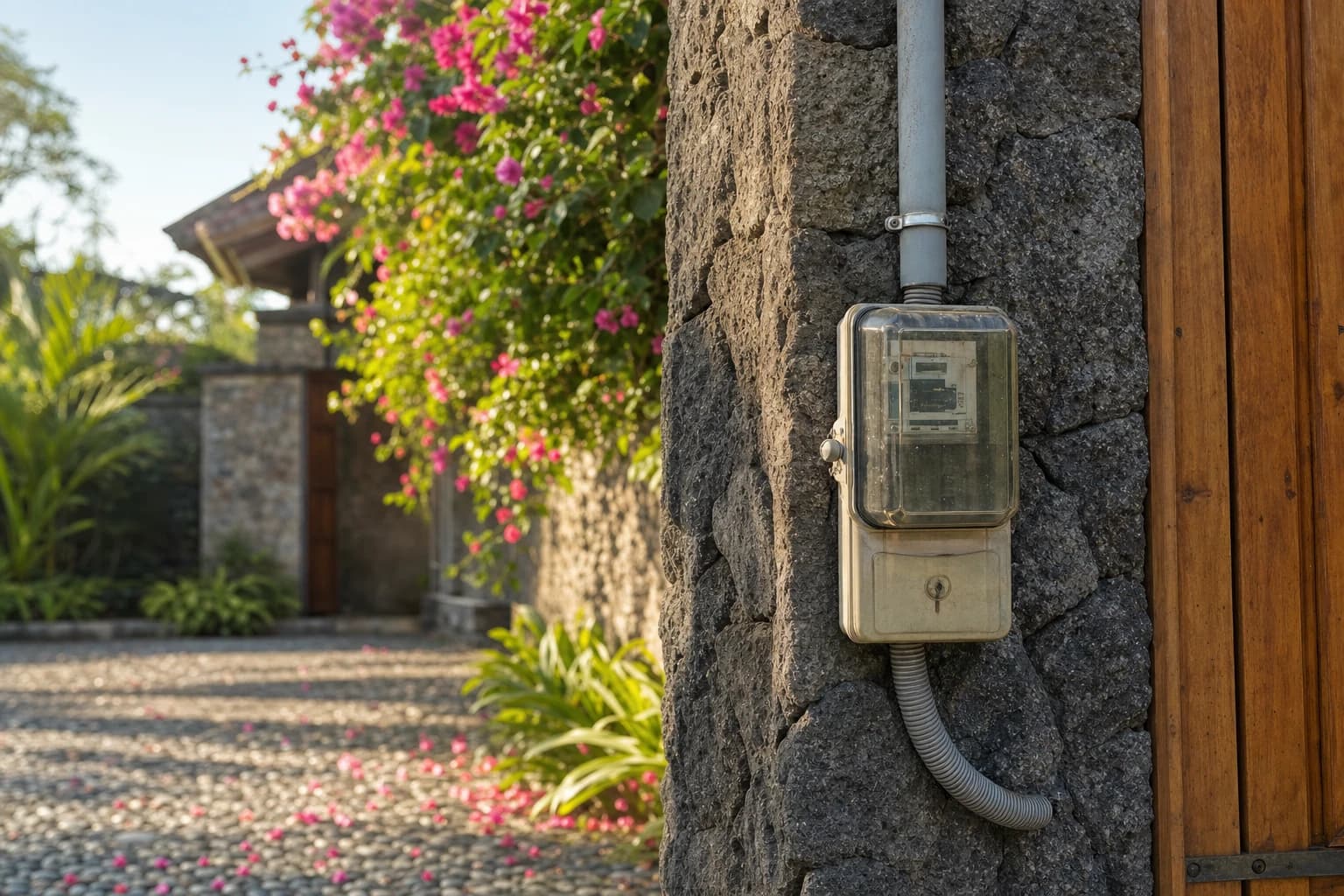
To find out a property's capacity before you sign, even remotely from a photo of the meter, the "CL" code on the display multiplied by 220 gives an estimate of the subscribed capacity: CL 4 for 900 VA, CL 6 for 1,300 VA, CL 16 for 3,500 VA.
Prepaid token or postpaid bill: how does it work?
Prepaid ("prabayar") is the dominant system in villas and rentals. You buy electricity credit as a 20-digit code — the token — which you key into the meter's keypad, and the meter beeps when around 20 kWh remain.
The kWh price is identical on prepaid and postpaid, a point spelled out in so many words when the January 2026 rate card was published. The token is not a "tourist tariff" in disguise, just a way of paying.
Where to buy tokens: the PLN Mobile app, GoPay, OVO, Dana and Shopee, the tills at Alfamart and Indomaret, bank ATMs and PLN's website. Top-up amounts generally start at Rp 20,000; most expats top up in blocks of Rp 200,000 to 500,000. The day you move in, write down your ID Pelanggan (the customer number, essential for topping up) and install PLN Mobile: balance, consumption history, outage reporting. For those who read French, the French-language guide Welcome in Bali walks through the purchase step by step.
How much electricity for your money? On a 1,300-2,200 VA meter, a Rp 100,000 token at Rp 1,444.70/kWh is worth 69.2 kWh gross; after around 5% street-lighting tax, roughly 65.7 kWh land on the meter.
On postpaid ("pascabayar", a monthly bill), PLN applies a minimum charge ("rekening minimum") even at zero consumption: on the order of 18 kWh a month at 450 VA, 36 kWh at 900 VA and 52 kWh at 1,300 VA — in each case 40 hours of running at the subscribed capacity, a rule that would put a 2,200 VA meter at 88 kWh. Those figures come from a local guide dated 2023 and have not been re-verified since.
What taxes come on top of the kWh price?
The PLN tariff is not the final price. On top of it comes the street-lighting tax, historically "PPJ", which became PBJT on electricity with the overhaul of local taxation (Law 1/2022 and regulation PP 4/2023). Levied as a percentage of the bill or of token purchases, it is set by each regency or city (kabupaten or kota), with a national cap of 10% for general use.
In Badung, the regency covering Canggu, Seminyak, Kuta and Uluwatu, the rate was historically set at 5% by a 2011 local regulation (Perda 19/2011). That text has since been replaced by Perda 7/2023, amended by Perda 8/2025, whose official online version — a scan — is unreadable: we could not confirm the exact 2026 rate at the source. Guides on the ground, for their part, report a surcharge of 3 to 5% on bills and tokens. So remember: around 5% depending on the municipality, with a legal ceiling of 10%. Denpasar, Gianyar (Ubud) or Tabanan may apply a different rate, which we have not checked.
What does a villa in Bali actually pay?
On this point the sources appear to contradict each other. Guides geared to local living quote bills of Rp 200,000 to 1.5 million a month; expat villa specialists talk about Rp 1.5 to 10 million. Both are right, because they are not describing the same home: on one side a house or guesthouse with moderate air conditioning, on the other a villa with a pool pump and AC in every bedroom. Air conditioning alone accounts for most of the gap.
The ranges observed in 2026:
| Housing type | Observed monthly PLN bill | Source |
|---|---|---|
| Room or small solo place | Rp 400,000 to 800,000 | Bali Villa Realty |
| House or guesthouse, no pool | Rp 200,000 to 900,000 in a local area; Rp 300,000 to 1.5 M in a tourist area | Sunburnt Atlas |
| 2-bed villa + pool, owner-occupied | Rp 1.5 to 3 M (~USD 100-200) | Anteyac and Bali Villa Realty |
| 2-bed villa, rented out, heavy use | Rp 3 to 6 M (~USD 200-400) | Anteyac |
| 3-bed villa and up, heavy AC | Rp 4 to 8 M (~USD 265-520) | Anteyac |
| 4-bed villa and up, intensive AC | Rp 5 to 10 M and beyond | Bali Villa Realty |
On the connection side, the typical subscribed capacities recorded by Anteyac: 3,500 to 5,500 VA for a two- or three-bedroom villa with a pool (R-2 band, Rp 1,699.53/kWh), 7,700 VA minimum for a three-bedroom with a heavy AC load, 11,000 VA and up for a four-bedroom. It is the only source to detail these thresholds, but they square with the official rate card.
In the overall budget of a rented two-bedroom villa, count on Rp 5 to 9 million a month in utilities all-in (electricity, water, fibre, gas), or roughly USD 330 to 555, with mains water coming to Rp 200,000-800,000 and fibre to Rp 450,000-1.5 million. Electricity is therefore, as a rule, a villa's biggest utility line; for the rent itself, the orders of magnitude are in our guide to renting yearly in Bali.

How do you estimate your bill before you even arrive?
You can run the numbers from London, Sydney or Paris with three inputs: the subscribed capacity, your estimated consumption and the local tax. A worked example — our own calculation, checkable line by line: a villa on 3,500-5,500 VA that uses 1,500 kWh in a month pays 1,500 × Rp 1,699.53 = Rp 2,549,295, plus around 5% street-lighting tax, so around Rp 2.68 million (about USD 158 at the reference rate the ministry used for the quarter, Rp 16,959.32 to the dollar) — squarely within the ranges in the table. For the full relocation budget, see our detailed guide to the cost of living in Bali.
Before signing for a rental found through a listing — on Lokalfinds or elsewhere, and all the more so from a distance — four questions to the owner give a clear picture of the bill to come:
- What is the subscribed capacity? Between 900 VA and 5,500 VA the kWh rate moves from Rp 1,352 to Rp 1,699.53, and the answer tells you what the home can run at the same time.
- Prepaid or postpaid meter? Same kWh price, not the same management: on postpaid, the minimum charge keeps ticking even while you are travelling.
- Is electricity included in the rent? Get it in black and white before handing over any money — vagueness around utilities is one of the classic red flags of a Bali rental.
- Can I see the bill or top-up history for the last three months? The most reliable figure on real consumption; a PLN Mobile screenshot will do.
Once on the ground, getting set up takes four moves — note the ID Pelanggan, install PLN Mobile, buy a first token, spot the nearest minimarket — to add to your moving-to-Bali checklist.
How do you bring the bill down?
Four levers, all drawn from the above:
- Air conditioning. It is what separates a local house at Rp 200,000-900,000 a month from a villa at several million; every unit that runs through the night shows up on the next top-up.
- The PLN Mobile history. Tracking your consumption week by week spares you a surprise at every token.
- The payment method. Prepaid if you are often away: on postpaid, the minimum charge keeps running even with the meter idle.
- The tariff band. The kWh rate jumps from Rp 1,444.70 to Rp 1,699.53 from 3,500 VA, 17.6% more: between two comparable homes, the one connected at 2,200 VA pays less for every kWh.
Frequently asked questions
How much does a kWh of electricity cost in Bali in 2026?
Rp 1,352/kWh on a non-subsidised 900 VA meter, Rp 1,444.70 on 1,300 and 2,200 VA, Rp 1,699.53 from 3,500 VA. These rates, set by the Ministry of Energy, have been in force since 1 January 2026 and broadly stable since 2022 for non-subsidised residential supply. Before tax, that works out at roughly USD 0.075 to 0.094 per kWh depending on the band; add the street-lighting tax, around 5% depending on the municipality, to get the price you actually pay.
Could PLN rates go up before the end of 2026?
Yes, it is possible. The Ministry of Energy reviews tariffs every quarter against the exchange rate, the crude price, inflation and the coal price. It froze them for the first three quarters of 2026; in June it even acknowledged in its press release that the parameters would have justified a rise, set aside "to preserve purchasing power". The decision for October-December is expected in late September, and nothing guarantees a fourth freeze.
How do you top up a prepaid (token) meter in Bali?
Have your ID Pelanggan to hand — the customer number tied to the meter — then buy a token via PLN Mobile, GoPay, OVO, Dana or Shopee, at an Alfamart or Indomaret till, at a bank ATM or on PLN's website. You receive a 20-digit code to key into the meter. Amounts generally start at Rp 20,000; most expats top up in blocks of Rp 200,000 to 500,000. The meter beeps when around 20 kWh remain.
How much does electricity cost for a villa with a pool in Bali?
Rp 1.5 to 3 million a month, roughly USD 100 to 200, for an owner-occupied two-bedroom villa with a pool — two independent sources agree. Under intensive rental use the same villa climbs to Rp 3 to 6 million; a three-bedroom with heavy air conditioning sits between Rp 4 and 8 million, and a four-bedroom and up runs Rp 5 to 10 million, sometimes more. A local house or guesthouse with moderate air conditioning comes in closer to Rp 200,000 to 1.5 million.
Does prepaid cost more than postpaid?
No: the kWh rate is identical under both systems, a point spelled out in so many words when the January 2026 rate card was published. On prepaid, the street-lighting tax is deducted at purchase: a Rp 100,000 token credits around 65.7 kWh on the 1,300-2,200 VA band instead of 69.2 kWh gross. On postpaid, PLN applies a minimum charge even at zero consumption — on the order of 52 kWh a month for a 1,300 VA meter, according to a local guide from 2023.
Can a foreigner get the subsidised rates?
Don't count on it. The subsidised rates, Rp 415/kWh at 450 VA and Rp 605/kWh at 900 VA, are reserved for registered Indonesian households. According to reports from the ground, homes rented to expats are in practice billed at the non-subsidised residential rate, or even at the business rate for some commercial villas. If a listing boasts unusually cheap electricity, check the meter's actual golongan rather than the promise.
What subscribed capacity (VA) does a villa in Bali need?
The connections observed: 3,500 to 5,500 VA for a two- or three-bedroom villa with a pool, 7,700 VA minimum for a three-bedroom with heavy air conditioning, 11,000 VA and up for a four-bedroom. The capacity sets the kWh rate: Rp 1,444.70 on 1,300 and 2,200 VA, Rp 1,699.53 from 3,500 VA. To check, the meter's "CL" code multiplied by 220 estimates the subscribed capacity; CL 16 corresponds to 3,500 VA.
Sources
- (official) Ministry of Energy ESDM, press release of 30 June 2026: Q3 2026 freeze, reference parameters.
- (official) Ministry of Energy ESDM, press release of 17 March 2026: Q2 freeze.
- (official) BPK, regulation PP 4/2023: how the PBJT on electricity is levied (the 10% cap itself is set by Law 1/2022, which this regulation implements).
- (official) Bapenda Badung, Perda 19/2011: street-lighting tax at 5% (2011 text, since replaced).
- (media) Kompas, 1 January 2026: full rate card, subsidised and B-2 tariffs.
- (media) Kompas TV, 1 July 2026: rate card maintained in July.
- (media) Antara, 5 July 2026: freeze confirmed on PLN's side.
- (institutional) UMSU University, 6 January 2026: identical rate on prepaid and postpaid.
- (commercial) Anteyac, 22 April 2026: villa bills, subscribed capacities, utilities budget.
- (commercial) Bali Villa Realty, 13 July 2026: bills, USD conversion at Rp 18,125 (rate of 13 July 2026), 3-5% surcharge; publication date read from the page's metadata, not shown on screen.
- (community) Sunburnt Atlas, July 2026: tokens, top-ups, bills for local homes.
- (community) Bali-island.com, 24 March 2026: converting a Rp 100,000 token into kWh.
- (commercial) Welcome in Bali, 26 May 2025: buying tokens (guide in French), ID Pelanggan, meter alarm.
- (commercial) S-Gala, 30 April 2026: CL code.
- (community) MrFixItBali, July 2023: postpaid minimum charge and observed 5% surcharge (page dated 2023).