Bali's tourist levy, branded LoveBali, costs 150,000 IDR per person — roughly 7.50 EUR according to France's foreign ministry (September 2026), or 9 to 10 USD. You pay it once per trip, before leaving Indonesian territory, and it has applied since 14 February 2024 to every foreign visitor coming to Bali for tourist activities, children and babies included: the rules set no age exemption whatsoever. Seven categories are spared, among them KITAS and KITAP holders, who are exempt automatically with no form to fill in; holders of a golden visa or another non-tourist visa, on the other hand, must file an exemption request on lovebali.baliprov.go.id at least 5 days before arrival, or they pay like everyone else. Payment is cashless only (card, bank transfer, QRIS), either online before you fly or at the counters at Ngurah Rai airport and Tanjung Benoa harbour; your proof of payment is a voucher with a QR code sent by email, and the amount is non-refundable. No fine is documented anywhere: the officers who check vouchers at Uluwatu or Tanah Lot make you pay on the spot and can turn you away from the site.
How much is the LoveBali levy, and since when has it existed?
The amount is set in rupiah and hasn't moved since launch: "Foreign Tourists levy are subject to Rp 150,000 per person", reads the official FAQ. What that means in your own currency shifts with the exchange rate: roughly 7.50 EUR according to France's foreign ministry in September 2026 (the same page previously showed 9.50 EUR), 9 to 10 USD, or around 15 Australian dollars according to English-language sites. Treat those as ballpark figures; the levy itself is denominated in rupiah.
France's Ministry for Europe and Foreign Affairs — to take one government advisory as an example — pins down the start date: since 14 February 2024, anyone travelling to Bali for a tourist stay has had to pay a levy of 150,000 IDR. The portal's exemption form still carries the launch announcement for that date.
On the Indonesian side, the official portal rests on five legal texts: Law No. 15 of 2023 on Bali Province; Provincial Regulation (Perda) No. 6 of 2023 on the levy for international tourists for the protection of Balinese culture and natural environment; Perda No. 2 of 2025, which amends it; Governor's Regulation (Pergub) No. 25 of 2025 amending Pergub No. 2 of 2024; and Governor's Decree No. 699/03-L/HK/2025. The PDF of Perda 2/2025 offered for download on the home page was still returning a 403 error on 6 September 2026; unable to read it, we rely on the portal's FAQ, terms and conditions, and exemption form.
| Key facts | Value | Source |
|---|---|---|
| Amount | 150,000 IDR per person | Official Love Bali FAQ |
| Indicative equivalent | ~7.50 EUR (September 2026), ~9-10 USD, ~15 AUD | France's foreign ministry, Emerhub, bali.com |
| In force since | 14 February 2024 | France's foreign ministry |
| Frequency | Once per trip, before leaving Indonesia | Official FAQ, Ministry of Tourism |
| Minimum age | None set by the rules | Convergent reading of 3 secondary sources |
| Refunds | None | Official terms and conditions |
Who has to pay Bali's tourist tax?
The official rule fits in a single sentence: "Every international tourist who travels to Bali and do tourist activities". The test is neither nationality nor length of stay but the purpose of the visit, as shown on your visa.
If you enter on a tourist visa — the case for most new arrivals before they secure a residence permit — nothing exempts you, even if you're flying in to sign a one-year lease. Exemptions hinge on the permit immigration has issued, not on your intentions. Our Bali visa guide walks through the entry options. The same logic applies to everyone around you: visiting parents, friends passing through — all pay 150,000 IDR each.
Children and babies are no exception. The official FAQ says "per person" without mentioning any age, and three secondary sources agree: "adults, children, and infants must all pay IDR 150,000 each", with no minimum age set. It isn't spelled out in black and white on the portal; it's a reading, but a unanimous one. For a family of four, budget 600,000 IDR — the same sum Emerhub arrives at.
Once per trip, not once per entry into Bali
The official wording is precise: "The levy is paid only 1 (one) time while traveling in Bali, before the person leaves the territory of the Republic of Indonesia". Indonesia's Ministry of Tourism says the same, and bali.com cautiously infers that a Bali-Lombok-Bali round trip within the same holiday does not trigger a second payment.
France's foreign ministry, however, describes the levy as payable at each entry into Balinese territory. Between the two, we follow the wording of the official portal — the administration that actually collects the money: one stay in Indonesia, one payment, even with a hop to Lombok or Java. Keep the voucher within reach on the way back all the same, in case an officer asks for it.
Who is exempt? The 7 official categories
The portal's terms and conditions list seven categories, repeated word for word in the FAQ and summarised by France's foreign ministry:
| # | Exempt category (official wording) | What to do |
|---|---|---|
| 1 | Holders of diplomatic and official visas | Nothing described |
| 2 | Crew members on transportation vehicles | Nothing described |
| 3 | Holders of a Temporary Stay Permit Card (KITAS) or Permanent Stay Permit Card (KITAP) | Nothing — exemption is automatic |
| 4 | Holders of family unification visas | Nothing described |
| 5 | Holders of student visas | Nothing described |
| 6 | Holders of golden visas | Request on the portal at least 5 days before arrival |
| 7 | Holders of other non-tourism visas issued by Immigration | Request on the portal at least 5 days before arrival |
For most expats, this is the line that matters: a KITAS or a KITAP exempts you automatically. The official exemption request form offers only two categories, "Holders of golden visas" and "Other Categories"; residents therefore have nothing to file, and Emerhub counts them among those who don't pay, remote-worker and investor KITAS included. If you're checked, you show your residence permit; France's foreign ministry also reminds exempt categories that they must be able to produce their supporting documents on arrival. If you're mid-conversion, our article on KITAS and long-stay visas in Bali explains at which point your status changes.
For categories 1, 2, 4 and 5, the terms and conditions impose no prior application: the filing requirement targets categories 6 and 7 only.

Golden visa or non-tourist visa: how do you file the exemption request?
The terms and conditions leave no room for doubt: categories 6 and 7 must "submit an application through the Love Bali System at least 5 (five) days before entering arrival gates in Bali". A request filed less than 5 days before arrival is "subject to user levy payment": you pay, exemption or not. The bali.com site quotes the same deadline.
The provider onlinevisaindonesia.com recommends a month's notice; the official text says 5 days. Given the portal's technical hiccups (more on that below), aiming for one to two weeks before your flight is a sensible middle ground.
The official form asks, for each person: passport number (16 characters maximum), surname and first name in capitals, email, nationality, arrival date, purpose of stay and exemption category. The supporting document — usually the visa — must be "in .pdf and maximum of file size is 2MB". A single form takes up to 9 applicants ("Max 9 applicants"); beyond that, the portal offers an import feature.
Where and how to pay: online, at the airport or at the harbour?
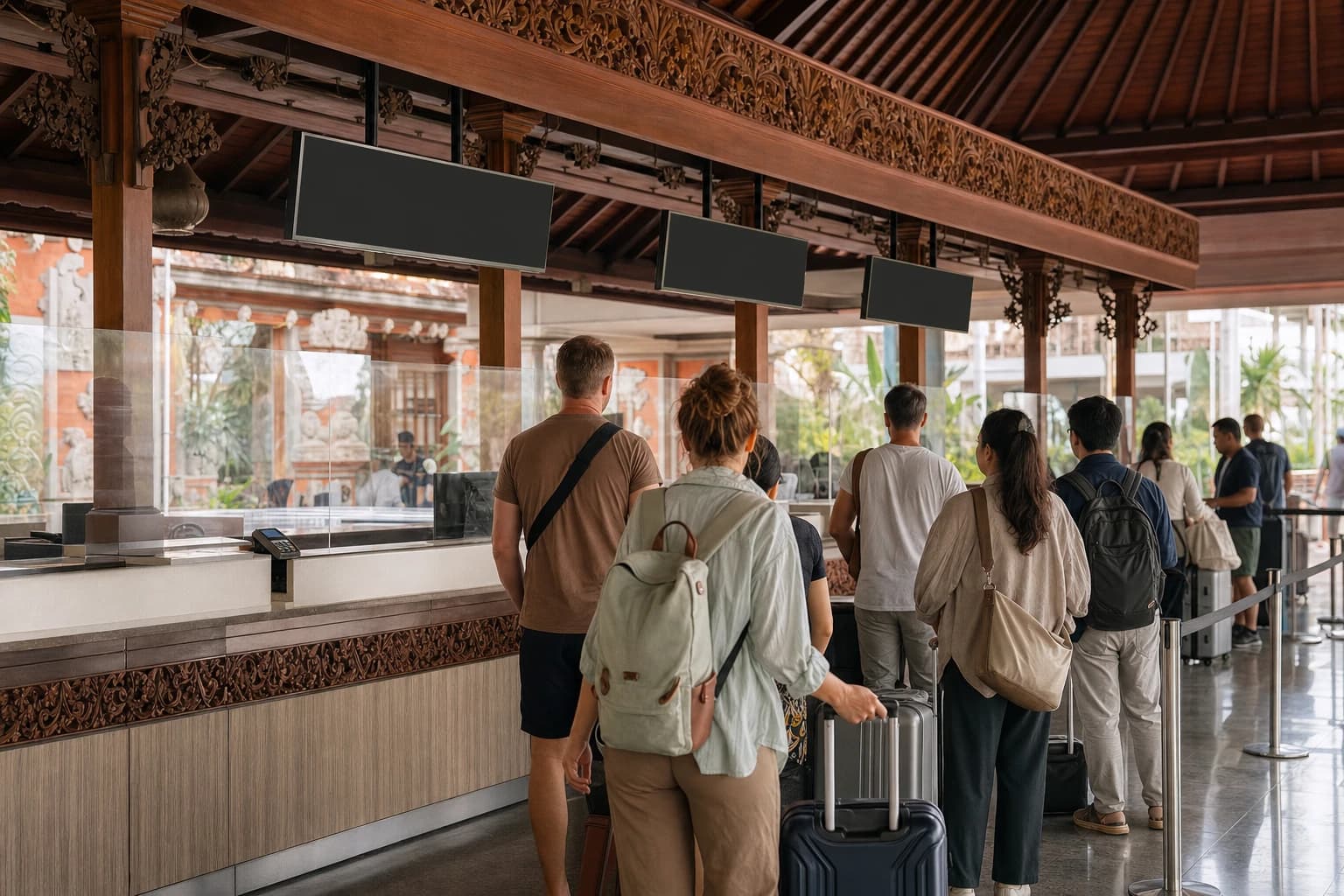
You have two routes. France's foreign ministry says the levy can be paid before arrival, on the Love Bali website or app, or on arrival. Indonesia's Ministry of Tourism names the physical points: the counters at I Gusti Ngurah Rai International Airport, run by bank BRI, and Tanjung Benoa harbour. The Bali Sun adds Ngurah Rai's domestic and international terminals and certain travel agents.
Either way, the ground rule is the same: no cash. The terms and conditions are categorical ("Levy payments for users are only accepted through non-cash methods") and the amount is charged in rupiah ("converted in Indonesian Rupiah"). The official FAQ lists the accepted methods: Visa, Mastercard, American Express and JCB cards, bank transfer, Virtual Account, UnionPay and QRIS. The onlinevisaindonesia.com site does mention paying in cash or by card at the BRI counters, but we stick to the official rule: at the counter, get your card out.
| Channel | When | Payment methods |
|---|---|---|
| Love Bali website or app | Before departure, from any country | Visa, Mastercard, Amex, JCB, UnionPay cards, bank transfer, Virtual Account, QRIS |
| BRI counter, Ngurah Rai airport | On arrival, international and domestic terminals | Cashless (card) |
| Tanjung Benoa harbour | On arrival by sea | Cashless |
| Certain travel agents | Locally | Not specified |
Three details matter from there. Proof of payment, first: "a proof of payment in the form of Levy voucher with a QR Code that is sent via email", says the official FAQ; keep that voucher on your phone. The cost of paying online, next: bali.com mentions a surcharge of around 4,500 IDR, but that is a single source the portal does not confirm. Refunds, finally: "The successfully received levy payments cannot be refunded", and onlinevisaindonesia.com adds that this holds even if you cancel your trip or your flight. So only pay for dates that are locked in.
Overloaded site, VPN, missing email: the workarounds
The portal and the app have suffered server overloads. The advice that comes up most often: a desktop browser rather than mobile, VPN switched off while you pay, and an eye on the spam folder to retrieve the voucher. As a last resort, there is always the BRI counter on arrival.
For family and friends booking from back home: the only official channel is lovebali.baliprov.go.id. Third-party sites sell "tourist tax payment" with inflated fees; as bali.com points out, "these websites are not representing the Balinese Government". A .go.id domain, nothing else.
What happens if you don't pay?
No penalty is documented, but the checks are very real. The Bali Sun, in its 2 April 2026 explainer, describes a legal obligation with no penalty mechanism for non-payment: no fine, no prison, no community service. Emerhub adds that national immigration cannot refuse you entry into Indonesia over an unpaid provincial levy.
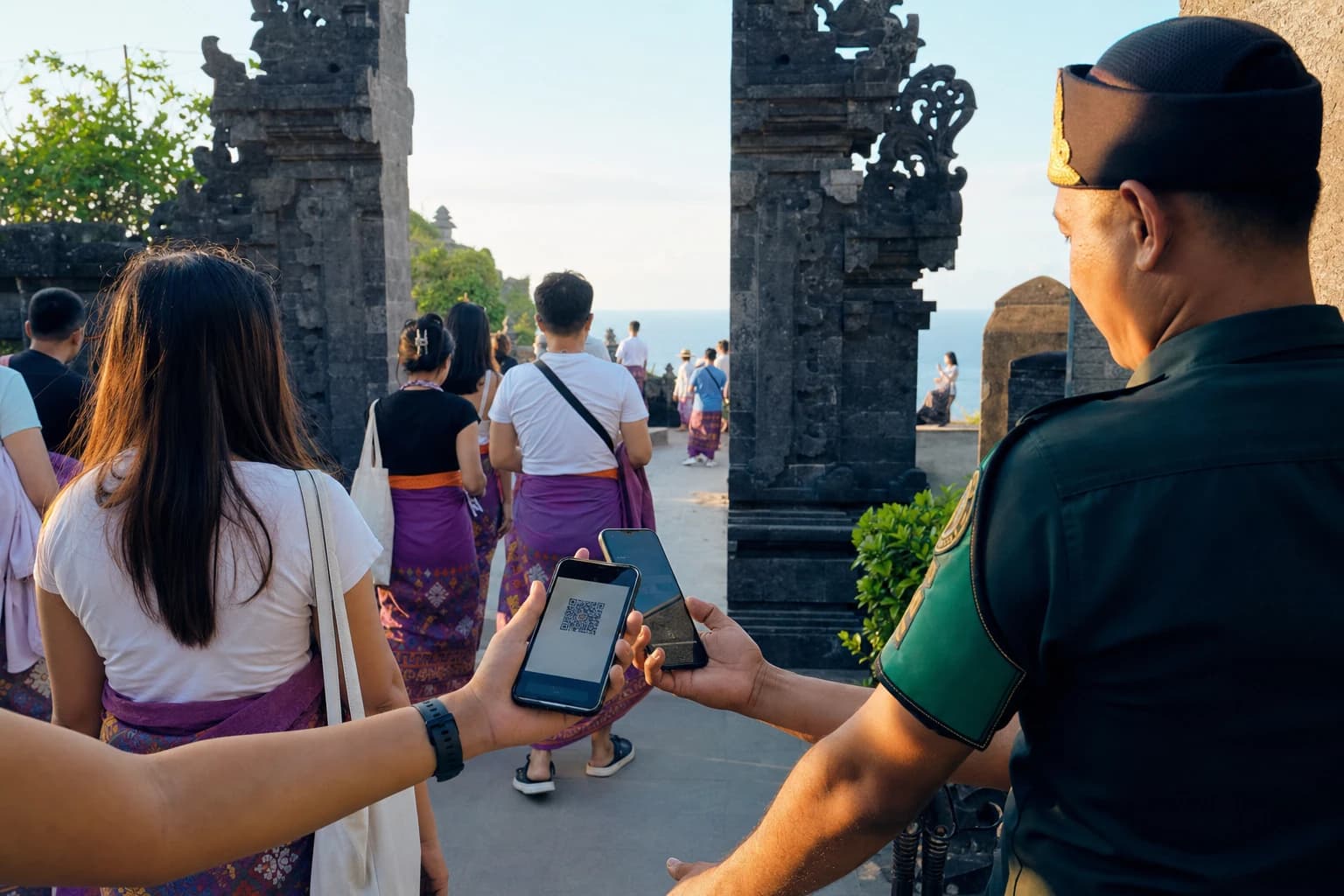
What does exist is on-site enforcement. Officers ("Tourism Task Officers" for The Bali Sun, Satpol PP for Emerhub, "Tourism Police" carrying out "random spot checks" for onlinevisaindonesia.com) patrol the major sites. Emerhub cites Uluwatu, Tanah Lot, Besakih and Tegallalang, along with the airport surroundings and the crossings to Nusa Penida. Without a voucher, you're made to pay on the spot; Emerhub specifies that a visitor "can be turned away from the site" until they have paid. The risk isn't a fine — it's time lost at a temple gate, bank card in hand.
Compliance remains low. According to The Bali Sun, "up to 35% of eligible visitors to Bali have made the payment" over the first two years — barely more than one visitor in three, at best. The figure comes from a single media source; treat it as an estimate. The province, Emerhub reports, wants to link payments to immigration data.
Is an increase to 250,000 or 500,000 IDR on the cards?
It has been proposed, not adopted. Emerhub, in its update of 7 August 2026, reports that Governor Koster has proposed raising the levy to between 250,000 and 500,000 IDR; until something is adopted, the amount in force remains the February 2024 one, and in early September 2026 the official portal still shows 150,000 IDR. Double-check the amount on lovebali.baliprov.go.id a few days before your flight rather than in an article — ours included.
Where does the money go?
Indonesia's Ministry of Tourism lists seven purposes: preservation of Balinese culture and customs, protection of the natural environment, development of quality cultural tourism, cleanliness, order, comfort and safety, tourist information, disaster management, and public transport infrastructure.
The detail, however, is not published: The Bali Sun notes that "detailed budget spending has not been published".
Preparing your move? The pre-departure cheat sheet
Four scenarios come up more than any other:
- Tourist visa while you wait for your KITAS: you pay 150,000 IDR, once, ideally online before departure. Once the KITAS is issued, you're exempt for subsequent trips, with no form to file.
- Golden visa or other non-tourist visa: exemption request on the portal at least 5 days before arrival, backed by a PDF of the visa under 2 MB. Under 5 days, you'll pay.
- Children: every child, babies included, pays 150,000 IDR; for a family of four, plan on 600,000 IDR.
- Visiting family or friends: give them the official address lovebali.baliprov.go.id and nothing else; they pay before they leave home and keep the QR voucher received by email.
Add this line to your moving-to-Bali checklist and to the arrival budget in our guide to living in Bali in 2026.
Frequently asked questions
How much is Bali's tourist tax in 2026?
150,000 IDR per person, an amount confirmed by the official FAQ of the Love Bali portal and unchanged since 14 February 2024 — roughly 7.50 EUR (France's foreign ministry, September 2026), 9 to 10 USD or around 15 Australian dollars depending on the day's rate. An increase to 250,000-500,000 IDR has been proposed by the governor, but it had not been adopted as of early September 2026; check the amount on the portal before you travel.
Do children and babies have to pay the LoveBali levy?
Yes, as the rules stand. The official FAQ sets the levy "per person" without mentioning any age, and three secondary sources concur: adults, children and infants each pay 150,000 IDR, with no minimum age set. It is not written explicitly on the portal, but no source contradicts it. A family of four therefore pays 600,000 IDR.
I live in Bali on a KITAS: do I have to pay the tourist tax?
No. Holders of a temporary (KITAS) or permanent (KITAP) stay permit are among the seven categories exempted by the official terms and conditions, and the exemption is automatic: the request form only offers the "golden visa" and "other" categories, so residents have nothing to file. If you're checked, show your residence permit. On a tourist visa, however, you pay.
Do you have to pay the levy every time you enter Bali?
No — once per trip. The official FAQ specifies that the levy is paid only once while travelling in Bali, before the person leaves the territory of the Republic of Indonesia; a Bali-Lombok-Bali round trip within the same stay therefore doesn't trigger a second payment. France's foreign ministry still describes a levy due at each entry into Balinese territory; we follow the official portal's wording and recommend keeping the voucher handy on the way back.
Can you pay the LoveBali levy in cash at the airport?
According to the official terms and conditions, no: only cashless methods are accepted. The FAQ lists Visa, Mastercard, American Express and JCB cards, bank transfer, Virtual Account, UnionPay and QRIS. At the BRI counters at Ngurah Rai airport and at Tanjung Benoa harbour, bring a card.
What happens if I don't pay the tourist tax?
No fine, prison sentence or other penalty is documented: The Bali Sun described in April 2026 a legal obligation with no penalty mechanism, and Emerhub specifies that non-payment does not lead to refusal of entry into Indonesia. Officers do, however, check the major sites such as Uluwatu or Tanah Lot: without a voucher, you're made to pay on the spot and access can be refused until you've settled up.
Is the LoveBali levy refundable if I cancel my trip?
No. The official terms and conditions specify that payments received cannot be refunded; onlinevisaindonesia.com adds that this holds even if you cancel your trip or your flight. So only pay once your dates are firm. If you haven't received your voucher, check your spam folder before paying a second time; at worst, the BRI counter at the airport lets you sort it out on arrival.
Sources
- (official) Love Bali, FAQ of the Bali provincial government portal — amount, one-time payment, payment methods (3 September 2026).
- (official) Love Bali, terms and conditions — 7 exempt categories, 5-day deadline, cashless, no refunds (3 September 2026).
- (official) Love Bali, exemption request form — form fields, 2 MB PDF, 9 applicants (3 September 2026).
- (official) Love Bali, home page — Perda No. 2 of 2025 amending Perda No. 6 of 2023 (3 September 2026; PDF of the text returning a 403 error on 6 September 2026).
- (official) France's Ministry for Europe and Foreign Affairs, Indonesia, entry and stay (in French) — 150,000 IDR since 14 February 2024, roughly 7.50 EUR, "at each entry" wording; page updated 4 September 2026.
- (official) Indonesian Ministry of Tourism, indonesia.travel — one-time payment, BRI counters at Ngurah Rai and Tanjung Benoa, cashless, seven purposes.
- (media) The Bali Sun, 2 April 2026 — no penalty, compliance "up to 35%", budget not itemised.
- (media) bali.com, Bali tourist tax for international travelers — Lombok example, surcharge of around 4,500 IDR (single source), third-party sites.
- (commercial) Emerhub, Bali tourist tax — KITAS/KITAP holders don't pay, sites checked, possible refusal of access, increase proposed by Governor Koster not adopted (update of 7 August 2026).
- (commercial) onlinevisaindonesia.com, update of 17 February 2026 — children and infants, technical tips; diverges on the deadline ("1 month") and on cash.
- (commercial) indonesie-tourisme.fr, visa page (in French) — 14 February 2024, 150,000 rupiah (8-9 EUR at the rate at the time).