The EPO (Exit Permit Only) is the written permit that lets you leave Indonesia for good by closing out your KITAS (ITAS) or KITAP (ITAP). Once issued, it is irrevocable: you must be out of the country no later than 7 days after it is issued, and the stay permit it closes can no longer get you back in. The application is filed before your stay permit expires, through your sponsor; for the airport and the south of Bali, it is handled by the Ngurah Rai immigration office (Jimbaran), through an account opened in the sponsor's name on the official e-visa portal. On cost, the national fee schedule lists Rp 100,000 per person, but several offices say it is free: budget Rp 0 to 100,000 in official fees, against roughly Rp 1,500,000 through a Bali agency. Processing officially takes 1 to 4 working days depending on the office (3 to 8 days according to private consultancies), and agencies advise getting started at least two weeks before departure. Must-have documents: passport (it receives the EPO stamp), original KITAS/KITAP card (it goes back to the state), sponsor's letter and ID, exit ticket with proof of payment. Leaving without an EPO exposes you, according to specialist consultancies (none of the official pages we reviewed covers this case), to being refused entry later and to having any new permit application blocked until the closure is done.
What exactly is the EPO, and who needs one?
The Samarinda immigration office defines it as "izin meninggalkan Wilayah Indonesia bagi orang asing pemegang Izin Tinggal Terbatas atau Izin Tinggal Tetap dan tidak untuk kembali": a permit to leave Indonesian territory for foreigners holding an ITAS or ITAP, with no return. The Sampit office adds the two textbook cases: moving to another country, or the end of a contract. The legal basis cited by the Karawang office is Law No. 6 of 2011 on immigration, supplemented by Ministerial Regulation No. 27 of 2014 (Permenkumham 27/2014) on the granting and cancellation of immigration permits.
The national stay-permit page on imigrasi.go.id mentions neither the EPO nor permit cancellation. The official information lives on the Directorate General's fee schedule and on the websites of the local offices (kantor imigrasi), whose document lists vary; for Bali, the reference is the Ngurah Rai page, detailed further down. Home-country advisories won't fill the gap either: the French foreign ministry's travel advice for Indonesia (updated 10 August 2026), to take one example, says nothing about exit formalities.
Who has to go through it? The Karawang office lists six situations in which an EPO is issued: expiry of the ITAS/ITAP without renewal, end of employment, change of sponsor, divorce for marriage-based permits, deportation or a court decision, and permanent departure. Consultancies boil that down to three cases: changing employer or sponsor, changing KITAS type (work to retirement, say), and leaving with no intention of coming back. So the EPO is not only for people packing their bags: a change of sponsor triggers it too, even if you stay in Bali.
Not to be confused with the ERP (Exit Re-entry Permit), whose definition shifts from one source to the next: Sampit reserves it for "certain overstay or deportation cases", Ngurah Rai describes an "ERP tidak kembali" (no return) that closes the permit on presentation of the exit stamp, so after departure, and the agency Let's Move Indonesia sees it as the way to regularise, from abroad, those who left without an EPO. InCorp, for its part, uses the term in its everyday sense: leaving temporarily and coming back without cancelling your permit. What the "no return" readings have in common, allowing for terminology that changes from one office to the next: the ERP closes a permit when the EPO could not be done before departure.
How much does the EPO cost: free, or Rp 100,000?
This is the sharpest contradiction in the file, and it sits between official sources. The national immigration fee schedule, section B (immigration permits), sub-section 5, lists "Izin Meninggalkan Wilayah Indonesia untuk Tidak Kembali (Exit Permit Only)" at Rp 100,000 per person. Dated 24 October 2023, that schedule was still online, unchanged, on 3 September 2026; three local offices reviewed the same day say something else.
| Source | Amount quoted for the EPO | Type |
|---|---|---|
| National fee schedule of the Directorate General of Immigration (24/10/2023) | Rp 100,000 per person | official |
| Kantor Imigrasi Samarinda | Rp 0 for the standard EPO; Rp 100,000 for the Golden Visa EPO | official |
| Kantor Imigrasi Sampit | Rp 0 ("gratis"), no fee at all | official |
| Kantor Imigrasi Yogyakarta | no fee | official |
| Bali agency, "all-inclusive" package | Rp 1,500,000 (roughly USD 85) | commercial |
Our reading: the EPO is free or close to it depending on the office, Rp 0 to 100,000, with the national schedule listing Rp 100,000 where several offices charge nothing (Samarinda reserves that amount for the Golden Visa). Ask your office for the amount when you file, and set aside a Rp 10,000 revenue stamp for the declaration-and-guarantee letter required in Samarinda, should your office apply the same list.
The real expense is the hand-holding. One Bali agency prices the "All Inclusive" EPO at Rp 1,500,000, specifying "Only processable inside Indonesia" and "7 days max": fifteen times the Rp 100,000 on the national schedule. Delegating makes sense when the filing lands a few days before a flight, but you are paying for logistics, not a government fee.
Which documents should you prepare?
The official lists share a common core and diverge on the extras; here is what the offices we reviewed require, Ngurah Rai first.
| Document | Ngurah Rai (Bali) | Other offices (Samarinda, Karawang, Yogyakarta, Sampit) |
|---|---|---|
| Written request from the sponsor | yes | yes, signed by the director for a work KITAS (Karawang) |
| Sponsor's ID card (KTP) | yes | yes, plus the proxy's ID if a power of attorney is used |
| Passport | scanned biometric page | original required, handed over to receive the EPO stamp (Sampit) |
| ITAS/ITAP stay permit | latest permit, scanned | original card returned to the state (Sampit); copy (Yogyakarta) |
| E-visa | yes | copy of the visa and of the entry stamp (Samarinda) |
| Plane ticket | ticket plus proof of payment | exit ticket, or proof of payment for a new visa (Yogyakarta) |
| Work file | depending on category (worker, investor) | original IMTA and DPKK, copy of the RPTKA (Karawang) |
| Family | marriage certificate, family card, birth certificates for family reunification | family card and marriage certificate if the sponsor is the spouse (Yogyakarta) |
| Forms and format | colour scans of the originals, uploaded to the portal | forms 25 and 27 (Yogyakarta); declaration and guarantee on a Rp 10,000 revenue stamp (Samarinda) |
| Proof of reason | not specified | purpose and destination of the departure (Samarinda) |
Two practical details weigh on how you organise the departure. In Sampit, the original passport "must be handed over to receive the EPO stamp": while the file is being processed, you don't have it on you. And the original ITAS/ITAP card has to be handed in "to be returned to the state": don't plan on keeping it as a memento, and don't let it disappear into a moving box.
Work-KITAS holders: Karawang asks for the original IMTA and DPKK and a copy of the RPTKA, documents the employer often holds. Get them back before you leave the company, especially if the departure follows a strained break-up.

How does the application work in Bali?
The Kantor Imigrasi Kelas I Khusus TPI Ngurah Rai, based in Jimbaran in Badung regency (kabupaten), publishes the procedure under the heading "Exit Permit Only (EPO) / ERP Tidak Kembali". The route it describes is online: the application goes through an account on the evisa.imigrasi.go.id portal, opened in the sponsor's name, with colour scans of the originals uploaded. The timing rule fits in one sentence: "Permohonan EPO diajukan sebelum izin tinggal berakhir", the application is filed before the stay permit expires. Wait until the last day of validity and you risk tipping into overstay while the file is being processed.
That online channel is not universal: Samarinda describes filing at the counter, with a queue number and collection. For Bali, stick to what Ngurah Rai publishes, and get the scans ready before you approach your sponsor (employer, Indonesian spouse or agent): they are the one driving the file, and they are not always available on the day you need them.
On jurisdiction, Ngurah Rai covers the airport and the south of the island; outside its area, the usual address for Denpasar and its surroundings is the Denpasar office (Jl. D.I. Panjaitan No. 3, Renon, Denpasar Timur), whose website does not detail the EPO. The exact allocation of jurisdictions has not been re-verified here: the sound reflex is to go to the office that issued your KITAS. One last trap: the old domain imigrasingurahrai.kemenkumham.go.id, still quoted on forums, no longer responds; the only valid address is ngurahrai.imigrasi.go.id.
What you get at the end, if your office proceeds like Sampit: a passport stamped EPO, without your residence card. From the moment of issue, the 7-day countdown starts.
How long does it take, and when do you have to be gone?
Three timelines stack up: filing before the flight, processing, and the exit window after issue. On each of them, official figures and agency figures diverge.
| Step | Official figures (immigration offices) | Agency and consultancy figures |
|---|---|---|
| Filing the application | before the stay permit expires (Ngurah Rai) | at least two weeks before departure (Emerhub) |
| Processing | 1 to 2 working days (Sampit), 3 working days maximum (Yogyakarta), collection 4 working days after the file is declared complete (Samarinda) | 3 to 5 working days (Emerhub, LMI Consultancy), 3 to 7 days (InCorp), 5 to 8 days on the regular service and 5 days express (visa-indonesia.com) |
| Departure after issue | 7 days maximum from the date of issue (Samarinda, Sampit) | 5 days (LMI Consultancy, Emerhub), 5 to 7 days (Cekindo), 7 days (Bali agency), 7 to 14 days (InCorp) |
On the exit window, go with the official figure: 7 days. Samarinda writes "paling lama 7 (tujuh) Hari terhitung sejak tanggal penerbitan", no later than seven days from issue, and Sampit specifies that the foreigner "wajib meninggalkan Indonesia", must leave Indonesia, within 7 days of the stamp. Two consultancies say 5 days, which amounts to building a margin into the official text; another quotes 7 to 14 days, which no official page we reviewed supports.
On processing, the offices quote 1 to 4 working days; the consultancies, 3 to 8 days, timelines that presumably include preparing the file on their side. Go with the offices' figures, plus a week of margin: Samarinda only counts its 4 days from the moment the file is declared complete, and the clock doesn't start while a document is missing.
That leaves the trickiest point, the ticket. Sampit wants a ticket dated "Maksimal 7 hari setelah pengajuan", at most 7 days after the application, whereas Emerhub recommends filing at least two weeks before you leave. The two instructions don't square perfectly, and nothing says Sampit's rule applies as-is at Ngurah Rai. Before buying a non-refundable ticket, ask your office or your agency what flight date they expect relative to the filing: the procedure costs at most Rp 100,000, a lost ticket runs into millions of rupiah.

What do you risk by leaving without an EPO?
None of the official pages we reviewed describes a specific penalty for leaving without an EPO. The consequences below come from consultancies with an interest in selling the procedure; they do converge, though, and they fit the official definition of the EPO as the closure of your status.
Emerhub (updated 2 June 2025) writes that the authorities will refuse entry to a traveller whose KITAS expired without being closed, and cites foreigners "unable to leave Indonesia" until the EPO had been done. Cekindo (25 June 2025) mentions being summoned for questioning and a possible refusal of entry "at any time". InCorp (7 November 2025) talks of overstay fines, entry restrictions or blacklisting, and puts the overstay fine at Rp 1 million per day, an amount confirmed by the Surakarta immigration office (article of 22 September 2025) and by the FAQ of the official e-visa portal. Let's Move Indonesia, finally, states that no new KITAS can be applied for until the old one has been revoked (revocation within 7 days of the EPO): no official page we reviewed confirms this, even though Karawang's issuance cases, change of sponsor among them, point the same way; have it confirmed by your kantor imigrasi.
And if it's already too late? The Samarinda office publishes a separate document list for an "Exit Permit Only di luar negeri", an EPO filed from abroad: the same documents as in Indonesia, as copies, plus a copy of the latest exit stamp in the passport. Let's Move Indonesia, for its part, indicates that an ERP can be processed from overseas ("Can be done overseas") for those who left without an EPO, on copies of the original visa documents; Ngurah Rai's "no return" ERP, tied to the exit stamp, points the same way. Contact the office that issued your KITAS, or a consultancy, copies in hand.
Sell, cancel, hand back: the countdown to a clean exit
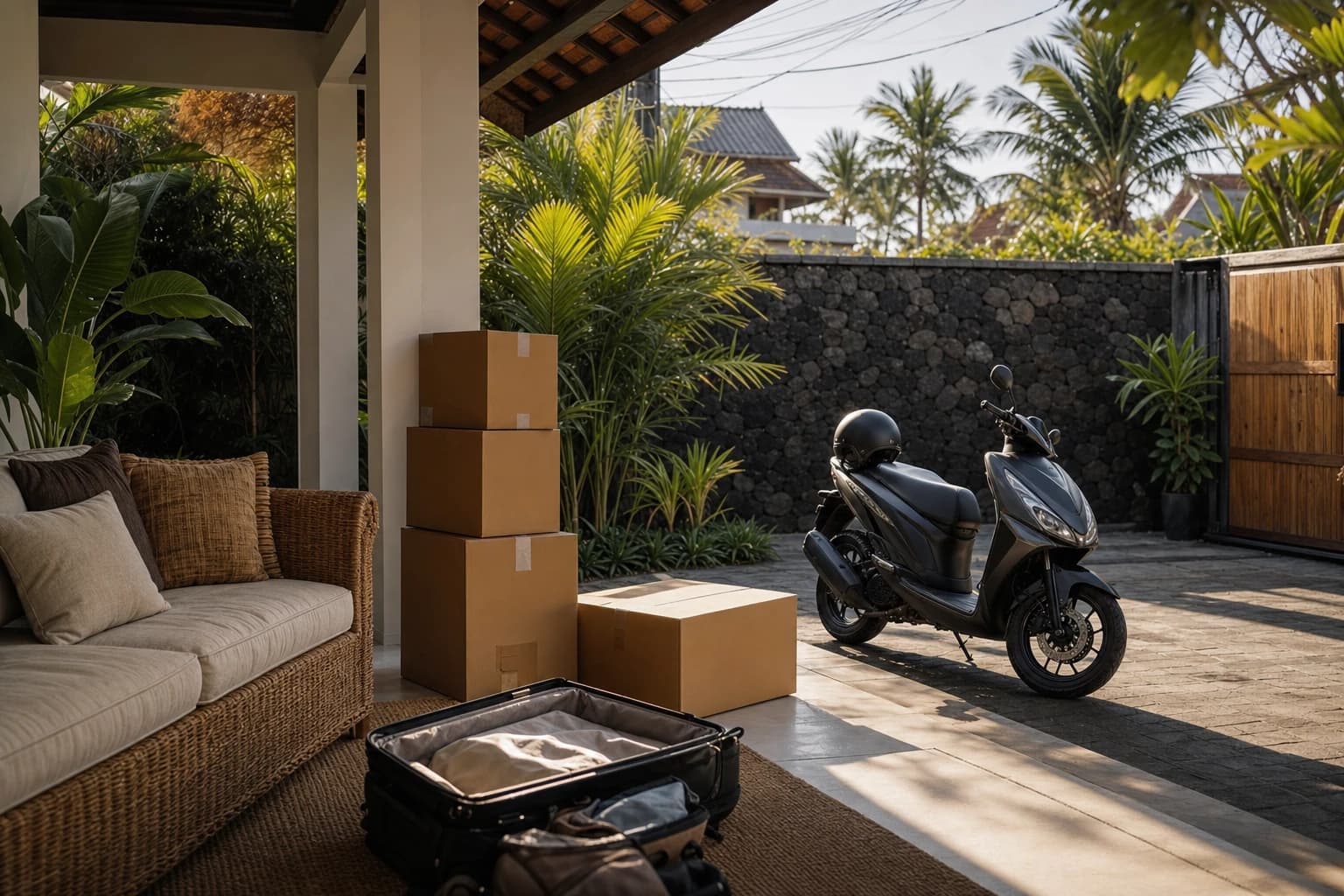
Two official constraints set everything else: an exit ticket required at filing, and departure no later than 7 days after issue. Add the agencies' advice (start two weeks before the flight) and the 1 to 4 working days of processing: the window for selling the scooter, the furniture and the appliances falls before the EPO is filed, not after. Once the passport is stamped, you have a week at most, with no residence card, to wrap everything up; that's no time to be haggling over a sofa.
So post your listings four to six weeks before the flight, that is two to four weeks before filing: big-ticket items rarely go in 48 hours. The resale prices to expect are in our guide to selling your furniture in Bali, and the five tips for selling fast on a marketplace count double when the deadline is a flight.
What the calendar dictates, in order:
- D-42 to D-28: get the exact document list from your sponsor or the office, retrieve the originals tied to a work KITAS (IMTA, DPKK, RPTKA), make colour scans, post your listings.
- D-28 to D-14: settle the filing date against the flight date with the office or the agency, buy the ticket, close the big sales.
- D-14 to D-7: complete file in the sponsor's hands, then filing on the agreed date, within the week before the flight if your office applies Sampit's rule, and in any case before the permit expires; the passport may be held during processing.
- Issue: passport stamped, card handed back, departure no later than 7 days after issue.
There's no reversing if you need to stay a few more days: the EPO "tidak bisa dibatalkan", cannot be cancelled, writes Yogyakarta. The only lever is the filing date.
Not in Bali yet? What the EPO changes in your planning
This looks like a topic for people on their way out; yet it shapes three choices made before you even arrive.
The first is your dependence on the sponsor: closing a KITAS goes through them, with an e-visa account in their name at Ngurah Rai, and a letter signed by the director for a work KITAS in Karawang. Choosing your employer, your agent or your corporate structure in Indonesia also means choosing who will, on departure day, have to sign a letter and click through a portal. The permit types are detailed in our guide to KITAS and long-stay visas in Bali.
The second is record-keeping: the documents requested for the EPO are those from your entry file (e-visa, IMTA, DPKK, RPTKA, marriage certificate or birth certificates for family reunification). Scan them in colour from day one and keep the originals somewhere you'll still remember in two years' time: one more line on the moving-to-Bali checklist.
The third is the budget and calendar for the end of your stay: negligible official fees (Rp 0 to 100,000), roughly Rp 1,500,000 in fees if you delegate and, above all, two to three weeks of margin between the decision to leave and the flight for the procedure alone, more if you have things to sell. The normal procedure is done on the spot, before departure ("Only processable inside Indonesia", writes the Bali agency selling the package); a rushed departure can be caught up with an EPO or an ERP filed from outside the country, a route Samarinda documents but whose form varies from office to office.
One last reflex: the pages that carry authority are in Indonesian, on subdomains of imigrasi.go.id. The agency articles, often in English, help you understand the route, but three of the seven we reviewed are undated; when an agency figure contradicts a kantor imigrasi, the latter wins.
Frequently asked questions
What is the EPO (Exit Permit Only) in Indonesia?
The EPO is the written permit that allows a foreigner holding an ITAS (KITAS) or ITAP (KITAP) to leave Indonesian territory without returning on that permit. It closes the stay status (legal basis: Law No. 6 of 2011 and Ministerial Regulation No. 27 of 2014) and is irrevocable once issued. It covers permanent departure as well as a change of sponsor or of KITAS type, even without leaving Bali.
How much does the EPO cost in Bali in 2026?
Between Rp 0 and 100,000 in official fees. The national fee schedule (24 October 2023, still online in September 2026) lists Rp 100,000 per person, but Samarinda, Sampit and Yogyakarta say the standard EPO is free (Samarinda reserves the Rp 100,000 for the Golden Visa). A Bali agency charges Rp 1,500,000, roughly USD 85, for its all-inclusive package: a service fee, not a government charge.
How long does it take to get the EPO?
Officially, 1 to 4 working days depending on the office: 1 to 2 days in Sampit, 3 at most in Yogyakarta, 4 after the file is declared complete in Samarinda. Consultancies quote 3 to 5 days (Emerhub, LMI Consultancy), 3 to 7 (InCorp) or 5 to 8 on the regular service. Start the process two weeks before the flight, as Emerhub advises, settle the filing date with your office, and always file before the stay permit expires.
How many days do I have to leave Indonesia after the EPO?
Seven days at most from the date of issue, according to Samarinda and Sampit. Two consultancies (LMI Consultancy, Emerhub) say 5 days, a safety margin; another quotes 7 to 14 days, with no official confirmation. Plan around the official 7 days and ask your office what flight date it expects relative to filing: Sampit requires a ticket dated at most 7 days after the application.
Can an EPO be cancelled, or can I come back on the same KITAS?
No. The Yogyakarta office writes that the EPO "tidak bisa dibatalkan", it cannot be cancelled; one consultancy specifies that it is single-use and requires leaving Indonesia immediately after issue. The passport receives an EPO stamp and the original ITAS/ITAP card is returned to the state. To come back, you need a new visa or permit; for a temporary trip out, the EPO is the wrong procedure.
What happens if I leave Indonesia without doing the EPO?
No official page we reviewed describes a specific penalty for this case. Consultancies report a later refusal of entry with an expired, unclosed KITAS, a possible summons, overstay fines (Rp 1 million per day, a figure confirmed by Indonesian immigration), entry restrictions or blacklisting. Let's Move Indonesia states, without official confirmation, that no new KITAS can be obtained until the old one is revoked, and that an ERP from abroad remains possible with copies of the original visa file; the Samarinda office, moreover, publishes a document list for an EPO filed from abroad, with a copy of the latest exit stamp.
Do I need an EPO to change employer without leaving Bali?
A change of sponsor is among the six issuance cases listed by Karawang, alongside the end of employment, divorce for a marriage-based permit and permanent departure; consultancies add a change of KITAS type, from work to retirement for example. According to Let's Move Indonesia, the EPO should come before any new application with a new sponsor, and Yogyakarta does accept proof of payment for a new visa in place of the exit ticket. The exact route remains to be confirmed with your office.
Sources
- (official) Directorate General of Immigration, immigration fee schedule, dated 24 October 2023, consulted 3 September 2026: Exit Permit Only at Rp 100,000 per person.
- (official) Kantor Imigrasi Ngurah Rai (Bali), services for foreign nationals, consulted 3 September 2026: EPO / ERP tidak kembali procedure via a sponsor account on evisa.imigrasi.go.id, filing before the permit expires, document list.
- (official) Kantor Imigrasi Samarinda, Exit Permit Only, consulted 3 September 2026 and re-checked on the 6th: definition, documents, "EPO di luar negeri" variant (filing from abroad, copy of the latest exit stamp), departure within 7 days, Rp 0 (standard) and Rp 100,000 (Golden Visa), collection 4 working days after the file is complete.
- (official) Kantor Imigrasi Sampit, EPO, consulted 3 September 2026: free of charge, 1 to 2 working days, ticket dated at most 7 days after the application, passport handed over for the stamp, card returned to the state, definition of the ERP.
- (official) Kantor Imigrasi Yogyakarta, Exit Permit Only, consulted 3 September 2026: EPO irrevocable, 3 working days maximum, no fee, forms 25 and 27, spouse-sponsor variant.
- (official) Kantor Imigrasi Karawang, Exit Permit Only, consulted 3 September 2026: legal basis UU 6/2011 and Permenkumham 27/2014, six issuance cases, documents for a work KITAS.
- (official) Directorate General of Immigration, stay permits, consulted 3 September 2026: national ITK/ITAS/ITAP page that does not mention the EPO.
- (official) Kantor Imigrasi Surakarta, overstay fine, 22 September 2025, consulted 6 September 2026: "Rp 1.000.000 per hari" from the first day of overstay.
- (official) Indonesian e-visa portal, FAQ, consulted 6 September 2026: overstay fine of "IDR 1,000,000 per day", possible detention, deportation or entry ban.
- (commercial) Emerhub, Exit Permit Only in Indonesia, 7 June 2024, updated 2 June 2025: filing two weeks before departure, 3 to 5 working days, exit within 5 days, refusal of entry with an expired KITAS.
- (commercial) InCorp Indonesia, Indonesia EPO, 7 November 2025: EPO vs ERP, 3 to 7 working days, departure within 7 to 14 days, overstay fines and blacklisting.
- (commercial) Cekindo, Exit Permit Only for KITAS holders, 25 June 2025: three triggering situations, departure within 5 to 7 days, risk of summons and refusal of entry.
- (commercial) Let's Move Indonesia, Exit Permit Only and Exit Re-entry Permit, undated pages: no new KITAS without revocation, permit revoked within 7 days, ERP possible from abroad.
- (commercial) LMI Consultancy, Exit Permit Only, undated: single use, exit within 5 days, 3 to 5 working days, IMTA and DPKK.
- (commercial) Visa-indonesia.com, EPO guide, 26 January 2026: official closure of status, 5 to 8 days regular, 5 days express.
- (commercial) Celerity, Bali immigration, Exit Permit Only, undated: all-inclusive package Rp 1,500,000, "Only processable inside Indonesia", 7 days max.