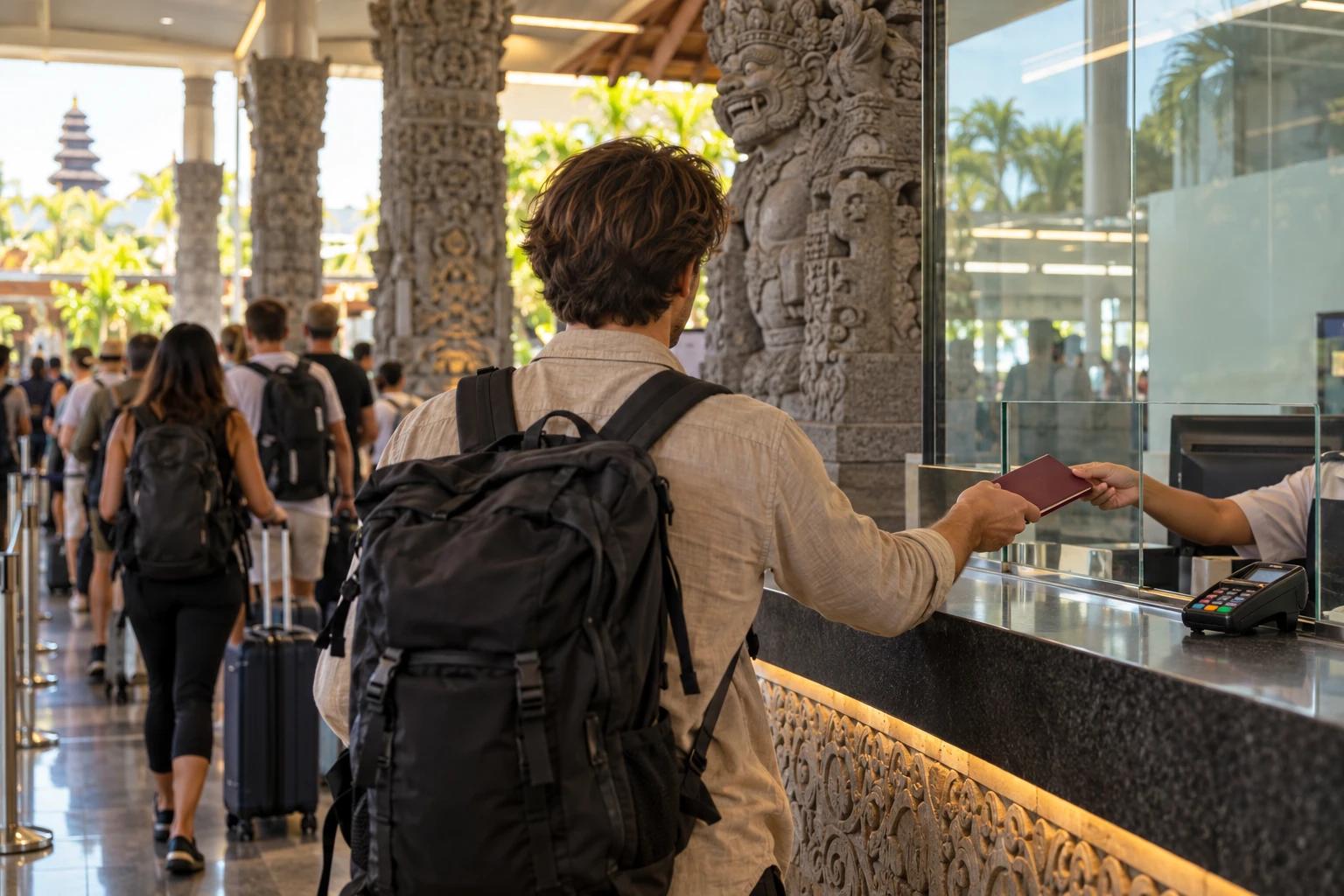
Grab or Gojek in Bali in 2026? Install both, and open Grab first when you land: it has partnered with the operator of Ngurah Rai airport since 2020, picks up passengers at the GrabCar Lounge in international arrivals, and its terms of service allow payment with a foreign card. On a motorbike, the price is regulated by the state: decision KP 667/2022 from Indonesia's Ministry of Transportation puts a ride between IDR 2,000 and 2,500 per kilometre (€0.10 to €0.12 at the ECB rate of 20 October 2026), with a minimum of IDR 8,000 to 10,000 for the first 4 kilometres. As for so-called banned areas, no law bans the apps anywhere on the island: only pickups at licensed transport stations (the airport, ports, managed sites) are reserved for registered vehicles.
Grab or Gojek in Bali: which one should you install?
Both apps cover the same needs; where they differ is coverage, payment and the airport.
Gojek lists GoRide (its motorbike taxi) and GoCar (its car service) as available in the "Bali (termasuk Gianyar dan Tabanan)" zone, meaning Gianyar and Tabanan included, according to its service-area pages checked on 20 October 2026. Its Bali blog post, published on 24 February 2024, counts around twenty services on the island, including GoFood, GoSend, GoBox and GoShop. One service is missing: GoBluebird, which lets you book a Bluebird taxi through Gojek. Its official city list runs to thirteen names, from Bandung to Yogyakarta, and Bali is not on it; Gojek notes that the list changes often.
Grab has been on the island since 2015 with GrabCar (its car service), and since 22 October 2016 with GrabBike (its motorbike taxi) and GrabExpress, launched at the time in Denpasar and Badung. Its Indonesian line-up also includes GrabFood and GrabMart.
On payment, the gap is clear. Grab Indonesia's terms of service, in force since 12 October 2026, provide for payment by a debit or credit card issued outside Indonesia, with a possible "Foreign Service Fee" to cover the processing of these cards, the amount being shown before you confirm; OVO balance and cash remain options. Gojek lets you register a card for GoRide and GoCar, but its help page doesn't say whether a foreign card will go through. Its GoPay wallet can be topped up with cash at a convenience store or from a bank, and cash is accepted for rides.
One last hurdle: signing up. Gojek rejects virtual and VoIP numbers, asks you to switch off any VPN and may refuse sign-up from a country where it doesn't operate, so you're better off creating the account once you're on the island, with a number that receives texts. Our Bali SIM card guide covers the plans and registration. To send an item, each app has its own courier service (GoSend, GrabExpress), which works under different rules.
| Criterion | Grab | Gojek |
|---|---|---|
| Motorbike | GrabBike, in Bali since 22/10/2016 | GoRide, Bali zone, Gianyar and Tabanan included |
| Car | GrabCar (in Bali since 2015), GrabCar Airport, GrabCar Rental from 4 to 12 hours | GoCar and GoCar (L), same zone |
| Bluebird taxi in the app | — | GoBluebird: Bali missing from the 13-city list |
| Ngurah Rai airport | partner of the operator since 2020, GrabCar Lounge | GoRide point near the motorbike car park (Gojek blog, 02/2024) |
| Card issued outside Indonesia | allowed, possible "Foreign Service Fee" | card registration available, foreign cards not specified |
| Wallet | OVO | GoPay |
| Cash | yes | yes |
| Food and groceries | GrabFood, GrabMart (nationwide offer) | GoFood, GoShop (listed for Bali in 02/2024) |
Sources: official Grab and Gojek pages checked on 20/10/2026, unless another date is given.
How much does a Gojek or Grab ride cost in Bali?
The price of a motorbike ride isn't a free-for-all: the state sets a band, and Grab and Gojek have to stay within it. The rule that applies is decision KP 667 of 2022 on calculating the price of motorbikes used for public transport via an app, the online motorbike taxis Indonesians call ojol (short for ojek online, an ojek being a motorbike taxi). Signed on 7 September 2022 on the minister's behalf by the director general of land transport, it is listed as "Berlaku", meaning in force, in the ministry's legal database as of 20 October 2026. The only amending text recorded in that database, decision KP 1001 of 22 November 2022, deals with the platforms' commission, not the fare scale.
The scale splits the country into three zones. Bali sits in zone I, alongside Sumatra and Java outside the Jakarta area:
- lower limit: IDR 2,000 per kilometre;
- upper limit: IDR 2,500 per kilometre;
- minimum: IDR 8,000 to 10,000, which the passenger pays for the first 4 kilometres.
For comparison, the Jakarta zone runs from IDR 2,550 to 2,800 per kilometre. Be wary of pages still quoting IDR 1,850 to 2,300: even the Indonesian business press was citing those figures in July 2025, but they come from decision KP 564 of 2022, which KP 667 revoked and which is marked "Dicabut" in the ministry's database.
How do you estimate a fare from the scale?
No reliable, dated source publishes fares for typical trips between two Bali neighbourhoods. The scale is enough to work one out, though: the zone I minimum is exactly 4 kilometres at each limit's rate (4 × 2,000 = 8,000; 4 × 2,500 = 10,000). A ride therefore costs the distance multiplied by IDR 2,000 to 2,500, without dropping below IDR 8,000 to 10,000. The table below applies that rule; conversions use the European Central Bank reference rate of 20 October 2026, €1 = IDR 20,170.57.
| Trip distance | Lower limit | Upper limit | In euros |
|---|---|---|---|
| 3 km (minimum) | IDR 8,000 | IDR 10,000 | €0.40 to €0.50 |
| 6 km | IDR 12,000 | IDR 15,000 | €0.59 to €0.74 |
| 10 km | IDR 20,000 | IDR 25,000 | €0.99 to €1.24 |
| 15 km | IDR 30,000 | IDR 37,500 | €1.49 to €1.86 |
| 20 km | IDR 40,000 | IDR 50,000 | €1.98 to €2.48 |
Lokalfinds calculation based on decision KP 667/2022, fare for the ride only.
The amount shown in the app can come out higher than this calculation, for three documented reasons:
- app fees. On some services, Gojek may charge the customer an app fee ("Biaya Jasa Aplikasi"), which it keeps in full; the amount varies by service, distance and zone, and appears in the payment breakdown. Grab's terms of service, for their part, provide for "Platform Fees" charged to customers;
- booking ahead. Scheduling a ride with Gojek costs IDR 3,000 extra on GoRide and IDR 10,000 on GoCar;
- a foreign card on Grab, with the "Foreign Service Fee" mentioned above.
The driver, meanwhile, has to charge the price shown in the app: ministerial regulation PM 12 of 2019 requires it. Since both apps apply the same scale, the only way to find out which is cheaper for a given trip is to enter the same address in both. To fit these rides into a monthly budget, see our guide to the cost of living in Bali in 2026.
The 8% commission changes the driver's share, not the fare scale
Since 1 July 2026, the commission platforms take from motorbike drivers has been capped at 8%, down from 15% plus up to 5% in extra fees before. The driver therefore receives 92% of the ride fare, according to the director general of land transport on 13 July 2026, who confirmed the same day that the zone-by-zone scale was still the one in KP 667. Presidential Regulation No. 27 of 2026, announced on 8 October 2026 according to the government's information portal, carries this cap over to passenger transport and leaves fare-setting to the Ministry of Transportation; its implementing rules are expected before 31 December 2026. Transport minister Dudy Purwagandhi had stated on 30 June 2026 that the fare passengers pay would not go up. For cars, the cap was not yet in place at the end of June 2026: the ministry said it was still discussing it.
What about cars: how much does an online taxi cost?
For GoCar and GrabCar, the framework is ministerial regulation PM 118 of 2018 on app-booked cars with drivers. Under it, the price must stay between two limits set by the minister or by the governor, depending on the operating area; the platform can neither set the fare itself nor run promotions below the lower limit; and the price includes the transport company's insurance. Its only amendment, from March 2019, leaves these rules untouched.
Those limits are nowhere to be found for Bali. The figures doing the rounds, IDR 3,500 to 6,000 per kilometre for the Sumatra-Java-Bali zone, date from 2017: CNN Indonesia presented them as the new fares on 1 July 2017, Kompas as a draft on 20 October 2017. The 2018 regulation keeps earlier limits in place until they are reviewed, but no official text open to consultation confirms these amounts, and Bali's legal database contains no governor's decision on this fare. As of 20 October 2026, there is therefore no verifiable official per-kilometre fare for a Grab or Gojek car in Bali.
The only figure published by an operator comes from Grab: from central Denpasar to the airport, about 13 km and 25 to 40 minutes, allow an average of IDR 90,000 to 150,000, or €4.46 to €7.44. The page is undated. Grab states that its prices are fixed and shown before booking, except for GrabTaxi.

So-called Grab and Gojek banned areas: why don't the apps work everywhere in Bali?
The answer comes in two layers: a handful of written rules, and a lot of local practice.
What do the provincial rules say?
Two regulations issued by the Governor of Bali cover the subject, both marked as in force in the provincial legal database.
Regulation No. 40 of 2019, signed by Governor Wayan Koster on 15 October 2019, covers app-booked cars. It requires platforms to apply geofencing that restricts their operation in areas where there is a licensed pangkalan, meaning an authorised transport station. It also requires a vehicle no more than 10 years old, registered in the province, and a driver who speaks Indonesian, English and Balinese, wears light Balinese adat (customary) dress and holds a certificate of residence in Bali.
Regulation No. 2 of 2020, dated 14 February 2020, organises these pangkalan, defined as spots off the roadway where passengers get on and off. It distinguishes three types depending on who runs them: an authority, such as the airport or a port; the body managing a tourist area; or a company, cooperative or village enterprise, including one belonging to the desa adat (the customary village). Each pangkalan needs a permit from the governor. Partner transport operators get priority there, a registered boundary can be protected by geofencing, and an unregistered public transport vehicle is not allowed to pick up passengers there.
In both texts, the restriction applies only where a licensed pangkalan exists; neither bans the apps anywhere else. In June 2023, the head of the province's transport agency, I Wayan Gede Samsi Gunarta, put it this way: there is no ban on ojol operating anywhere; a driver who enters a pangkalan's area simply has to cooperate with it. In February 2026, The Bali Sun was still pointing out that the apps are legal across the whole island.
What happens on the ground?
| Place | What happens | Nature | Source, date |
|---|---|---|---|
| Licensed pangkalan (airport, port, managed tourist site) | pickups reserved for registered vehicles, geofencing possible | written rule (regulation 2/2020) | text of 14/02/2020 |
| Canggu | the desa adat asks drivers not to wait around in groups, without banning rides | desa adat instruction | detikBali, 07/03/2023 |
| Canggu, Jalan Pantai Batu Bolong | two men in vests, described as drivers from a local ojek stand, block and threaten a driver who had come to pick up a tourist; Kuta Utara police are investigating | conflict, no text cited | detikBali, 05/09/2026 |
| Kuta | drivers breaking the rules (passenger without a helmet, parking on the pavement) photographed and reported to the operator, which cuts their access to the app | desa adat agreement with a single platform | NusaBali, 12/12/2023 |
| Tirta Empul (Gianyar) | drop-offs allowed, pickups banned, customary fine of 100 kg of rice | customary sanction | The Bali Sun, 28/12/2023 |
| Ubud | plan for designated pickup points on desa adat land | proposal by the Gianyar transport agency, not adopted | Warta Bali, 11/08/2024 |
| Nusa Dua | community of 516 online drivers from the desa adat, backed by a cooperative; according to its chair, only local drivers pick up customers there | local organisation, a model the governor wants to extend to Ubud and Sanur | Kompas, 09/03/2026 |
The Canggu episode, filmed on 3 September 2026, shows how far a "red zone" claimed by stand-based drivers can go: the detikBali article cites no text that underpins it. The workaround The Bali Sun was already describing in 2023: when a local taxi stand is in sight, walk a few minutes away and book from a nearby street. At Tirta Empul, only pickups are penalised, not drop-offs.
The promised provincial law is not in force
On 28 October 2025, Bali's provincial parliament approved a draft regional law on app-booked tourist transport: drivers holding a Bali-domicile identity card, DK number plates, a "Kreta Bali Smita" label, standardised fares. Its coordinator, I Nyoman Suyasa, explained the next day that the text concerned tourist vehicles only: existing online motorbike taxis and online taxis would not have had to meet these conditions.
The draft did not survive review by the central government. According to the province's legal bureau, the opinion issued on 9 July 2026 struck out the entire chapter on tourist transport, after a letter from the Ministry of Transportation dated 7 July found that a province cannot create a new category of transport. On 3 August 2026, the head of Bali's transport agency explained that the residence requirement and geofencing had also been dropped from the draft, even though both already appear in regulation 40/2019, which is still in force.
The text was then reworked. In late October 2026, the Ministry of Home Affairs gave it its registration number under a new title: it no longer refers to tourist transport but to "special rental transport" (angkutan sewa khusus), the national category for app-booked cars defined by Ministry of Transportation regulation 118/2018. On 30 October, I Nyoman Suyasa, who chairs the Bali parliament committee in charge, said only the governor's signature was missing. As of 22 November 2026, we have found neither a signature nor a publication of the law: check its status before relying on any new rules. The driver-quota agreement the governor wanted to strike without delay in February 2026 has not led to any text that we could find.
Grab at Bali airport: where do you get picked up?
The 2020 regulation lists the airport among the pangkalan run by an authority: you can't be picked up just anywhere.
Grab operates there through a partnership with PT Angkasa Pura I, then the airport operator (merged into InJourney Airports in September 2024), soft-launched on 10 January 2020. According to CNBC Indonesia, Grab was then presenting itself as the only ride-hailing service officially authorised at the airport; it worked with the airport's five taxi operators, and its drivers came from the neighbouring desa adat of Tuban, Kelan and Kuta. Its Denpasar airport page, checked on 20 October 2026, states:
- pickup point: the GrabCar Lounge in the international arrivals terminal;
- GrabCar Airport: up to 4 passengers and 60 kg of luggage;
- GrabBike: no pickups from airports;
- advance booking available for transfers.
On the Gojek side, the only official pointer is a blog post from 24 February 2024: the pickup point for online motorbike taxis was near the airport's motorbike car park, a 10- to 15-minute walk from the arrivals gate. The same post mentions a car pickup point along the way without saying where it is. We found no more recent official Gojek page on the subject, so follow the app's directions when you book. Finally, The Bali Sun mentioned changes to pickups at certain stations, including the airport, in February 2026, without giving details.

Safety: number plate, driver, helmet and emergency button
Ministerial regulation PM 12 of 2019, still in force, sets out what a passenger on an online motorbike taxi can insist on:
- the right driver and the right bike: the driver and vehicle details shown in the app must match the person and motorbike doing the ride;
- a helmet meeting the Indonesian SNI standard for both driver and passenger;
- one passenger only, never two;
- a reflective vest bearing the driver's identity;
- an emergency button in the app, for driver and passenger alike, and a complaints number on display.
Grab says it provides the helmet on GrabBike. In Kuta, the desa adat announced at the end of 2023 an agreement with one platform to cut off app access for drivers it reports, notably for carrying a passenger without a helmet.
Both apps add their own tools. On Grab, the emergency button sits in the Safety Centre on the trip screen: it offers to call the 110 emergency number or Grab's safety team. Trip sharing sends someone close to you a real-time tracking link, and Grab says it checks its drivers through periodic selfies. On Gojek, the package is called Gojek SHIELD: facial verification of drivers, phone-number masking, trip sharing and an emergency button; Gojek also highlights its insurance cover.
Before you get on, check the vehicle's plate, colour and model in the app, as Grab advises, and compare the driver with their photo. If anything doesn't match, don't get on: for motorbikes, PM 12 requires exactly that match.
The alternatives: Bluebird, a private driver or a scooter
Bluebird. Since GoBluebird isn't offered in Bali, go through the company's own app, MyBluebird; Bluebird has offered app booking for its taxis in Bali since 14 May 2014. Its Fixed Price feature shows the price before you book, with no change for time of day or traffic, and payment in cash, by card or by digital wallet; Bluebird's page doesn't say whether it is active in Bali. None of the official pages we checked publishes the metered fare for Bluebird taxis in Bali.
A car with a driver. Goldenbird, the Bluebird group's rental brand, rents out cars with drivers in Bali by the hour or by the day, fuel and tolls included according to its FAQ; it doesn't rent cars without a driver. Its page shows an entry price for the Innova without spelling out the conditions and says the rate depends on your needs, so get a quote in MyBluebird before you commit. Grab also offers GrabCar Rental, from 4 to 12 hours.
A private driver. For a day trip or regular journeys, an independent driver booked in advance is the other option: browse driver and transport listings on Lokalfinds, and get the price, duration, vehicle model and plate confirmed in advance.
A scooter. Our rent or buy a scooter in Bali calculation gives you the break-even point, and our Bali driving licence guide covers the papers to carry with you.
Frequently asked questions
Is Grab or Gojek cheaper in Bali?
Neither is, as a rule. On a motorbike, both apply the same state fare scale, IDR 2,000 to 2,500 per kilometre with a minimum of IDR 8,000 to 10,000 (decision KP 667/2022). The difference comes from app fees, where they apply, which vary by service, distance and zone, and from foreign card fees on Grab: compare the same address in both apps.
How much does a Gojek motorbike ride cost per kilometre in Bali in 2026?
The ride fare is regulated between IDR 2,000 and 2,500 per kilometre, or €0.10 to €0.12 at the ECB rate of 20 October 2026. Under 4 km, the minimum applies: IDR 8,000 to 10,000. A 10 km ride therefore comes to IDR 20,000 to 25,000, before any app fees, which Gojek shows in the payment breakdown.
Can you order a Grab motorbike as you walk out of Bali airport?
Not a motorbike: Grab's airport page, checked on 20 October 2026, says GrabBike doesn't do pickups from airports. A car, yes: GrabCar Airport picks passengers up at the GrabCar Lounge in the international arrivals terminal, up to 4 people and 60 kg of luggage. Grab has worked there in partnership with the airport operator since January 2020.
Why does a Grab or Gojek driver ask me to walk to another spot?
You are probably inside the area of a pangkalan, a licensed transport station: Bali Governor Regulation No. 2 of 2020 reserves pickups there for registered vehicles and allows the zone to be protected by geofencing. Elsewhere, local drivers sometimes claim their own zones, as in Canggu in September 2026, with no known official text to back them. The usual workaround, described by The Bali Sun: walk a few minutes away before booking.
Do Grab and Gojek accept foreign bank cards?
Grab does: its terms of service of 12 October 2026 provide for payment with a card issued outside Indonesia, with a possible "Foreign Service Fee" shown before you confirm. Gojek lets you register a card for GoRide and GoCar, but its help page doesn't say whether foreign cards are accepted. Both apps take cash, and each has its own wallet: OVO for Grab, GoPay for Gojek.
Can you book a Bluebird taxi in the Gojek app in Bali?
No, according to the official GoBluebird city list checked on 20 October 2026: it covers thirteen cities, including the Jakarta area, Surabaya and Yogyakarta, but not Bali. For a Bluebird taxi on the island, use the company's own app, MyBluebird: Bluebird has offered app booking in Bali since May 2014.
Does the 8% commission cap bring fares down?
No. The cap, in force since 1 July 2026 for motorbikes and carried over by Presidential Regulation No. 27 of 2026, reduces the share taken from the driver, who keeps at least 92% of the ride fare. The scale the passenger pays is still the one in decision KP 667/2022; the transport minister stated on 30 June 2026 that fares would not go up.
Sources
Official
- Ministry of Transportation (Kemenhub), JDIH — decision KP 667/2022, online motorbike taxi fare scale, 07/09/2022, PDF read on 20/10/2026 — official.
- Kemenhub, JDIH — decision KP 1001/2022, platform commission, 22/11/2022 — official.
- Kemenhub, JDIH — regulation PM 12/2019, motorbike taxi safety, 11/03/2019 — official.
- Kemenhub, JDIH — regulation PM 118/2018, online car taxis, 18/12/2018, amended by PM 17/2019 (article 19 only) — official.
- Province of Bali, JDIH legal database — Governor Regulation No. 40/2019 on online taxis, 15/10/2019, and No. 2/2020, both in force as of 20/10/2026 — official.
- Governor of Bali — Regulation No. 2/2020 on pangkalan, official copy hosted by Buleleng regency, 14/02/2020 — official.
- InfoPublik (government information portal) — publication of Presidential Regulation No. 27/2026, 08/10/2026 — official (report; text of the regulation not published online).
- European Central Bank — reference rate of 20/10/2026, €1 = IDR 20,170.57 — official.
Operators (official company pages)
- Grab — Denpasar airport page, Indonesia terms of service of 12/10/2026, safety page, emergency button guide, 04/09/2026, GrabBike launch in Bali, 2016 — commercial.
- Gojek — GoRide service area, GoCar service area, GoBluebird service area, card payment, app fees, scheduled booking, sign-up, Gojek SHIELD, Gojek in Bali, 24/02/2024, transport from the airport, 24/02/2024 — commercial.
- Bluebird — app booking in Bali, 14/05/2014, MyBluebird Fixed Price, 30/04/2024, Goldenbird Bali — commercial.
Media
- Bisnis.com — the zone fare scale remains that of KP 667/2022, 13/07/2026; 2025 simulation citing the KP 564 figures, 01/07/2025 — media.
- Viva — the minister: fares will not go up, 01/07/2026 — media.
- Liputan6 — 8% commission, motorbikes only, 28/06/2026 — media.
- CNN Indonesia — Presidential Regulation No. 27/2026, 09/10/2026; 2017 online taxi fares, 01/07/2017 — media.
- Kompas — draft online taxi fares, 20/10/2017; draft regional law approved by the provincial parliament (DPRD), 28/10/2025; Nusa Dua drivers, 09/03/2026 — media.
- CNBC Indonesia — GrabCar Airport at Ngurah Rai, 24/01/2020 — media.
- Kontan — Angkasa Pura I and II merged into PT Angkasa Pura Indonesia (InJourney Airports), 10/09/2024 — media.
- detikBali — the transport agency (Dishub): no ban on ojol, 21/06/2023; Canggu: no waiting in groups, 07/03/2023; the Batu Bolong incident, 05/09/2026; scope of the draft regional law, 29/10/2025; chapter struck out by the central government, 03/08/2026 — media.
- Warta Bali — central government rejection, residence and geofencing dropped, 03/08/2026; Ubud zoning plan, 11/08/2024 — media.
- Barometer Bali — Home Affairs registration number, governor's signature awaited, 30/10/2026; Balinetizen — new "angkutan sewa khusus" title, 30/10/2026 — media.
- NusaBali — app access cut for offending drivers in Kuta, 12/12/2023 — media.
- The Bali Sun — apps legal, according to the transport agency, 23/06/2023; Tirta Empul, 28/12/2023; the governor's taxi announcements, 26/02/2026 — media.