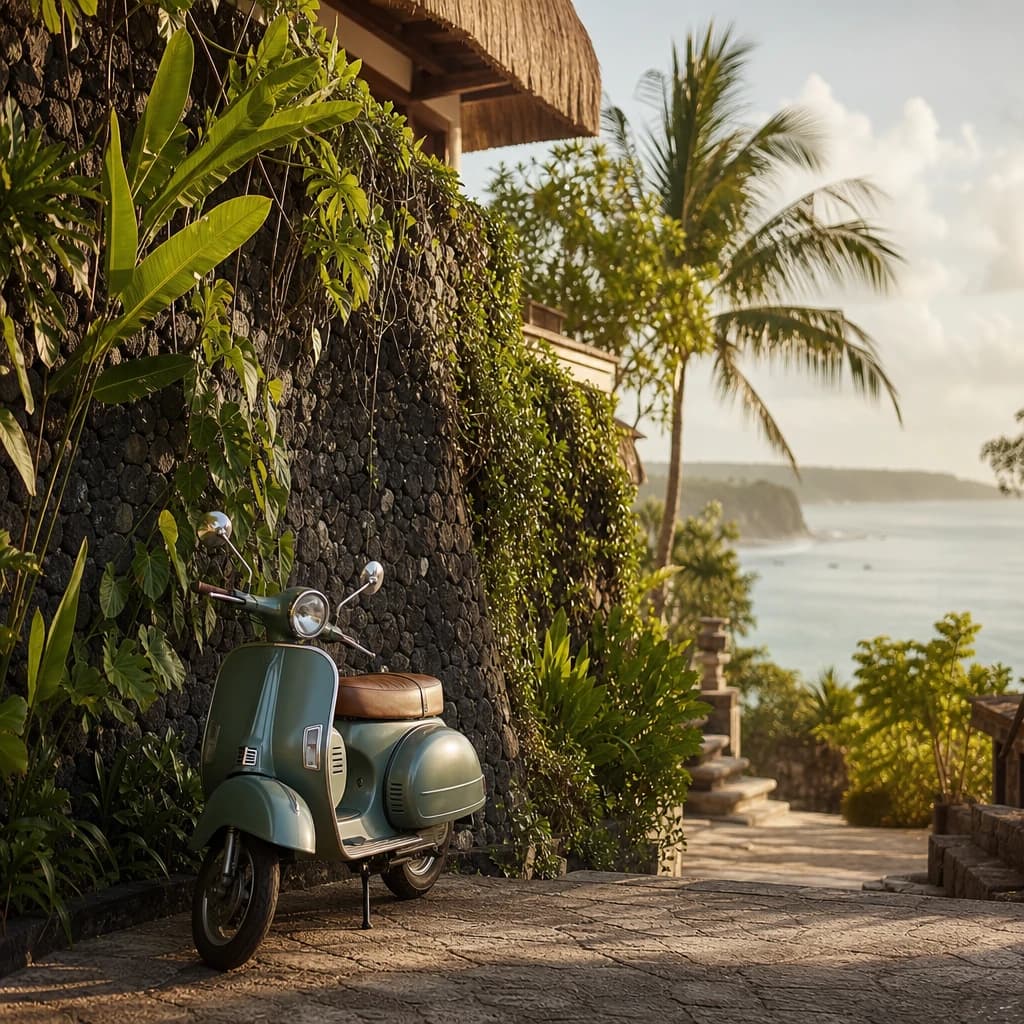
To buy a used scooter in Bali without getting burned: make sure the STNK (registration card) and the BPKB (ownership book) match both the bike AND the seller, check the chassis and engine numbers, start the scooter cold, and only pay the balance once the official transfer goes through at the Samsat. Budget 12 to 30M IDR depending on the model.
Buy or rent: the real question to settle first
Before you reach for your wallet, ask yourself the one question that actually matters: how long are you staying in Bali? The rule of thumb shared across the expat community is simple. Less than 4 months on the island? Renting stays cheaper and hassle-free (no paperwork, no resale to deal with). More than 6 months, and especially if you keep stacking visa renewals? Buying second-hand quickly becomes the smart play: you spread out the cost and sell when you leave, often for close to what you paid if you chose well.
A rented scooter runs around 900K to 1.3M IDR a month for a Scoopy or a Vario, more for an NMAX. Over a year, you spend the equivalent of buying a solid used model outright, and you never own a thing. That's exactly why buying makes sense as soon as your stay stretches out. The trick is doing it smartly, because Bali's used market is loaded with traps, especially for foreigners that sellers can spot from a mile away.
The popular models and realistic used prices
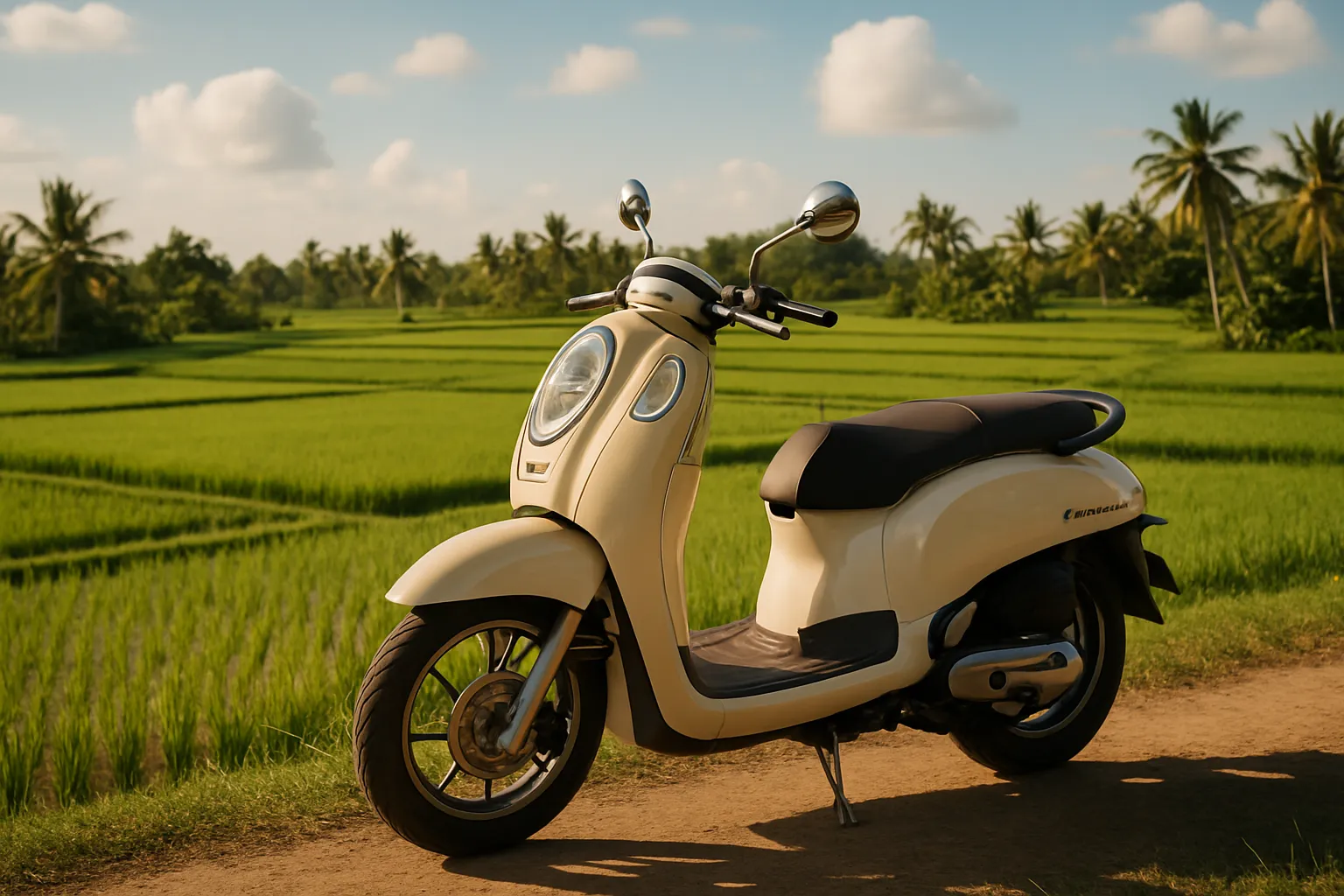
In Bali, three or four models dominate the landscape. They're also the easiest to resell, service, and find spare parts for. No need to chase something exotic: a common scooter is a reassuring scooter.
Honda Scoopy
The darling of beginners and smaller riders. Light, nimble, easy on fuel, perfect for weaving through Canggu or Ubud traffic. The 110-125cc engine is more than enough for city use and coastal roads. New, it sells for around 23M IDR in Denpasar; for a recent used one (2021-2024), figure 12 to 17M IDR depending on year and condition.
Honda Vario 125 / 160
The island's absolute best-seller. A bit more torque than the Scoopy, ideal if you occasionally carry a passenger or your groceries. It's the easiest model to flip on resale. New, the Vario runs around 24-26M IDR. Used, a 2020-2022 Vario 125 goes for 13 to 17M IDR. Heads up: a Vario that "looks pristine" offered under 12M IDR should set off alarm bells about the paperwork.
Honda PCX 160
The comfort maxi-scooter. Heavier, more stable on the road, ideal for longer rides down to Uluwatu or up north. Generous seat, roomy under-seat storage. New, it climbs to 34-41M IDR. Used (2021-2023), expect 22 to 30M IDR. It's an investment, but the comfort is in a different league from a little 110cc.
Yamaha NMAX
The PCX's direct rival, hugely popular with expats who clock real miles. Excellent handling, ABS braking on the recent versions. New, it sits around 31-33M IDR. Used, a 2020-2022 NMAX runs between 18 and 25M IDR; mint 2023 models stay above that.
| Model | Engine | Year | Fair used price (IDR) | Rough EUR/USD |
|---|---|---|---|---|
| Honda Scoopy | 110-125cc | 2021-2024 | 12-17M | ~700-1,000 € / 750-1,100 $ |
| Honda Vario 125 | 125cc | 2020-2022 | 13-17M | ~750-1,000 € / 850-1,100 $ |
| Honda PCX 160 | 160cc | 2021-2023 | 22-30M | ~1,300-1,750 € / 1,400-1,900 $ |
| Yamaha NMAX | 155cc | 2020-2022 | 18-25M | ~1,050-1,450 € / 1,150-1,600 $ |
These ranges are 2026 benchmarks. The IDR/EUR rate moves around; check the day's rate. And keep the "foreigner tax" in mind: a Vario sold for 11M IDR to a local will instinctively be quoted at 13 or 14M to a bule (foreigner). Knowing these ranges is already half the negotiation.
The paperwork: STNK and BPKB, the heart of the matter
This is where it all comes down. A scooter in Bali is only worth its price if its papers are clean. Two documents, and you need to know them cold.
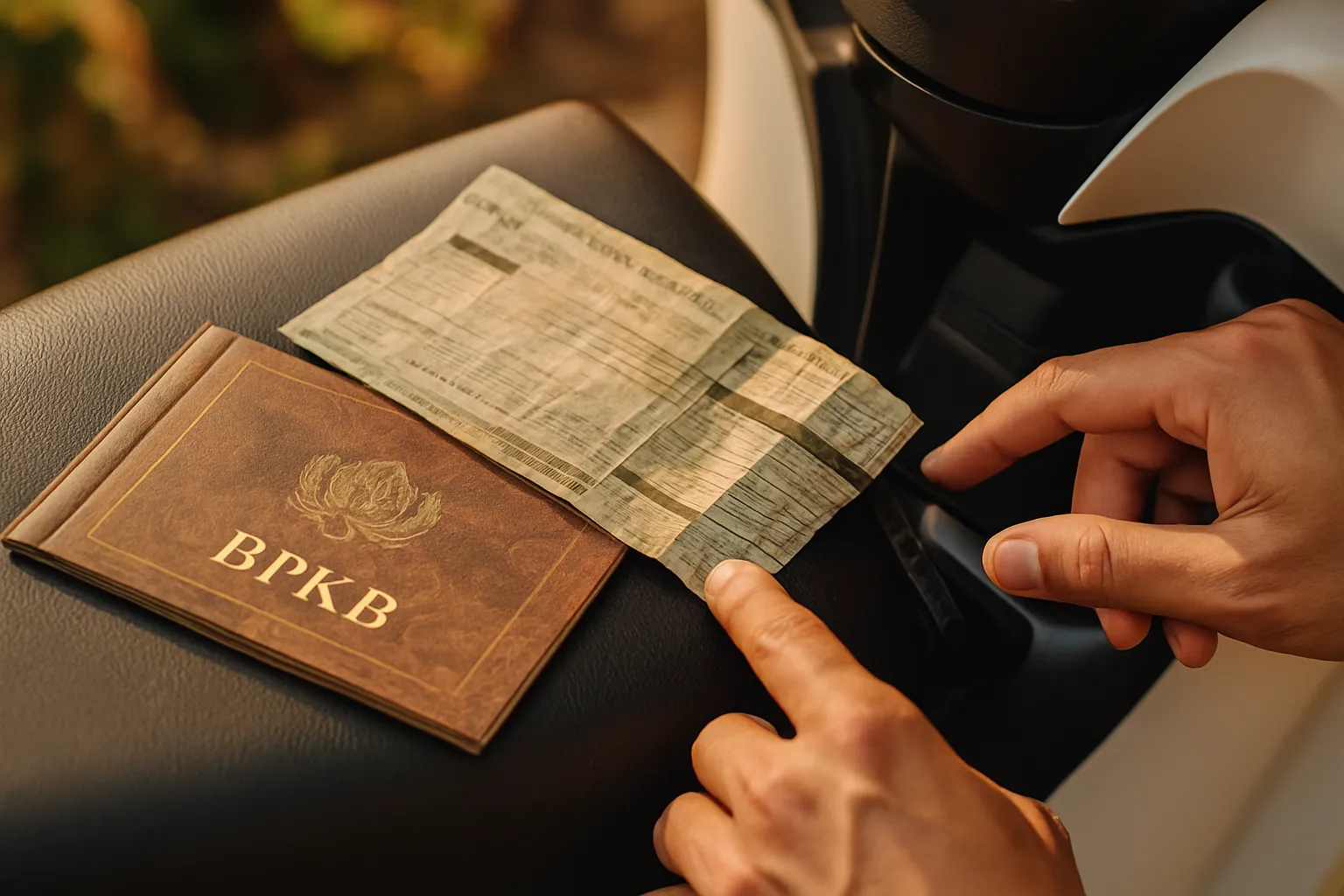
The STNK (Surat Tanda Nomor Kendaraan, official Korlantas POLRI guide) is the equivalent of the registration card. It proves the bike is registered and confirms the annual tax is paid. Crucial point: if the tax is unpaid, YOU as the new owner are the one who settles the penalty, not the previous owner. So check the validity date printed on it.
The BPKB (Buku Pemilik Kendaraan Bermotor, detailed by Korlantas POLRI), the famous "blue book," is the ultimate proof of ownership. Whoever's name appears on the BPKB is the vehicle's legal owner. Without the BPKB, you're not buying a scooter: you're buying a problem.
The golden rule: the chassis number stamped on the frame and the engine number stamped on the block must match EXACTLY what's written on the STNK and the BPKB. Ask the seller to show you those stampings (the chassis number is often under the footrest or near the steering head). If they drag their feet, if they "left the BPKB at home," or if they offer an abnormally low price: walk away.
Common scams (and how to dodge them)
Bali's used market revolves around a handful of classic scams. Knowing them is your best protection.
- The forged or mismatched STNK. Chassis/engine numbers that don't match the card. Always check in person, never from a photo.
- The sale with a card in someone else's name. The scooter stays registered to the previous owner, or even to a rental outfit. At a police stop, the bike can be seized. Insist that the Samsat transfer is done into your name.
- The disguised rent-to-own. Some "sellers" are actually offloading a rental-fleet scooter they don't hold the BPKB for. No original BPKB, no deal.
- The tampered odometer. On Hondas and Yamahas, the dash comes off quickly. Cross-check against real wear (grips, seat, footrests) and ask for the service history.
- The hidden unpaid tax. The seller "forgets" to mention two years of arrears that you'll discover at transfer time. Check the date on the STNK.
- The repainted crash bike. Straightened frame, crude welds, fresh paint hiding an impact. Inspect the chassis from every angle.
The mechanical checks in 10 minutes
You don't need to be a mechanic to spot a tired scooter. A methodical inspection does the job. Ideally do it in the morning, with the scooter cold (a seller who "just took it for a spin" is often hiding a hard start).
- Cold start: the engine should fire on the first try, with no blue smoke (burnt oil) and no rattling.
- Tires: wear bars still visible, no cracking on the sidewalls. Brand-new tires on an otherwise worn scooter could mean something's being covered up.
- Brakes: test both disc and drum at 30 km/h. No metallic noise, no spongy lever.
- Suspension: push down hard on the seat; it should bounce back once and then settle. If not, the shocks are shot.
- Steering: with the front wheel lifted, the handlebars should turn freely with no notchiness or play.
- Frame: no suspicious welds, no creases in the frame, front and rear wheels properly aligned.
- Electrics: indicators, horn, headlights, dash, electric starter, it all needs to work.
- Oil level and belt: on automatics (CVT), a worn-out belt is expensive. Ask when it was last replaced.
Negotiation: your best tool
In Bali, the first price quoted is never the final price. Haggling is part of the culture, and nobody takes offense. A few effective levers:
- Pay cash. Immediate cash in hand is a strong argument.
- Point to concrete flaws (worn tires, a belt due for replacement, tax to settle) to justify your counter-offer, not pointless haggling.
- Compare openly with other similar listings you've scouted. Showing you know the market shuts down the "foreigner tax" fast.
- Don't let on that you're in a hurry. A seller who senses urgency won't budge.
- Keep a buffer for the card transfer (~250K to 500K IDR through an agent) in your overall budget.
Aiming 10 to 15% below the listed price is reasonable on most private-seller ads.
Where to buy: the good and the bad channels
Not all channels are equal. Denpasar has the widest selection and the best prices, but Canggu and Seminyak, more convenient, post "tourist-inflated" tags.
- Expat-to-expat, on Lokalfinds: this is the safest channel for a foreigner. You'll find used scooters listed by other expats, often well looked after, with clean paperwork, and a community that speaks your language. Favor sellers with the "Verified" badge, read the listing carefully, ask for extra photos, and always set up a test ride before buying. Buying from another expat selling before they leave dramatically cuts the risk of dodgy paperwork.
- OLX and Facebook Marketplace: huge volume, but very uneven quality and plenty of opaque dealer profiles. Double down on caution about the papers.
- Expat WhatsApp groups: good word-of-mouth deals, sellers often trustworthy because they're "known" to the community.
- Garages and brick-and-mortar dealers: pricier, but some offer a short warranty and handle the card transfer for you.

The ownership transfer at the Samsat
The step that seals the deal. The transfer (balik nama) puts the STNK and BPKB into YOUR name (or that of a trusted local / sponsor, depending on your visa situation). It's done at the Samsat office. You can also check the tax status and validate the STNK online through SIGNAL, the official digital Samsat run by Bapenda Bali. Typical cost: 250K to 500K IDR if you go through an agent (calo) who handles the queues, more if the BPKB has to be "repatriated" from another province.
The absolute rule: only hand over the balance of the payment at the moment of transfer, or make it conditional on receiving the original BPKB. Ideally, set the appointment at the Samsat with the seller. A modest deposit to hold the scooter is fine; paying in full before you have the papers in hand never is.
License and legality: do not skip this
Owning a scooter isn't enough, you also need the right to ride it. And in 2026, Bali isn't messing around anymore.
To ride legally, you have two options. Either you hold an International Driving Permit (IDP) with the category A stamp (two-wheelers), carried alongside your national license. Watch out: the B stamp (car) does NOT cover a scooter, not even a little 110cc. Or, if you have a KITAS (temporary stay permit), you can get the local Indonesian license SIM C, the official equivalent of a motorcycle license for residents.
Since the launch of the "Dharma Dewata" task force in April 2026, the island enforces a zero-tolerance policy toward foreigners in breach. Checks are frequent, especially in Canggu and Ubud, and openly target foreign riders. Without a category A IDP (or SIM C) and a valid STNK, you're looking at an on-the-spot fine and, in serious cases, the seizure of the vehicle. A helmet is mandatory, for you and your passenger alike, it's the first thing the police check.
A detail that can wreck a trip: a photo of your IDP on your phone is almost never accepted. Carry the physical booklet. And above all, riding without a valid license voids your travel insurance coverage: in an accident, your provider can refuse to cover anything at all, hospital included.
Insurance: a reflex too often forgotten
On the insurance front, a lot of expats ride uncovered, which is a mistake. First, check the "two-wheeler" clauses in your travel or health insurance: most require that you ride legally (so a category A IDP or SIM C) to cover a claim. For long-term use, look into a local motorbike policy that covers at least third-party liability. The cost of care after a serious accident dwarfs the price of any premium. Riding with a helmet, a valid license, and insurance: that's the non-negotiable trio.
Sources
For the official procedures around vehicle paperwork and ownership transfer in Indonesia, refer to the authoritative government sources:
- Korlantas POLRI — Panduan STNK: the national traffic police's official guide to the STNK (registration, annual pengesahan, tax).
- Korlantas POLRI — Panduan BPKB: official explanations of the BPKB, the vehicle's proof of ownership, and its registration.
- SIGNAL — Samsat Digital Nasional (Bapenda Bali): the official service to check and pay vehicle tax (PKB) and validate the STNK online in Bali.
Frequently asked questions
What budget should I plan for a decent used scooter in Bali in 2026?
Figure 12 to 17M IDR for a recent Scoopy or Vario in good shape, 18 to 25M IDR for a Yamaha NMAX, and 22 to 30M IDR for a Honda PCX 160. Add 250K to 500K IDR for the card transfer. A "pristine" scooter offered under 12M IDR should raise suspicions about the paperwork.
Can a foreigner buy a scooter in their own name in Bali?
Yes, a foreigner can buy and register a scooter, but the process depends on your visa status. With a KITAS, transferring it into your name is straightforward. On a tourist visa, many go through a trusted local sponsor for the BPKB. In every case, insist on the original BPKB at transfer.
STNK and BPKB, what's the actual difference?
The STNK is the annual registration card that proves the bike is registered and the tax is paid. The BPKB is the definitive proof of ownership (the "blue book"): whoever's name is on it is the legal owner. Both must match the vehicle (chassis and engine numbers) and the seller.
What license do I need to ride a scooter in Bali?
You need an International Driving Permit (IDP) with the category A stamp for two-wheelers, carried with your national license. The B stamp (car) isn't enough. KITAS holders can get the local SIM C license, the Indonesian equivalent of a motorcycle license.
What's the risk at a police checkpoint in 2026?
Since the "Dharma Dewata" task force of April 2026, it's zero tolerance. Without a category A IDP (or SIM C), a valid STNK, or a helmet, you risk an on-the-spot fine and possible seizure of the vehicle. Riding illegally also voids your insurance coverage in an accident.
How do I avoid getting scammed on the mileage?
The odometer is easy to tamper with. Cross-check the displayed mileage against real wear (grips, seat, footrests, brakes) and the model year. Ask for the service history and be wary of an older scooter with a suspiciously low reading.
Is it better to buy expat-to-expat or from a local dealer?
Buying expat-to-expat, for instance through Lokalfinds, is generally safer for a foreigner: scooters are often better maintained, papers are in order, and communication is easier. Brick-and-mortar dealers are pricier but sometimes offer a warranty and handle the transfer. Whatever the channel, always check the papers and take a test ride.