In Bali in 2026, an entry-level residential fibre line goes for Rp 229,000 to Rp 300,000 a month (USD 13 to 17) with the major providers, and climbs to Rp 500,000-700,000 for 400 to 500 Mbps depending on who you sign with. On mobile, a local data eSIM starts at Rp 15,000 (7 GB with by.U). On the only independent measurement available, the Opensignal Fixed Broadband Experience report of April 2026, it is GlobalXtreme, a Bali-based provider, that walks away with all five awards for the Bali Nusa Tenggara region, ahead of Biznet Home. Two points most guides leave out. First, since 1 July 2026, taking out a mobile line requires biometric face verification, and each identity is capped at three prepaid numbers. Second, Starlink, pitched everywhere as the universal plan B, has seen its measured speed in Indonesia fall from 42 Mbps to 15.8 Mbps in a single year, after it had to freeze sign-ups for want of capacity. The rule for working remotely on this island has not changed: never depend on one connection.
How to read a Bali internet price before you compare
Three habits, or the comparison means nothing.
Almost every price you see is promotional. Indonesian price lists work on a "from" basis (mulai dari) and move with each campaign. XL SATU advertises its entry tier at Rp 229,000 "promo" against a list price of Rp 289,000, a gap printed in black and white on its official plans page.
Prices change from one area to the next. Biznet states plainly that its price list applies to the Jakarta region and "may differ depending on the installation location". Put another way, no national tariff binds the provider at your Bali address: only a coverage check produces the real price.
PPN, Indonesia's VAT, is not always included. It stays at 11% on ordinary goods and services in 2026: the Directorate General of Taxes has confirmed there will be no rise and no new levy this year, the 12% rate remaining confined to luxury goods. An internet subscription sits in the ordinary bracket. In practice, XL SATU bills Rp 254,190 for a line advertised at Rp 229,000, and Rp 333,000 for one at Rp 300,000. So add 11% to any tax-exclusive price, every single time.
Bali's fibre providers, compared
Five providers cover just about everything a settled expat needs. Here are their entry tiers.
| Provider | Entry plan | Monthly price | FUP | Worth knowing |
|---|---|---|---|---|
| GlobalXtreme (Bali-based) | Lite 01 — 200 Mbps | Rp 300,000 | Advertised with no FUP | Winner of all 5 Opensignal Bali Nusa Tenggara awards; installation from Rp 300,000; up to 500 Mbps (Lite+ 02, Rp 1,000,000) |
| Biznet Home | Home Internet 0D — 100 Mbps | Rp 250,000 | Yes, since January 2024 | 300 Mbps at Rp 375,000, 400 Mbps at Rp 575,000; price list published for Jakarta |
| IndiHome (Telkomsel) | 50 Mbps | Rp 230,000 | Not stated on the official page | 75 Mbps at Rp 250,000, 150 Mbps at Rp 325,000; Catchplay+ and Prime Video streaming included |
| XL SATU (formerly First Media) | 250 Mbps (100 base + Speed Booster) | Rp 229,000 promo | Not disclosed | Rp 254,190 including tax; free installation; up to 10 devices |
| MyRepublic | Velo — 150 Mbps | Rp 250,000 | Advertised with no FUP | Claims symmetrical 1:1 speed; free installation; price excludes 11% PPN |
"From" prices, promotional and area-dependent, taken from the providers' official sites in August 2026. A coverage check at your exact address is essential.
A few details that change the decision.
GlobalXtreme is the only name on this list whose business was born in Bali: operated by PT Internet Madju Abad Milenindo, it claims a presence on the island since 1999 and also covers Malang, Balikpapan and Samarinda. More to the point, it is the runaway winner of the latest independent measurement, taking the five Opensignal trophies of April 2026 for the Bali Nusa Tenggara region — consistent quality, reliability, download speed, upload speed, video experience — ahead of Biznet Home. Its price list, published on its own site, runs from 200 Mbps at Rp 300,000 up to 500 Mbps at Rp 1,000,000, with 10% off on six months and 20% off on a year, and installation from Rp 300,000 (sometimes waived if the cable run stays within the standard distance).
Biznet Home needs a correction. You still read everywhere that Biznet is "FUP-free": that stopped being true in January 2024, when the provider rolled a fair-use policy out to every Home Internet customer. The reason its management gave: illegal resale of bandwidth. The line stays up once the quota is spent, but it is throttled. Another figure worth updating: the Rp 250,000 entry tier is now advertised at 100 Mbps, not 50.
IndiHome is now a Telkomsel brand. Its selling points remain national coverage and bundled streaming. The twin offer Telkomsel One combines fibre and mobile, with a quota shareable between six people maximum (one administrator and five members), handy for a family or a share house.
XL SATU, the old First Media absorbed by XL Axiata, has the best advertised megabits-per-rupiah on this list. One caveat, though: contrary to what plenty of comparison pages repeat, its official plans page includes no mobile data quota on the residential tiers. Its footprint has always been urban.
MyRepublic has one argument that speaks directly to content creators: symmetrical 1:1 speed, as much going up as coming down, and no FUP. Both are the provider's own claims, to be read as a commercial commitment rather than an independent measurement.
Which provider suits your set-up
The right ISP depends less on an absolute ranking than on how you work and which street you live in.
The digital nomad in Canggu. If you live on video calls and push heavy files around, upload speed and consistency come first. MyRepublic's symmetrical 1:1 is built for exactly that; GlobalXtreme, winner of the regional Opensignal measurement, is the other safe bet. The south of the island is the best-equipped area: you will have a choice, provided the villa's exact address is covered. If you have not settled on an area yet, our tour of Canggu's micro-neighbourhoods helps you decide before you even pick an ISP.
The family in Ubud. Several devices at once, streaming in the evening, video calls with the grandparents: you need stable shared bandwidth. IndiHome and its Telkomsel One bundle (streaming included, mobile quota shared between up to six people) or XL SATU (10 to 14 devices depending on the tier) both cover it comfortably.
The resident in a less dense area (the Bukit, the east and the north). Here the question is no longer "which ISP?" but "does fibre even reach this far?". The drill is simple: ask GlobalXtreme and Biznet for a coverage check before you sign the lease, not after. Roll-out is moving fast: local players now advertise fibre in parts of the Bukit that had none two years ago. So trust neither a dated map nor a neighbourhood's reputation — ask for a test at the address.
One last habit, and it applies everywhere: in a villa or a coliving, the fibre link is often shared between several units. The speed on the contract is not the speed in your room at 8pm.
Mobile and eSIM: the new rules to know
Before fibre, your first move on landing will be a mobile line, and it stays your safety net once you are settled. But the framework changed in 2026.
Permenkomdigi No. 7 of 2026, promulgated and in force on 19 January 2026, overhauls mobile subscriber registration. Two direct consequences for a foreigner:
- since 1 July 2026, every new subscriber has to pass a biometric facial recognition check at the point of registration;
- each identity is capped at three prepaid numbers, across all providers combined.
For a foreigner, the accepted documents are a passport, a KITAS or a KITAP, on top of the biometrics. If your stay permit is not sorted yet, our guide to KITAS and long-stay visas will spare you discovering the problem at the counter of a GraPARI, the name given to Telkomsel's official shops.
The second classic sticking point: the phone you brought from home. Until its IMEI has been registered with customs, its access to the Indonesian network stays temporary, whatever SIM card you put in it. Registration itself is free; what can apply is import duty, with an allowance of USD 500 on the value for an ordinary passenger, then customs duty of 10%.
On the plans themselves, here is what Telkomsel and its all-digital brand by.U actually publish.
| Plan | What you get | Price | Who it suits |
|---|---|---|---|
| Tourist Prepaid Card (Telkomsel) | 25 GB + 25 min of calls | Rp 150,000 | Short arrival, collection in Bali and Lombok |
| WNA Tourist Starterpack 60 GB | 60 GB / 30 days | Rp 250,000 | A one-month stay; price seen at an authorised reseller |
| eSIM SIMPATI | 3 GB | Rp 35,000 | Instant stopgap with no physical card |
| eSIM RoaMAX | 10 GB roaming / 7 days, 85 countries | Rp 160,000 | Trips outside Indonesia |
| by.U "Super Kaget" | 7 GB | from Rp 15,000 | Residents, everything managed in the app |
That table comes with two warnings. The first: the validity of by.U bundles changes from one campaign to the next. The same Rp 15,000 / 7 GB tier has been advertised at 14, 20 and 30 days in turn; check the duration in the app when you buy, not in a comparison table. The second: Telkomsel also sells a SIMPATI pre-order at Rp 100,000 (25 GB, 25 local minutes, 25 international minutes, 30 days), collectable only in Bali and at Mandalika Lombok. It is cheaper than the Tourist Card for near-identical contents: compare the two before you pay at the airport counter.
A word on 5G. It is neither absent from Bali nor everywhere on it. Telkomsel claims 225 Hyper 5G sites in the south of the island, of which 67 in Denpasar and 136 in Badung, with continuous coverage advertised along the Kuta-Canggu, Nusa Dua and Renon-Sanur corridors. Beyond those corridors you are on 4G. Indonesia's median mobile speed as measured by Ookla's Speedtest Global Index sits at 59.18 Mbps in February 2026, placing the country 73rd worldwide: more than enough for a backup hotspot.
Starlink: what the numbers actually say
Starlink fuels a lot of wishful thinking among nomads. The independent measurements counsel caution.
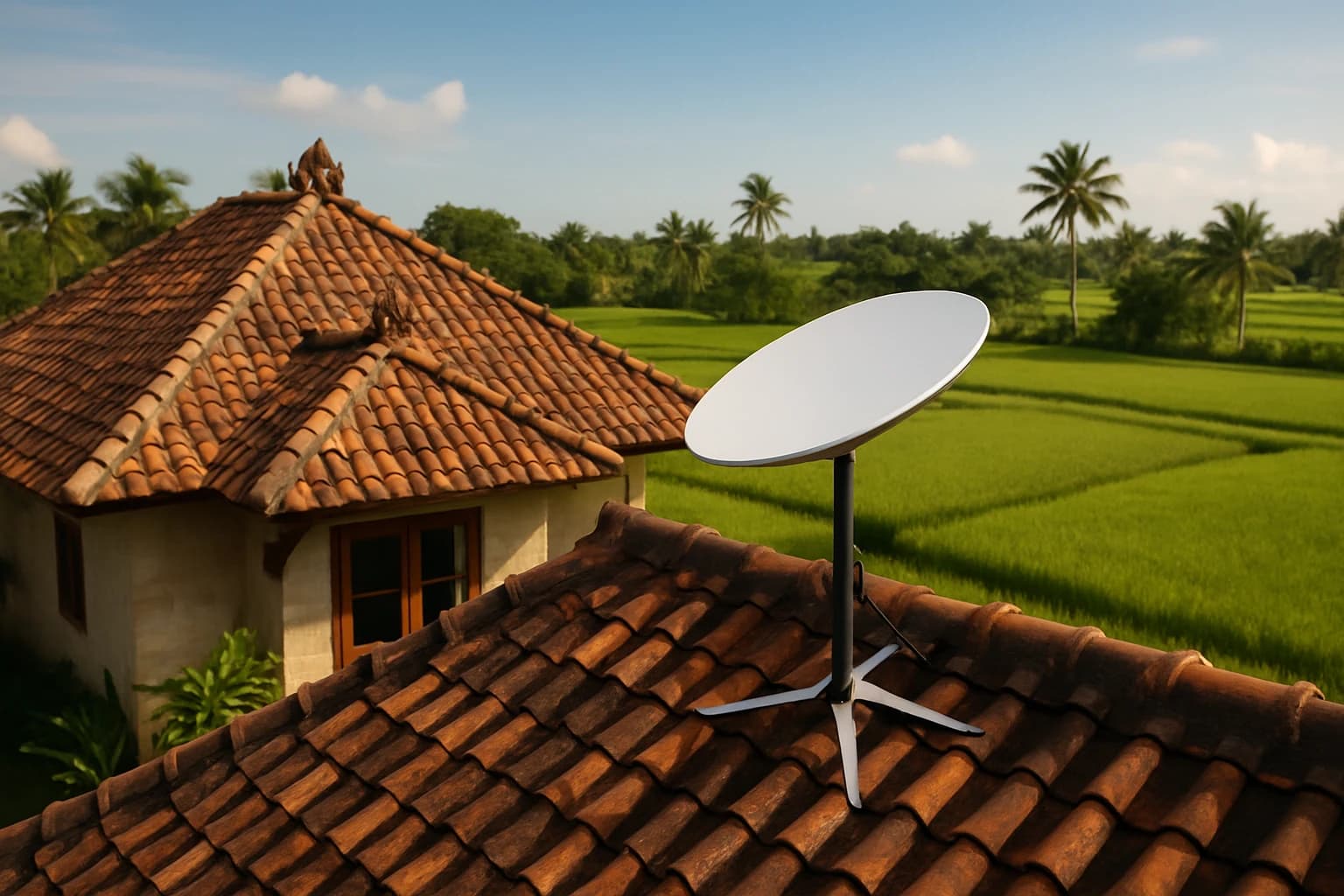
The service launched in Indonesia on 19 May 2024, at a ceremony held in Denpasar itself. A year later, Opensignal published an unsparing verdict: average download speed fell from 42 Mbps to 15.8 Mbps, and upload from 10.5 to 5.4 Mbps, a drop of nearly two-thirds in twelve months, put down to network congestion. The one bright spot in the reading: consistent quality improved, from 24.2% to 30.9%. In other words, the connection has become steadier, and markedly slower.
The commercial consequence followed. Overwhelmed by demand, Starlink froze new sign-ups in Indonesia in mid-2025, before reopening on 22 July 2025, as the Ministry of Communication and Digital Affairs confirmed, quoting the message displayed during the shutdown: "capacity sold out across the whole of Indonesia". On reopening, demand surge fees of Rp 8 to 9.4 million were applied, roughly three times the average Indonesian monthly wage. Articles from mid-2026 still report saturated areas and activations that will not go through; others state that those surcharges no longer apply in Indonesia. We found no official source that settles it: **treat availability as uncertain and check your address on Starlink's Indonesian site before committing to anything.**
On price, the Indonesian list recorded in 2026 puts Residensial Lite at Rp 479,000/month and Residensial at Rp 750,000/month (the nomadic Jelajah Tanpa Batas plan going up to Rp 1,639,000). A press source from July 2026 quotes Rp 510,000 and Rp 800,000 instead: the gap is explained nowhere, and could just as easily come from a price revision as from PPN being folded in. The hardware kit, billed separately, is put at around Rp 7 million by specialist sites, a figure to confirm directly on the official page, since it appears on no primary source we could consult.
The verdict fits in three lines. Where fibre reaches — Canggu, Ubud, Sanur, Seminyak, Denpasar — it is faster and two to three times cheaper than Starlink. Where it does not, Starlink remains the only serious option, but with a measured speed that is nothing special any more and availability to check case by case. And as a plain backup, a 4G eSIM costs far less and needs no hardware at all.
| Need | Best option | Why |
|---|---|---|
| A villa in the south of the island | Fibre (GlobalXtreme, Biznet, XL SATU, MyRepublic) | Highest advertised speed, lowest monthly cost |
| Heavy uploading (video calls, big files) | Symmetrical fibre (MyRepublic) | Upload = download, as claimed |
| Instant backup | 4G eSIM (by.U, Telkomsel) | From Rp 15,000, no hardware, travels with you |
| An area with no fibre | Starlink | The only coverage off the terrestrial network — subject to capacity |
| A make-or-break day | Café-coworking | A professional link, and usually a UPS on site |
The two-connection strategy remote workers use
The real secret of the people who "never drop out" has nothing to do with a miracle provider. It is redundancy, in three layers, in this order: the home WiFi as the main line, an eSIM hotspot as backup on a different provider, and a café-coworking for the days that genuinely matter (the client meeting that decides everything, a deadline, a pitch). To find them, see our pick of the best cafés and coworking spaces in Bali.
That leaves the factor almost every guide forgets, and the one that puts everybody offline at the same moment: the power cut. This is not a theoretical worry. On 2 May 2025, a fault on the submarine cable linking Java to Bali plunged the entire island into darkness for around three and a half hours, hitting some 940,000 customers. On 22 February 2026, an incident on the Java-Bali interconnection, linked to extreme weather, again left nine regencies without power for 57 minutes, from 7.39pm to 8.36pm. Perfect fibre is worth nothing when the router has no power.
The professionals' answer fits into a single object: a UPS big enough to keep the router and the laptop alive long enough to switch over to the mobile hotspot. With that trio — fibre plus eSIM plus UPS — a power cut stops being a work stoppage. It is also the kind of kit that turns up second-hand on the island, like the rest of the villa furniture.

What to check before you sign the lease
Internet is a housing criterion in its own right, as much as the pool or the neighbourhood. Most leases mention "WiFi", but that word guarantees neither speed, nor provider, nor stability. Before you commit to a year paid up front (the local norm), work through this list:
- Run a speed test on site: a speedtest from your own phone on the property's WiFi, ideally at the end of the day, when the network is loaded.
- Ask for the ISP's name and the exact plan: is it real fibre? Which tier? Is the link shared with other units? Who pays the bill, you or the landlord?
- Order a coverage check at the address if you plan to take out the subscription yourself: it is free, and it is the only answer that binds the provider.
- Check the backup mobile coverage in that specific street: your fallback eSIM has to get a signal there.
- Budget for a UPS if your work tolerates no downtime.
And remember that internet is only one line of the housing budget. Electricity (above all with air conditioning), gas and drinking water are almost always on you, on top of the rent. We break it all down in our guide to renting in Bali by the year: the real 2026 prices, worth reading before you sign. The full picture of settling in, meanwhile, is in Living in Bali in 2026: the ultimate expat guide.
On Lokalfinds, plenty of property listings state whether there is fibre and at what speed. Ask the advertiser before the viewing: one minute of messaging can save you from finding out after you have moved in.
Frequently asked questions
Which is the best internet provider in Bali in 2026?
On the only independent measurement available, the Opensignal Fixed Broadband Experience report of April 2026, GlobalXtreme takes all five awards for the Bali Nusa Tenggara region — consistent quality, reliability, download and upload speed, video experience — ahead of Biznet Home. Mind how far that result reaches: it covers Bali and the Nusa Tenggara islands as a whole, not your street. On mobile, Telkomsel is the provider claiming the densest network on the island, with 225 5G sites in the south.
How much does fibre cost per month in Bali?
Budget Rp 229,000 to 300,000 a month (USD 13 to 17) for an entry tier, and Rp 500,000 to 700,000 for 400 to 500 Mbps. Official prices recorded in August 2026: XL SATU at Rp 229,000 (250 Mbps promo), IndiHome at Rp 230,000 (50 Mbps), Biznet and MyRepublic at Rp 250,000 (100 and 150 Mbps), GlobalXtreme at Rp 300,000 (200 Mbps). These are promotional prices, published for the Jakarta region by some of them, and excluding 11% PPN in some cases: only a coverage check at your address gives you the real figure.
Do I need an eSIM or a physical SIM card in Bali?
Both work, and an eSIM saves you handling a physical card. But since 1 July 2026, Permenkomdigi 7/2026 requires biometric face verification from every new subscriber and limits each identity to three prepaid numbers. The text allows registration in an official shop or self-service; for a foreigner, having a passport, KITAS or KITAP checked by a staff member in store remains the route described. So plan on a trip to a GraPARI rather than a fully remote activation. On arrival, Telkomsel's Tourist Prepaid Card (Rp 150,000, 25 GB, 25 min) gets you online immediately; for a resident, by.U goes down to Rp 15,000 for 7 GB.
Is Starlink worth it in Bali?
Rarely, and far less often than you are told. Opensignal measured Starlink's download speed in Indonesia falling from 42 Mbps to 15.8 Mbps between 2024 and 2025, with upload down to 5.4 Mbps. In Canggu, Ubud, Sanur or Seminyak, fibre is faster and two to three times cheaper. Starlink keeps its value only where no fibre reaches. Add uncertain availability on top: sign-ups were frozen in mid-2025 for want of capacity, reopened on 22 July 2025 with demand surge fees of Rp 8 to 9.4 million, and several areas were still blocked in 2026.
Is Bali's internet fast enough for remote work and video calls?
Yes, in the areas that are wired, as long as you do not confuse the speed on the contract with the speed in your room. The tiers sold by the five major providers run from 50 to 500 Mbps, but in a villa or a coliving the link is often shared between several units, and it saturates in the evening. For upload — video calls, sending big files — MyRepublic's symmetrical 1:1 plan is a claimed advantage. The real risk is not slowness, it is the dropout.
Which areas of Bali have the best connection?
The south of the island concentrates the infrastructure: Denpasar and Badung alone account for 203 of the 225 5G sites Telkomsel claims there, and the Kuta-Canggu, Nusa Dua and Renon-Sanur corridors are advertised as continuous coverage. Canggu, Seminyak and Ubud are the best served for fibre. Rural areas and the east of the island remain patchy, but roll-out is moving fast: rather than trusting a neighbourhood's reputation, ask for a coverage check at the exact address before you sign.
How do I avoid internet outages while working remotely in Bali?
Through redundancy, and by treating electricity as the weak link. The method: home WiFi as the main line, an eSIM hotspot on a different provider as backup, a café-coworking for critical days, and a UPS to keep the router and computer running through a power cut. That last point is not theoretical: Bali suffered an island-wide outage of 3 hours 30 minutes on 2 May 2025 (940,000 customers) and another of 57 minutes across nine regencies on 22 February 2026, both tied to the Java-Bali electricity interconnection.
Sources
Official sources
- JDIH Kemkomdigi — Peraturan Menteri Komunikasi dan Digital No. 7 of 2026 — official: full text and in-force status of the mobile subscriber registration rules (promulgated 19 January 2026).
- Peraturan BPK — Permenkomdigi No. 7/2026 record — official: promulgation and entry-into-force dates, scope (registration, data security, abuse prevention, penalties).
- Bea Cukai — IMEI registration and checking — official: IMEI registration form, USD 500 allowance per passenger, 10% customs duty, registration free of charge.
- Directorate General of Taxes (DJP) — no new tax in 2026 — official: confirmation that PPN stays at 11% on ordinary goods and services, the 12% rate remaining reserved for luxury goods.
Independent measurements
- Opensignal — Indonesia Fixed Broadband Experience Report, April 2026 — independent measurement: GlobalXtreme takes all five Bali Nusa Tenggara awards ahead of Biznet Home; state of fixed-line penetration and the shift to fibre.
- Opensignal — Starlink in Indonesia, one year on (8 October 2025) — independent measurement: download speed down from 42 to 15.8 Mbps, upload from 10.5 to 5.4 Mbps, consistent quality from 24.2% to 30.9%, demand surge fees.
- Bloomberg Technoz — Speedtest Global Index ranking — press citing Ookla: Indonesian median mobile speed at 59.18 Mbps, 73rd worldwide (February 2026 data).
Press
- Kompas Tekno — Komdigi formalises the new SIM rules, biometrics and the cap on numbers (24 January 2026) — press: application from 1 July 2026, maximum of three numbers, documents accepted from foreigners.
- Tirto — registering a prepaid SIM card as a foreign national — press: two registration channels (official shop or self-service), passport and stay permit checked by a staff member in store.
- Kompas Tekno — Biznet starts applying a FUP policy (13 February 2024) — press: the end of quota-free unlimited at Biznet Home and the reason given by the provider.
- ANTARA — Kemkomdigi confirms Starlink activations have reopened (22 July 2025) — press (state news agency): freeze then reopening of sign-ups, the "capacity sold out across the whole of Indonesia" message.
- IDN Times — one year of Starlink in Indonesia — press: demand surge fees of Rp 8 to 9.4 million, comparison with the average wage, share of urban usage.
- Harian Jogja — Starlink surcharges, the Indonesian picture (6 July 2026) — press: a source that instead reports no surcharge in Indonesia and quotes Rp 510,000 / Rp 800,000 — a contradiction flagged in the article.
- Kompas Denpasar — blackout in Bali, PLN points to a transmission incident (23 February 2026) — press: the 22 February 2026 outage, 7.39pm to 8.36pm, nine regencies affected.
- Bali Discovery — island-wide 3.5-hour blackout (May 2025) and ABC News — the Java-Bali submarine cable — press: the 2 May 2025 blackout, duration and cause.
- CNN — Starlink's launch in Indonesia (20 May 2024) — press: date and place of the launch, in Denpasar.
Commercial sources (providers' price lists)
- XL SATU — residential plans — commercial: Rp 229,000 promo / Rp 289,000 list, Rp 254,190 including tax, 250 Mbps with Speed Booster, up to 10 devices, free installation.
- Biznet Home — 2026 price list — commercial: 100 Mbps at Rp 250,000, 300 Mbps at Rp 375,000, 400 Mbps at Rp 575,000, prices published for Jakarta.
- GlobalXtreme — installation cost and the Lite / Lite+ tiers — commercial: installation from Rp 300,000, from 200 Mbps at Rp 300,000 up to 500 Mbps at Rp 1,000,000, six-monthly and annual discounts.
- GlobalXtreme — provider home page — commercial: operated by PT Internet Madju Abad Milenindo, presence in Bali claimed since 1999, coverage of Malang, Balikpapan and Samarinda.
- Telkomsel — IndiHome prices and tiers — commercial: 50 Mbps at Rp 230,000, 75 Mbps at Rp 250,000, 150 Mbps at Rp 325,000, 200 Mbps at Rp 490,000, streaming included.
- Telkomsel One Dynamic — commercial: quota shared between six people maximum (one administrator and five members).
- MyRepublic — official comparison and the Velo / Wonder tiers — commercial: Velo 150 Mbps at Rp 250,000, 1:1 symmetry and absence of FUP claimed, prices excluding 11% PPN.
- Telkomsel — Tourist Prepaid Card price — commercial: Rp 150,000 for 25 GB and 25 minutes of calls.
- Telkomsel — SIM card activation for a foreigner — commercial: SIMPATI pre-order at Rp 100,000 (25 GB, 25 local minutes, 25 international minutes, 30 days), collection in Bali and at Mandalika Lombok.
- Telkomsel — eSIM — commercial: eSIM SIMPATI 3 GB at Rp 35,000.
- Telkomsel — eSIM RoaMAX — commercial: 10 GB of roaming over 7 days in 85 countries at Rp 160,000.
- by.U — the "Super Kaget" bundle — commercial: 7 GB from Rp 15,000, validity varying by campaign.
- Telkomsel — 5G network expansion — commercial: 225 Hyper 5G sites in the south of Bali, of which 67 in Denpasar and 136 in Badung.
- Starlink Indonesia — residential plans — commercial: official sign-up page, to consult for real availability at your address.