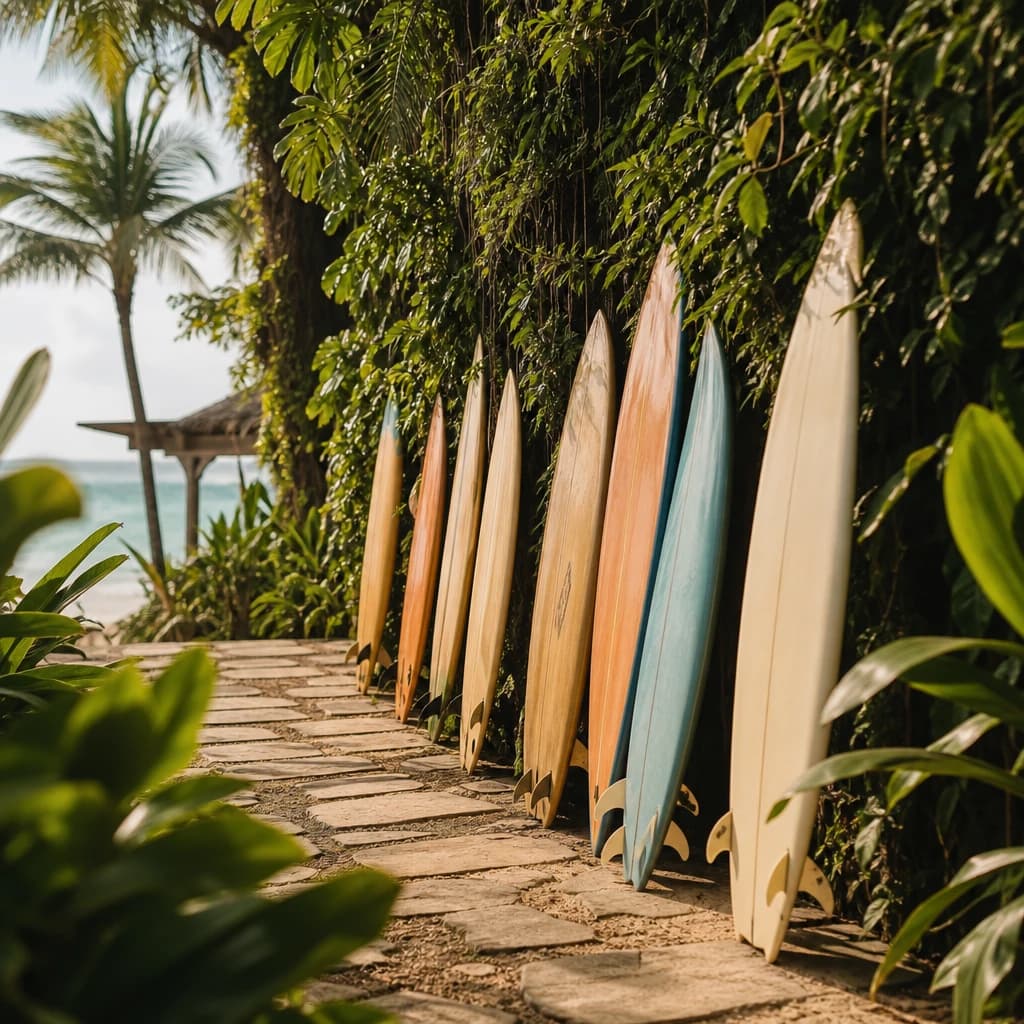
Buying a used surfboard in Bali is almost a rite of passage: you pick your board by skill level, body weight and volume in litres (beginner = weight in kg × 0.8 to 1.0), you inspect it in direct sunlight to hunt for dings, delamination and hidden water damage, you haggle, and you budget 1.5 to 9 million IDR (≈ 75 to 450 €) depending on the type. Buy smart and you'll resell it without losing a rupiah.
Bali has one of the most active used-surfboard markets in the world. Every week backpackers fly home and dump their gear cheap, surfers who are leveling up sell their old board to move up a model, and locals offload stock. The result: you'll find everything, at every price, everywhere — from Canggu to Uluwatu by way of Kuta. Great deals, sure. But the flip side is that the used market also concentrates every trap in the book: an under-volumed board sold to a beginner, water damage painted over, a popped fin box, a price jacked up for the passing tourist. This guide gives you the real questions to ask and the real things to check before you hand over a single banknote.
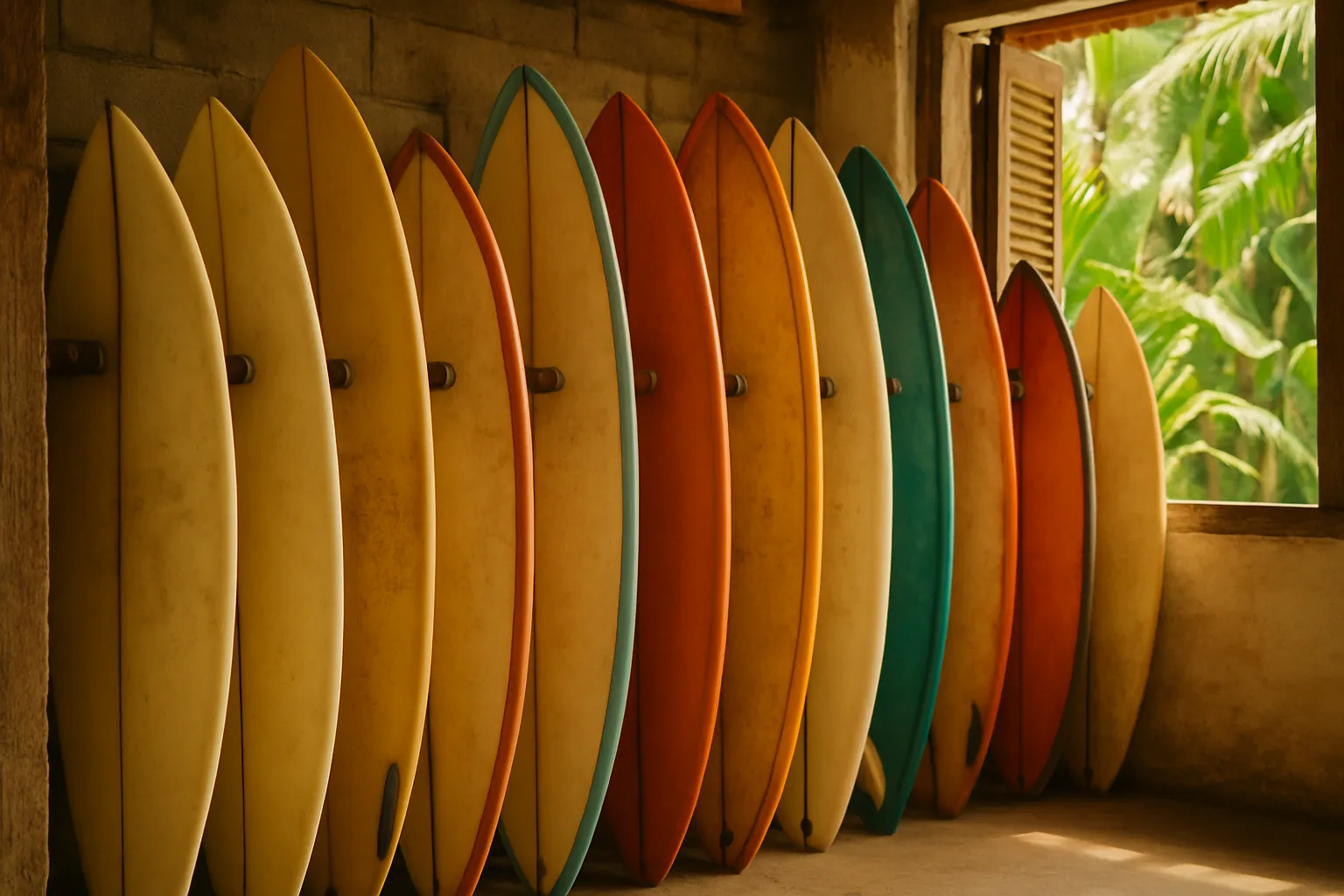
Which board for which surfer?
Before you even talk condition or price, you need to pick the right type of board. A board in mint condition but wrong for your level will do you more harm than good: you'll paddle and go nowhere, you won't catch waves, and you'll end up frustrated. Here are the main families and who they're for.
Soft-top (foamie / foamboard)
This is THE board for the total beginner. Thick, wide, super buoyant, made of soft foam — so it won't hurt when it lands on you (and it will land on you). In Bali, this is what every surf school rents out. Perfect for your first few weeks on beach breaks like Batu Bolong (Canggu) or Kuta Beach. You catch waves easily, you pop up, you build confidence. The downside: once you start stringing together clean take-offs, you'll feel how limited it is when you try to turn.
Funboard / mini-mal
The next step up. Somewhere between 7' and 8', still very floaty but in a hard construction (epoxy/PU), it lets you actually progress: paddle faster, drop into steeper waves, start drawing lines. It's often the best first used board to buy in Bali, because it'll carry you through 1 to 2 years of progression. Common brands: Torq, NSP, Mick Fanning Softboards (hard range).
Shortboard
The performance board: short (5'8" to 6'4"), low volume, twitchy and responsive. Strictly for solid intermediates and advanced surfers. On Bali's powerful reefs (Uluwatu, Padang Padang, Bingin), it comes into its own. For a beginner, it's a classic and expensive mistake: you can't paddle it and you can't float it. Sought-after brands: JS, Pyzel, Channel Islands, DHD, Sharp Eye.
Fish / twin
Shorter and wider than a shortboard, with a swallow tail and often two fins. Very floaty for its length, perfect for small, mushy waves — exactly what Bali serves up a lot of in the off-season. An excellent second board for an intermediate who wants to have fun on the flat days. Brands: Lost, Album, Channel Islands (Twin Fin).
Longboard
9' and up, back to the roots: glide, style, noseriding. Perfect on long, mellow waves (Old Man's in Canggu, Balian). Versatile enough for beginners AND for experienced surfers chasing pure soul. Heavy and awkward to carry on a scooter — get a side-mounted board rack. Brands: Stewart, Bing, Walden, Thomas Bexon.
| Type | Level | Ideal use in Bali |
|---|---|---|
| Soft-top / foam | Total beginner | First few weeks, beach breaks (Kuta, Batu Bolong) |
| Funboard / mini-mal 7'–8' | Beginner → intermediate | Progression, mid-size waves, your "1 to 2 year" board |
| Shortboard 5'8"–6'4" | Solid intermediate → advanced | Powerful reefs (Uluwatu, Bingin, Padang) |
| Fish / twin | Intermediate | Small mushy waves, fun, off-season |
| Longboard 9'+ | All levels | Long, mellow waves (Old Man's, Balian) |
Volume first: do the litres math
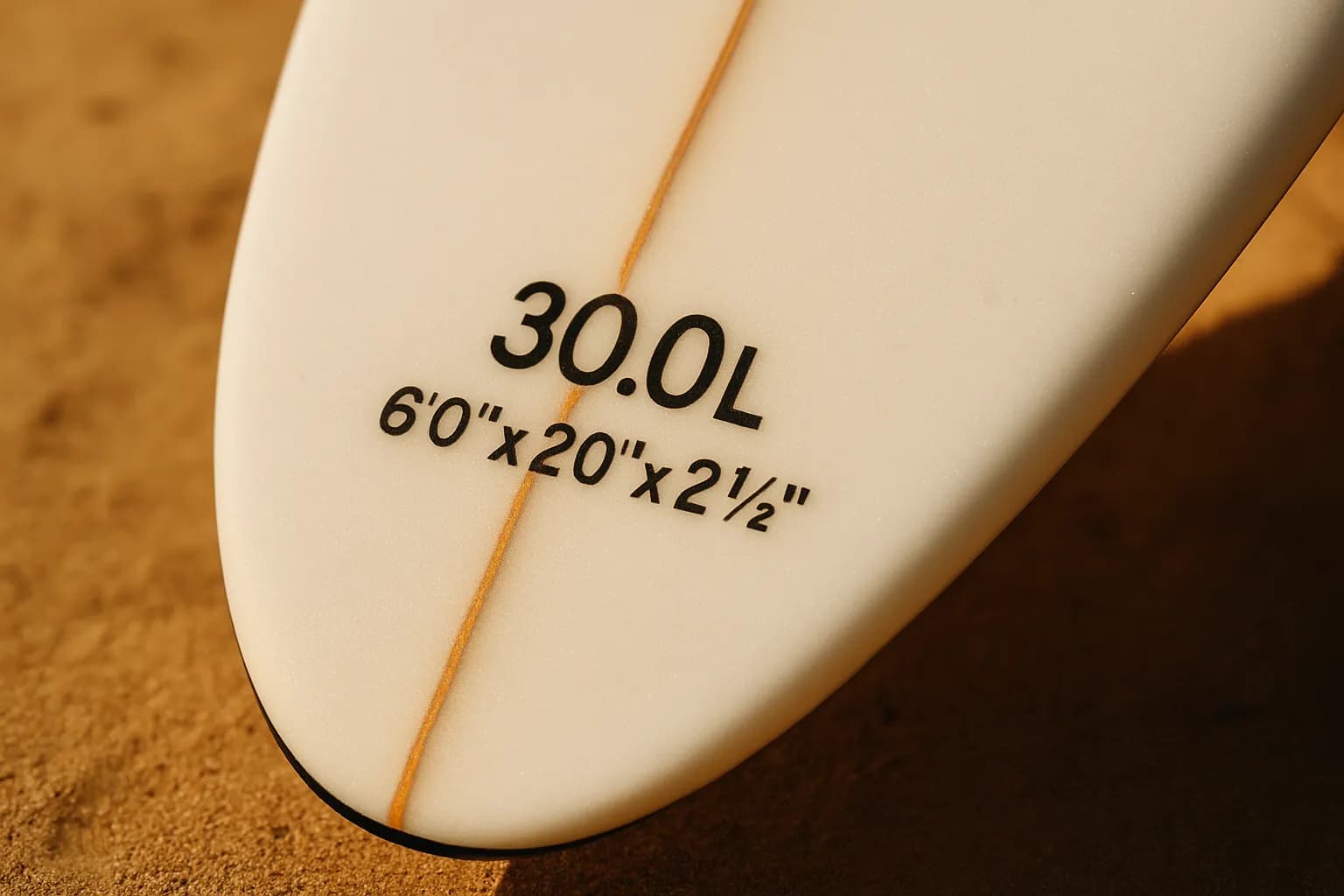
This is THE thing 90% of beginners overlook — and the most dangerous one for your purchase. A used board can be in great physical shape AND completely wrong for your size. The right objective number isn't the length in feet, it's the volume in litres. Every modern board lists it (usually printed near the stringer, toward the tail).
The standard formula (the "Guild Factor," the reference shapers use) starts from your body weight in kilos, which you multiply by a coefficient based on your level:
- Beginner (up to ~2 years of practice): weight (kg) × 0.8 to 1.0. More volume = more float = more waves caught and a much faster learning curve.
- Intermediate: weight (kg) × 0.5 to 0.6.
- Advanced: weight (kg) × 0.35 to 0.4.
- Pro / expert: weight (kg) × 0.28 to 0.32.
Worked example: a 75 kg beginner aims for 75 × 0.8 to 1.0 = 60 to 75 litres. An 80 kg beginner aims for 64 to 80 litres. That's a lot, and that's normal: at this stage, volume is your best friend.
> Heads up: the most common mistake is going × 0.4 "to ride like the pros." For a beginner, that's dramatically under-volumed: you'll never paddle fast enough to catch waves, you'll struggle, you'll get put off, and you'll have bought the board for nothing. For a beginner, you stay at × 0.8–1.0, full stop.
Adjustments to apply:
- +3 to 5 litres if you surf rarely (less than once a week) — less practice, more margin needed.
- +2 to 3 litres if you're 45 or older, or coming back from an injury (shoulder, back).
- +2 to 3 litres if you mostly surf small, mushy waves (a common scenario in Bali during the off-season).
If the seller doesn't know their board's volume (rare, but it happens on older boards), note the brand + model + exact dimensions and look up the spec sheet on the shaper's official website. Without a known volume, you're buying blind.
Inspecting a used board: the anti-scam checklist
A used board in Bali has been through it: sun, salt, baggage holds, wipeouts on the reef. The real risk isn't a cosmetic scratch, it's water getting into the foam (water damage), which adds weight, rots the board from the inside and makes it beyond repair. Here's how to hunt the problems down.
1. Check it in direct sunlight
The number-one reflex. In direct light, the resin turns translucent and reveals what's hiding underneath: darker or yellowish patches give away old water damage, while bubbles or lifting under the paint signal delamination (the board's skin separating from the foam). If you spot diffuse brown stains, walk away: the foam has already drunk.
2. The pressure test
Press firmly with your thumb on the deck (the top) and the bottom, along the whole length. Small pressure dings up top are normal and nothing to worry about. But if the skin sinks in softly, "crackles," or gives under light pressure on the bottom, that's delamination: the fibreglass layer no longer bonds to the foam. Heavy repair — walk away.
3. Dings and cracks
Inspect every ding (impact). A well-repaired ding is hard, smooth, watertight. A ding left unrepaired or badly patched (soft resin, star cracks, a crumbling edge) lets water in. Be especially wary of fine cracks running along the stringer (the central wooden strip): a sign of a serious impact or of a board that's been snapped and glued back together.
4. Tail and nose
These are the two most exposed ends. Look for cracks, chips, and repairs hidden under a fresh coat of paint. A touch-up that's too clean and too localized often hides recent damage.
5. Fin boxes and leash plug
Slot a fin into each box and check for play: it shouldn't move. A lifted or cracked fin box = a big repair. Pull hard on the leash plug (the leash anchor point): if it shifts or pulls up, it needs redoing, otherwise you'll lose your board on the first big set.
6. The weight and "knock-knock" test
Heft the board. A board that's abnormally heavy for its size has probably taken on water. Tap the surface gently with your fingertips: a full, sharp sound = healthy; a dull, flat, hollow sound over one area = delamination or water inside. Compare different areas against each other.
> Golden rule: never inspect a board in the rain, in the shade, or at night. Ask to see it outside, dry, in broad daylight. An honest seller has no reason to say no.
Realistic price ranges (used, Bali 2026)
For reference, a new board made locally in Bali runs around 8 million IDR (~560 $). Used sits well below that. Here are realistic ranges seen in 2026 (conversions: 1 € ≈ 20,000 IDR, 1 $ ≈ 17,000 IDR — check the current rate):
| Type | Common brands | Used price (IDR) | ≈ EUR / USD |
|---|---|---|---|
| Soft-top 7'–8' beginner | Generic, Mick Fanning, Catch Surf | 1.5 – 2.5M | 75–125 € / 90–150 $ |
| Funboard / mini-mal 7'2" | Torq, NSP | 3.5 – 5M | 175–250 € / 210–300 $ |
| Performance shortboard | JS, Pyzel, Channel Islands | 4 – 7M | 200–350 € / 240–420 $ |
| Fish / twin | Album, Lost | 4 – 6M | 200–300 € / 240–360 $ |
| Longboard 9' | Stewart, Bing, Walden | 5 – 9M | 250–450 € / 300–540 $ |
These ranges are for a board in good shape, no water damage. A heavily used, yellowed board or one with visible repairs should drop 20 to 40%. On the other end, a recent premium model (released less than a year ago) with fins included can push the top of the range. Smart tip: a well-chosen used board resells for almost what you paid a few months later — that's the whole beauty of the Bali market. The textbook example you'll see on the ground: a complete setup (with leash, fins and a board bag) bought for 4M IDR, resold for 2M IDR after one season of heavy use.
Where to buy your board in Bali
Surfer to surfer, on Lokalfinds
The best value is the individual reselling their own board. On Lokalfinds, the classifieds site of Bali's expat community, you'll find listings under the Sports & Leisure > Surf & Watersports category, with detailed photos, the price shown and the seller's direct contact. You chat, you set up an in-person inspection, you negotiate with no middleman. And when it's your turn to level up, you resell your board on Lokalfinds to another surfer in the community — the perfect loop.
Used surf shops (Canggu, Uluwatu)
Canggu (Jl. Raya Canggu, Batu Bolong) and Uluwatu are packed with specialist shops that buy and resell used gear. Pricier than a private seller, but the inspection is done by pros and some offer a small warranty or a partial buy-back. Handy if you're starting out and don't feel confident judging the condition yourself. Kuta (Poppies I and II) is still a classic spot for gear too.
Facebook groups
Groups like "Bali Surfboards Buy And Sell" churn through a huge volume of listings. It's fast, but it's also where you'll find the most dodgy boards and "tourist" prices. In-person inspection is mandatory: never pay in advance, never trust photos alone.

Haggling without burning bridges
In Bali, haggling is part of the game — even between surfers. A few principles:
- Look up the new price of the model before you talk numbers. You'll know instantly whether the used price is fair or inflated.
- Use the flaws you spotted during the inspection as honest leverage: "The leash plug moves, it'll need redoing — can we adjust the price?"
- Pay cash, in person, after inspecting. Never a deposit from a distance.
- Ask for a package: if the seller throws in the leash, fins and a board bag, the all-in price becomes far better value than buying those accessories separately.
- Stay respectful: halving the price on a decent board just makes the seller defensive. Aim for a 10 to 25% discount depending on condition.
The accessories not to forget
A board on its own isn't enough. Plan for these (or negotiate them into the bundle):
- The leash: essential and a safety item. Length suited to the board (a touch longer than the board itself). Check the cord isn't cracked. Budget 150,000 to 400,000 IDR new.
- The wax (or a grip pad): rated for warm water (tropical wax). A few tens of thousands of IDR. Essential so you don't slip off.
- The fins: make sure they're included and compatible with the box (FCS II, Futures…). A new set of fins is pricey, so it's a real bargaining chip.
- The board bag: protects from the sun (which yellows and weakens the resin) and from knocks on the scooter. A used board bag does the job perfectly.
- The scooter board rack: if you ride between spots on two wheels, it's pretty much mandatory in Bali.
Frequently asked questions
What board volume for a 75 kg beginner?
Aim for 60 to 75 litres (75 kg × 0.8 to 1.0). At this level, volume trumps everything else: it lets you paddle fast, float, and catch as many waves as possible to progress quickly. Whatever you do, don't drop down to 30 litres "to look like a pro" — you'll just put yourself off surfing.
How can I tell if a used board has taken on water?
Three quick tests: look at it in direct sunlight (dark patches = water in the foam), heft it (abnormally heavy = bad sign), and tap the surface with a finger (a dull, flat sound = delamination or water inside). When in doubt, walk away: water damage is rarely fixable for good.
What's a fair price for a used board in Bali?
Depending on the type: 1.5 to 2.5M IDR for a beginner soft-top, 3.5 to 5M for a funboard, 4 to 7M for a performance shortboard, 5 to 9M for a longboard. A heavily used or repaired board should drop 20 to 40% from these ranges.
Is it better to buy new or used in Bali?
For starting out, used is clearly the smarter move: you pay less and you learn on a board you'll be able to resell for almost the same price once you level up. New (≈ 8M IDR for local stock) mainly makes sense if you want a specific custom shape or a high-end performance board.
Where can I buy a used board in Bali?
Three options: surfer to surfer on Lokalfinds (best price, direct contact, in-person inspection), in the used surf shops of Canggu, Uluwatu and Kuta (pricier but pro inspection), or via Facebook groups (high volume but maximum caution). In every case: a physical inspection is a must before you pay.
Should I rent before buying my first board?
Yes — it's honestly the best advice for a true beginner. Rent for 2 to 4 months: you'll try different volumes and types, you'll figure out what suits you, and you'll then buy the right board first time instead of getting it wrong.
What accessories do I need besides the board?
At minimum a leash (safety, 150–400k IDR new), some tropical wax, compatible fins, and ideally a board bag to protect from the sun. Negotiate it all as a package with the seller: it's almost always better value than buying each piece separately.